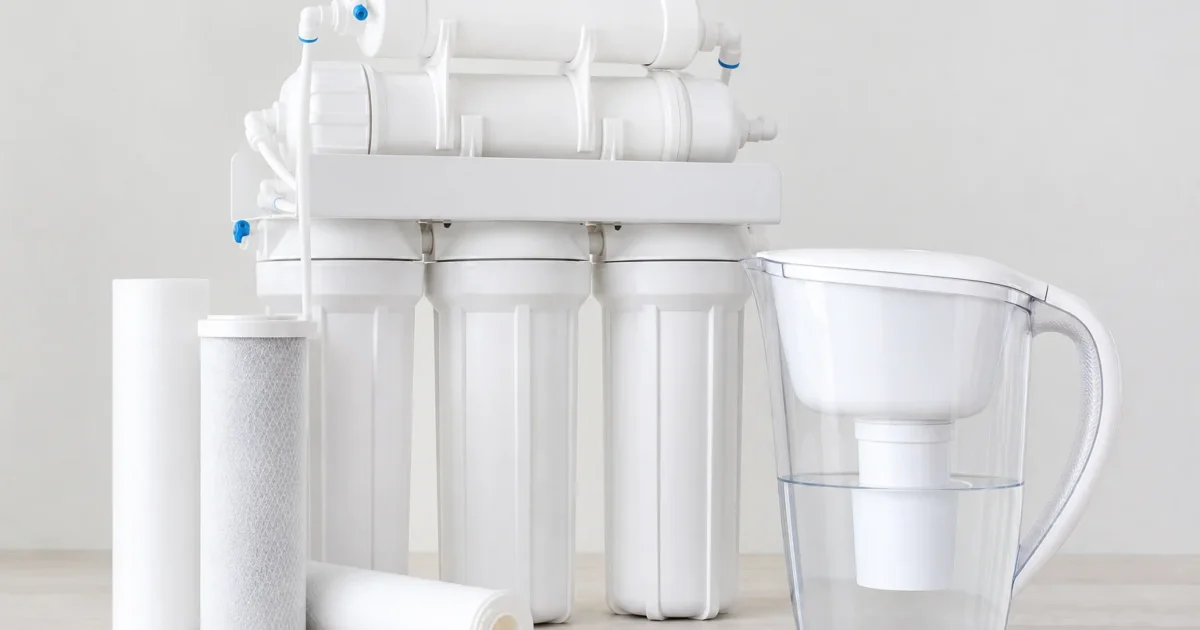
If you want to know how to remove PFAS from water at home, the short answer is this: use a filter certified to NSF/ANSI 53 or NSF/ANSI P473 for PFOA and PFOS reduction, or a reverse osmosis system certified to NSF/ANSI 58. Those are the only claims backed by independent testing. A filter that merely says “reduces contaminants” or “PFAS-ready” on the box, with no certification number, is making a marketing claim, not a tested one.
PFAS – per- and polyfluoroalkyl substances – are a large family of synthetic chemicals. The two most studied are PFOA and PFOS. They do not break down easily, which is why they are often called “forever chemicals.” This guide is the field-guide version: what actually works, what is genuinely certified, and where the gaps are.
The Certifications That Actually Mean Something
Three standards matter for PFAS, and they are not interchangeable.
- NSF/ANSI 53 covers drinking water treatment units for health-related contaminant reduction. The PFAS-relevant claim under this standard is reduction of PFOA and PFOS to below 70 parts per trillion (ppt) – combined, in the influent challenge water.
- NSF/ANSI P473 is a protocol specifically written for PFOA/PFOS reduction. It was developed when PFAS first became a public concern and predates much of the PFAS-specific language now folded into Standard 53.
- NSF/ANSI 58 is the standard for reverse osmosis systems. PFAS reduction is an available claim under this standard.
The key word is claim. A product is not “NSF certified for everything” just because it carries an NSF mark. Certification is granted claim by claim. A pitcher can be certified to reduce chlorine taste and odor (an aesthetic claim under NSF/ANSI 42) and carry no PFAS claim at all. So the question is never “is it NSF listed” – it is “is it listed for PFOA/PFOS reduction.”
You can verify any product yourself. NSF publishes a free, searchable database of certified products at info.nsf.org, and you can filter by the specific reduction claim. If a product’s PFAS claim is real, it is in that database. If it is not in the database, treat the claim as unverified.
How PFAS Removal Actually Works
Two technologies do the real work: activated carbon and reverse osmosis.
Activated carbon – specifically high-quality granular activated carbon (GAC) and carbon block – adsorbs PFAS onto its surface. The longer-chain PFAS like PFOA and PFOS are removed reasonably well by good carbon. Shorter-chain PFAS (such as PFBS and GenX/HFPO-DA) are harder for carbon to hold, and performance drops as the filter loads up. This is why the certification matters: a certified carbon filter has been tested to a defined capacity, so you know how many gallons it holds the claim for before the cartridge must be replaced.
Reverse osmosis (RO) pushes water through a semipermeable membrane that rejects the PFAS molecules along with most dissolved solids. RO is the most thorough household option for the broad PFAS family, including many of the short-chain compounds carbon struggles with. The U.S. EPA notes that reverse osmosis, activated carbon, and ion exchange are the treatment approaches with demonstrated effectiveness for PFAS, per its PFAS drinking water guidance.
The honest trade-off with RO: it sends water to drain. A typical undersink RO system wastes several gallons for every gallon of filtered water it produces, though newer high-efficiency units have narrowed that ratio considerably. It also removes beneficial minerals along with the contaminants, and it is slower than a carbon filter. If you are weighing the running cost of an RO system, our reverse osmosis cost calculator will walk you through cartridge replacement and water-to-drain math.
Which Certified Options Actually Exist
Certified PFAS-reduction products do exist across every format. The point is to confirm the specific listing, not the brand reputation.
- Undersink RO systems. Reverse osmosis is the category with the broadest PFAS performance. Look for a system whose NSF/ANSI 58 listing explicitly includes a PFOA/PFOS (or broader PFAS) reduction claim – not every RO unit carries it.
- Carbon pitchers and dispensers. Several pitcher-format filters carry a genuine PFOA/PFOS reduction claim. The certification is per cartridge and per gallon-capacity rating, so the replacement schedule is part of the claim. A pitcher that exceeds its rated capacity is no longer operating inside its tested performance.
- Faucet-mount and undersink carbon blocks. Carbon block cartridges sized for PFOA/PFOS can hit the NSF/ANSI 53 claim. Capacity is typically lower than RO, so replacement discipline matters more.
- Refrigerator filters. This is the honest gap. Most standard refrigerator filters are certified for chlorine, lead, or cyst reduction – not PFAS. Some newer cartridges have added a PFOA/PFOS claim, but you cannot assume it. Confirm the model printed on your current filter or in the manual first – one fridge line uses different filters across model years, and an aftermarket replacement may not hold the same certification as the OEM cartridge it replaces.
Because the certified claim travels with a specific cartridge model and not the appliance, the only reliable move is to read the model number and check it against the NSF database. If you are matching a replacement to your fridge or system, our which-filter-fits finder helps you confirm the model before you buy.
What Is Not Certified (And Why That Matters)
This is where the field guide earns its name.
“PFAS” as a single claim does not exist. There are thousands of PFAS compounds. No household filter is certified to remove all of them. The legitimate claims are for specific compounds – most commonly PFOA and PFOS, and increasingly a broader named list. A product that says “removes PFAS” without naming the compounds and the standard is overstating what was tested.
Boiling does nothing. PFAS do not evaporate at boiling temperature the way some contaminants do. Boiling water concentrates PFAS slightly as volume is lost. It is the wrong tool entirely.
Standard sediment and basic carbon filters are not enough. A whole-house sediment filter or a basic taste-and-odor carbon filter is not tested for PFAS and should not be assumed to reduce it.
Water softeners do not remove PFAS. A softener is an ion-exchange system tuned for hardness (calcium and magnesium). It is the wrong chemistry for PFAS. If you are sizing a softener for hardness, that is a separate job – our water softener sizing calculator handles it – but do not expect it to touch PFAS.
The EPA finalized national drinking water limits for several PFAS in 2024, setting enforceable limits (MCLs) of 4 ppt for PFOA and PFOS individually. You can read the rule on the EPA’s PFAS drinking water page. Note that 4 ppt is far below the 70-ppt challenge level used in the older NSF/ANSI 53 PFOA/PFOS protocol, so a filter certified to the older threshold is not automatically meeting the new regulatory target. NSF’s PFAS standards continue to be updated; verify the current listing rather than relying on a years-old certification mark.
How to Choose, Step by Step
- Test or check your water first. Look at your utility’s annual Consumer Confidence Report, which now reports regulated PFAS. If you are on a private well, a certified laboratory test is the only way to know your actual levels.
- Decide the breadth you need. If your concern is mainly PFOA/PFOS, a certified carbon filter may suffice. If you want the widest coverage including short-chain PFAS, reverse osmosis is the stronger choice.
- Verify the exact listing. Find the product’s model in the NSF certified products database and confirm the PFOA/PFOS reduction claim is listed – not just that the brand appears.
- Read the capacity rating. The certification holds only for the rated gallons. Buy with the replacement cartridge cost in mind.
- Follow the replacement schedule. An expired cartridge is an uncertified cartridge. This is the single most common way a good filter quietly stops working.
Does a Brita or standard pitcher remove PFAS?
Only if that specific model carries a certified PFOA/PFOS reduction claim. Many standard pitchers are certified only for chlorine taste and odor (an aesthetic claim) and carry no PFAS claim. Check the exact model in the NSF database before assuming it reduces PFAS.
Is reverse osmosis better than carbon for PFAS?
For breadth, yes. Reverse osmosis rejects a wider range of PFAS, including many short-chain compounds that carbon holds poorly. The trade-offs are water sent to drain, slower output, and removal of beneficial minerals. Certified carbon is a reasonable, cheaper option if your main concern is PFOA and PFOS specifically.
Does boiling water remove PFAS?
No. PFAS do not break down or evaporate at boiling temperature. Boiling slightly concentrates PFAS as water is lost to steam, so it makes the problem marginally worse, not better.
What is the difference between NSF/ANSI 53 and P473?
NSF/ANSI 53 is the broad health-contaminant reduction standard, under which PFOA/PFOS is one available claim. P473 is a protocol written specifically for PFOA/PFOS reduction. Both are legitimate; the practical point is the same – confirm the product’s listing names PFOA and PFOS, not just an NSF mark.
How do I know when to replace my PFAS filter?
The certification holds only up to the cartridge’s rated gallon capacity. Follow the manufacturer’s stated capacity and replacement interval. An over-used cartridge is no longer operating within its tested performance, even if the water still looks and tastes fine.
The Bottom Line
To remove PFAS from water, choose a filter with a verified PFOA/PFOS reduction claim under NSF/ANSI 53 or P473, or a reverse osmosis system certified under NSF/ANSI 58 – and confirm that claim in the NSF database, not on the box. Reverse osmosis gives the broadest coverage; certified carbon is a cheaper path if PFOA and PFOS are your main concern. Boiling, softening, and basic sediment filters do not do the job. And whichever you choose, replace the cartridge on schedule – because an expired filter is an uncertified one.
Related guides
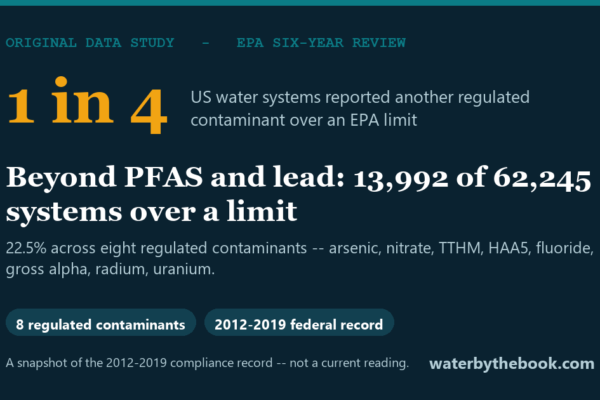
Beyond PFAS and Lead: About 1 in 4 US Systems Reported Another Contaminant Over a Limit
Correction (2026-06-29): a watchdog data-integrity audit corrected two things in the underlying data – the EPA Six-Year Review’s…
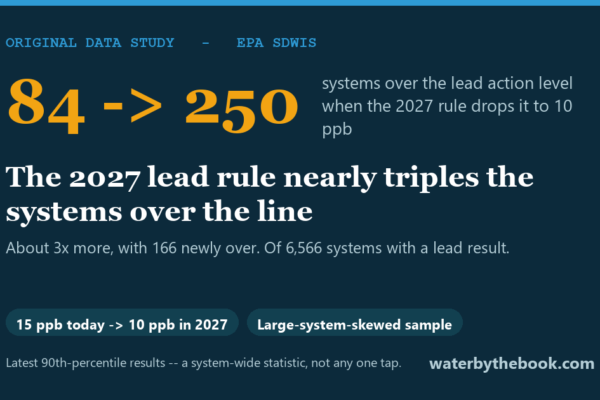
The 2027 EPA Lead Rule Nearly Triples the Water Systems Over the Line
Here is the honest national picture of lead in tap water, and it is not the one either…
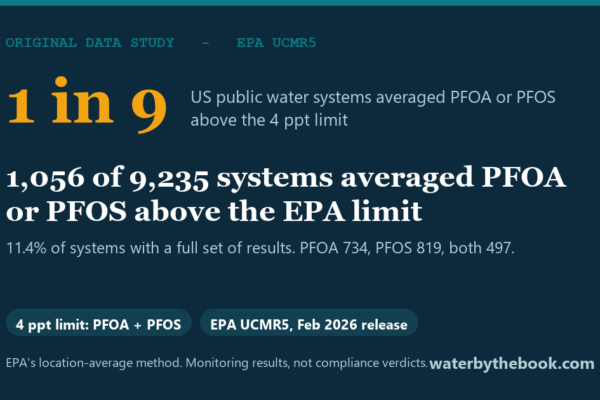
About 1 in 9 US Water Systems Averaged PFOA or PFOS Above the EPA Limit
About 1 in 9 US public water systems -- 1,056 of the 9,235 that reported a full set…