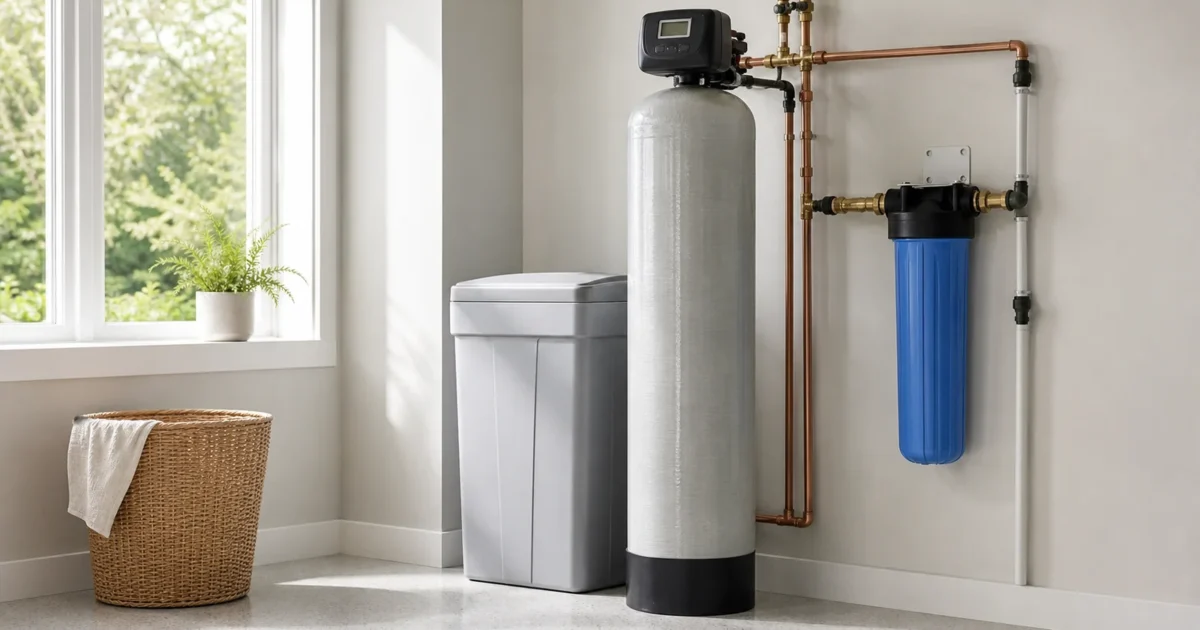
Treat the water for the whole house – correctly sized
Hard-water scale, sediment at every tap, a rotten-egg smell from the well – these are point-of-entry problems. They’re solved where the water enters the home, not at a single faucet. The catch is sizing: an undersized softener regenerates constantly and wears out early; an oversized one wastes salt and water. This hub helps you size it right and match the treatment to the actual problem.
A water softener fixes hardness (scale, spotting, dry skin). It does not, on its own, fix heavy iron or a sulfur smell – those need an oxidizing/air-injection filter. Naming that difference up front saves homeowners from buying the wrong unit.
Start with your problem
- “What size softener do I need?” -> What Size Water Softener Do I Need? (Sizing by Hardness + Household) – grains-per-gallon x people x usage -> grain capacity, with a worked example. Or use the softener sizing calculator.
- “My well water smells like rotten eggs” -> Well Water Smells Like Rotten Eggs: What It Is and Which Filter Fixes It – hydrogen sulfide, how to test, and the treatment that actually fixes it (not a basic carbon filter alone).
- “My water has iron / rusty staining” -> How to Get Iron Out of Well Water – ferrous vs ferric iron, why a softener alone handles only light iron, and the oxidizing/air-injection fix.
- “Which softener salt should I use?” -> Water Softener Salt Types: Rock vs Solar vs Evaporated – purity, bridging/mushing, and when potassium chloride makes sense.
Match the treatment to the problem
- Hardness (scale, spots, dry skin) -> ion-exchange water softener, sized to your hardness + household.
- Sediment / cloudiness at every tap -> whole-house sediment filter (often a Big Blue 10”/20” cartridge), sized to flow.
- Chlorine taste/smell whole-home -> whole-house carbon filter.
- Sulfur smell / iron (well water) -> air-injection or oxidizing filter – a softener alone won’t fix it.
Test your water first so you treat the real problem – the EPA’s drinking-water resources explain what to check – and confirm any unit you buy is listed by NSF for the claim you need.
Size it
-> Open the softener sizing calculator – enter your hardness (grains per gallon), household size, and usage to get the grain capacity you need.
How do I know what size water softener I need?
Multiply your water hardness (grains per gallon) by daily water use (about 75 gallons per person per day) to get your daily grain load, then choose a grain capacity that regenerates roughly every 3-7 days. The sizing calculator does the math.
Will a water softener remove iron or a sulfur smell?
Not reliably on its own. A softener targets hardness; heavy iron and hydrogen-sulfide (rotten-egg) smell need an oxidizing or air-injection filter. Some softeners handle light iron only.
Whole-house filter or water softener – which first?
They do different jobs. If you have hard water, a softener; if you have sediment or chlorine throughout the house, a whole-house filter. Many homes install both, with the sediment filter first.
What causes a rotten-egg smell in well water?
Usually hydrogen sulfide gas, sometimes from sulfur bacteria. Test to confirm, then treat with oxidation/air-injection – a basic carbon filter alone is rarely enough.
Related guides
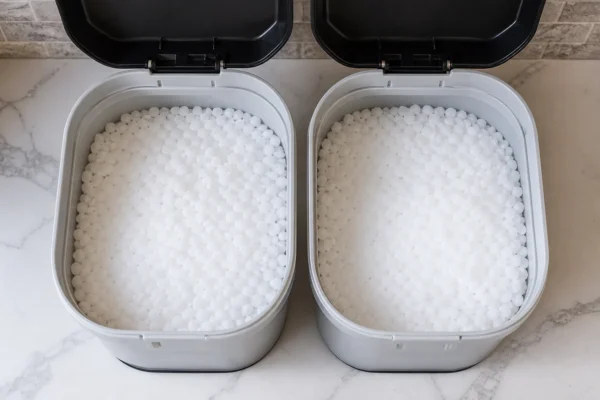
Water Softener Salt Types: Rock vs Solar vs Evaporated
The short answer: of the three common water softener salt types, evaporated salt pellets are the best choice…
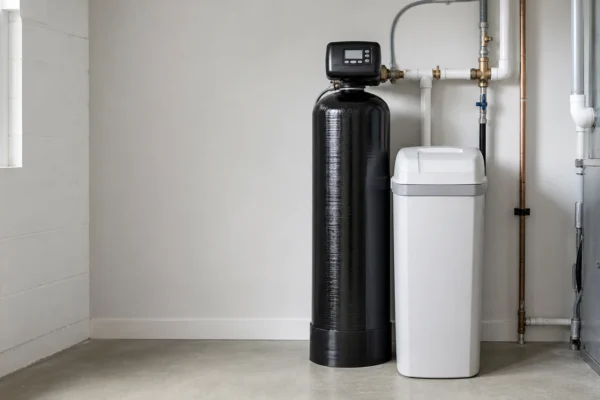
How to Get Iron Out of Well Water: Test First, Then Match the Filter
To get iron out of well water, you do two things in order: test the water to learn…
Well Water Smells Like Rotten Eggs: What It Is and Which Filter Fixes It
When your well water smells like rotten eggs, the cause is almost always hydrogen sulfide gas (H2S) dissolved…