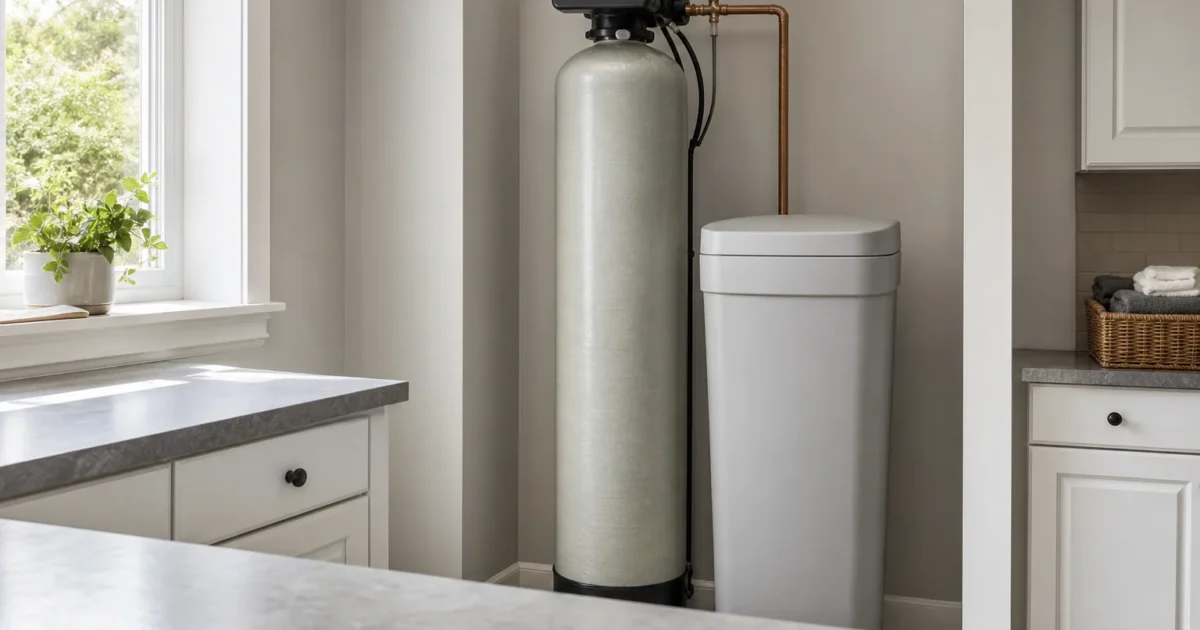
The short answer to “what size water softener do I need?” is the one that matches your daily grain load with room to spare. Multiply your water hardness in grains per gallon by your household’s daily water use in gallons. That gives the grains your softener must remove every day. Then pick a grain-capacity rating that lets the system run about a week between regenerations at roughly 75 percent of its rated capacity. For most families of four on city water, that lands at a 32,000-grain or 40,000-grain unit. The rest of this guide shows you how to land on the right number for your home, not a generic one.
Sizing is arithmetic, not magic. Two inputs decide it: how hard your water is, and how much water your household uses. Get those two right and the capacity falls out of the math. Get them wrong and you either overpay for a tank that rarely cycles or starve a small unit that regenerates daily, wastes salt, and wears out early.
The Two Numbers That Decide Everything
Water hardness is measured in grains per gallon (gpg). One grain per gallon equals 17.1 mg/L of calcium carbonate. If your water report lists hardness in mg/L or ppm, divide by 17.1 to convert to gpg. The U.S. Geological Survey classifies water as soft below 60 mg/L (about 3.5 gpg), moderately hard from 61 to 120 mg/L (3.5 to 7 gpg), hard from 121 to 180 mg/L (7 to 10.5 gpg), and very hard above 180 mg/L (over 10.5 gpg).
The second number is daily water use. The EPA reports that the average American uses about 82 gallons per day at home, and the water-treatment industry commonly sizes systems using 75 gallons per person per day. We use 75 gpg-per-person here because it is the standard sizing figure; if your household runs higher, use your real number from your water bill.
So the daily grain load is:
people x 75 gallons x hardness (gpg) = grains removed per day
That single line is the whole job. Everything else is choosing a tank big enough to carry that load for about a week.
How to Find Your Real Hardness Number
Do not guess your hardness. Three honest ways to get it, cheapest first.
Read your annual water-quality report. If you are on a municipal supply, your utility publishes a Consumer Confidence Report every year, and hardness is usually listed (often in mg/L). Convert to gpg by dividing by 17.1.
Test it yourself. A drop-count titration test kit costs a few dollars and reads directly in gpg. If you are on a private well, this is the right path, because well hardness is not published anywhere.
Send a sample to a certified lab. This matters most if you suspect iron or manganese, which a basic hardness kit will not catch. Iron changes the math, and we cover that below.
One honest caveat, the same rule we repeat on every spec claim: confirm your own water’s number before you buy. A neighbor’s reading or a regional map is a starting estimate, not your number. Hardness varies block to block on some supplies, and it shifts when a utility changes its source.
A Worked Example, Start to Finish
Take a family of four on city water with hardness measured at 10 gpg.
Daily water use: 4 people x 75 gallons = 300 gallons per day.
Daily grain load: 300 gallons x 10 gpg = 3,000 grains per day.
Weekly grain load: 3,000 x 7 = 21,000 grains per week.
Now the part most charts skip. A softener should not run to its absolute rated capacity before regenerating, because efficiency falls off near the end of the resin’s cycle. Size so the unit regenerates at roughly 75 percent of its rating. So divide your weekly load by 0.75:
21,000 / 0.75 = 28,000 grains.
That points to a 32,000-grain softener as the clean fit for this household. It carries a full week between regenerations with headroom, and it regenerates efficiently rather than scraping the bottom of the resin bed every cycle. A 24,000-grain unit would technically meet the raw weekly load but would regenerate more often and harder, which burns more salt and water over the life of the system.
If you would rather not run the arithmetic by hand, the water softener sizing calculator takes your people, hardness, and daily gallons and returns the grain capacity with the same 75-percent buffer built in.
The Iron Adjustment Most Charts Ignore
Here is the trade-off named out loud: a softener alone will not fix heavy iron, and ignoring iron in your sizing math will undersize the unit and foul the resin.
Dissolved (ferrous) iron loads the resin the same way hardness does. The standard correction is to add about 4 to 5 gpg of “compensated hardness” for every 1 ppm of iron in your water, then size off that higher combined number. So if your true hardness is 10 gpg and you have 2 ppm of iron, you size as if your water were roughly 18 to 20 gpg, not 10.
But there is a ceiling. A standard softener handles clear-water (dissolved) iron up to a point, commonly cited around 1 to 3 ppm depending on the resin and the manufacturer’s spec. Above that, or if your iron is already oxidized (red or rust-colored water, staining), you need a dedicated iron filter ahead of the softener, not a bigger softener. Check your unit’s iron rating on the spec sheet before you assume the softener can carry it. Manufacturers like Culligan and others publish the iron tolerance for each model; treat that printed number as the limit, not a suggestion.
Reading a Grain-Capacity Rating Honestly
Grain capacity is usually quoted as a single headline number, but that number depends on how much salt you dose per regeneration. The same resin tank can be rated, for example, 32,000 grains at a high salt dose and far less at an efficient low dose.
The honest way to read a spec: a softener rated 32,000 grains hits that figure at its maximum salt setting, which is its least salt-efficient mode. Run it at a lower, more efficient salt dose and the usable capacity drops, but your salt and water cost per gallon softened improves. Most modern metered (demand-initiated) softeners manage this trade-off automatically by regenerating on measured water use rather than on a fixed timer. The EPA WaterSense program notes that demand-initiated regeneration is the more water- and salt-efficient design, which is the one worth paying for.
This is also why “bigger is better” has a limit. An oversized tank that takes two weeks to exhaust can sit too long between regenerations, which lets the resin bed channel and can let bacteria establish in stagnant brine. Size to regenerate roughly weekly. That is the sweet spot the 75-percent rule targets.
A quick reference for common households at 10 gpg city water:
- 1 to 2 people:
24,000grains is plenty - 3 to 4 people:
32,000grains - 5 to 6 people:
40,000grains - Harder water (
15gpg or more) or any iron: move up one size, then re-check the math
If your water is harder than 10 gpg, do not borrow this chart, run your own numbers. At 20 gpg, a family of four needs roughly 40,000 to 48,000 grains, not 32,000.
Where a Softener Fits in Your Whole-Home Plan
A softener removes hardness. It does not remove chlorine taste, lead, PFAS, or sediment, and on its own it will not make water you would choose to drink for flavor. Many homes pair a softener with point-of-use filtration at the kitchen sink or fridge for taste and contaminant reduction. If that is your situation, our which filter fits finder helps you match a drinking-water filter to your actual water, and the reverse osmosis cost calculator shows the real per-gallon cost if you are weighing an RO system for drinking water alongside the softener.
Sizing the softener correctly is the foundation. It protects your plumbing, your water heater, and your fixtures from scale, and it does so at the lowest ongoing salt and water cost when the capacity matches your real load.
Frequently Asked Questions
What size water softener do I need for a family of four?
For a family of four on city water around 10 gpg hardness, a 32,000-grain softener is the standard fit. The math: 4 people x 75 gallons x 10 gpg = 3,000 grains per day, which is 21,000 per week. Dividing by 0.75 for efficient regeneration gives 28,000 grains, so a 32,000-grain unit carries the load with headroom. Harder water or any iron pushes you to 40,000 grains.
How do I convert my water hardness from ppm to grains per gallon?
Divide the ppm (or mg/L) figure by 17.1. One grain per gallon equals 17.1 mg/L of calcium carbonate. So 171 mg/L hardness is 10 gpg. Use the gpg number in all softener sizing math; capacity ratings are always expressed in grains.
Does iron in my water change the size I need?
Yes. Add about 4 to 5 gpg of compensated hardness for every 1 ppm of dissolved iron, then size off that higher total. But a softener has an iron ceiling, commonly around 1 to 3 ppm depending on the model’s spec sheet. Above that, or if your water is already rust-colored, you need a dedicated iron filter ahead of the softener rather than a larger softener.
Is a bigger water softener always better?
No. An oversized softener that goes two weeks between regenerations can let the resin bed channel and let the brine tank stagnate. Size the unit to regenerate roughly once a week at about 75 percent of its rated capacity. That is the most efficient and reliable operating point.
How much water and salt does a softener use?
It depends on hardness, household size, and the salt dose per regeneration. A demand-initiated (metered) softener regenerates based on measured water use rather than a fixed timer, which the EPA’s WaterSense program identifies as the more water- and salt-efficient design. Confirm the regeneration mode on the spec sheet before you buy.
Related guides
Water Softener Salt Types: Rock vs Solar vs Evaporated
The short answer: of the three common water softener salt types, evaporated salt pellets are the best choice…
How to Get Iron Out of Well Water: Test First, Then Match the Filter
To get iron out of well water, you do two things in order: test the water to learn…
Well Water Smells Like Rotten Eggs: What It Is and Which Filter Fixes It
When your well water smells like rotten eggs, the cause is almost always hydrogen sulfide gas (H2S) dissolved…