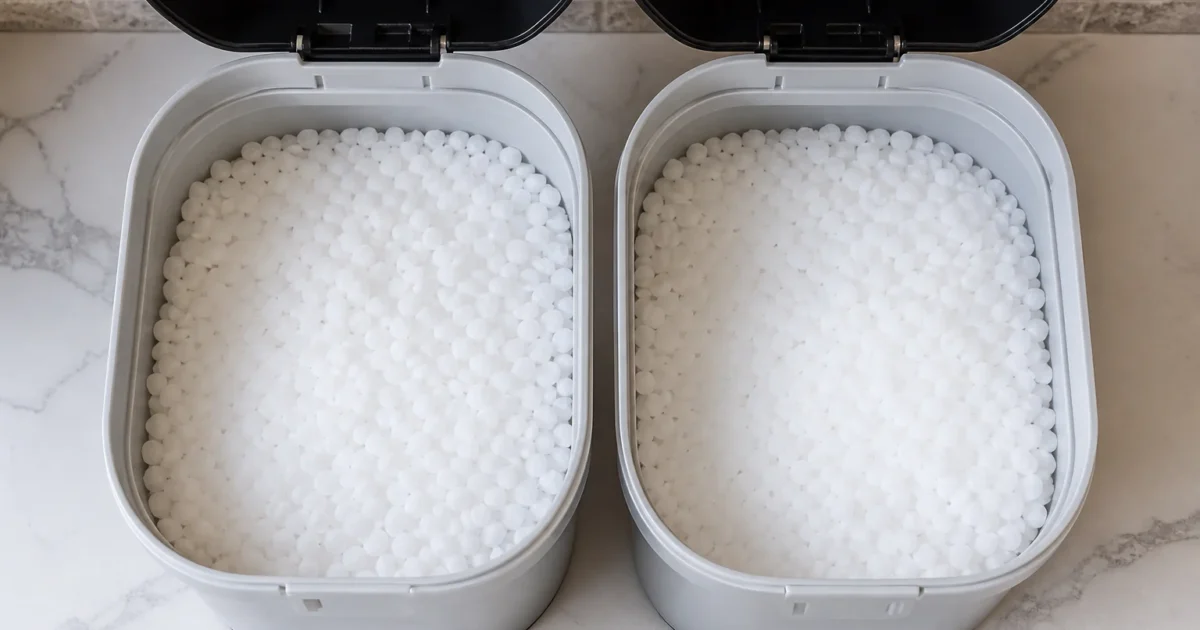
The short answer: of the three common water softener salt types, evaporated salt pellets are the best choice for most softeners. They are the purest, which means less sludge in the brine tank and fewer maintenance headaches. Solar salt is a reasonable, cheaper second choice for low-to-moderate use. Rock salt is the cheapest, but its impurities can foul your tank – skip it unless your softener’s manual specifically allows it.
That is the decision in one paragraph. The rest of this article compares the water softener salt types in detail – where each one fails, what they cost, and the one variable that overrides everything else: what your softener brand printed in the manual.
The Three Water Softener Salt Types, By Purity
All three common water softener salt types – rock, solar, and evaporated – are sodium chloride. The difference between these water softener salt types is purity – how much of the bag is actual NaCl versus insoluble minerals that do not dissolve and instead settle in your brine tank.
Rock salt is mined from underground deposits and sold as coarse crystals. It is the least pure of the three. Industry sources put rock salt purity in the range of roughly 95% to 99% sodium chloride, with notably higher levels of insoluble matter – mostly calcium sulfate – than the other types. That calcium sulfate does not dissolve. Over months it builds up as a crust in the brine tank.
Solar salt is made by evaporating seawater or brine in open ponds using sun and wind. The result is a clean crystal, typically greater than 99.5% sodium chloride. Cargill, a major salt producer, describes solar salt as a higher-purity product than rock salt precisely because the evaporation process leaves the insoluble minerals behind (Cargill: How are rock salt and solar salt different?). Solar salt sells as crystals or pellets.
Evaporated salt is the purest. It is produced by mechanically heating brine to drive off water, leaving nearly pure salt. Morton’s Clean and Protect evaporated pellets are formulated specifically to reduce bridging and mushing in the resin tank (Morton Salt: Clean and Protect Pellets). Evaporated salt almost always comes in pellet form.
By the book, purity is not a marketing number here. Across the water softener salt types, it is the single best predictor of how often you will have to break up a salt bridge or scoop mush out of the bottom of your tank.
Bridging and Mushing: Why Purity Matters
Two failure modes drive most brine-tank complaints, and salt purity influences both.
Bridging is when salt forms a hard crust – a bridge – across the top of the tank with an empty pocket of air underneath. The water level sits below the bridge, so the salt never touches the water and the brine stops forming. Your softener runs its regeneration cycle, draws weak or no brine, and your water quietly goes hard again. People often blame the unit when the real cause is a salt bridge they cannot see.
Mushing is the opposite problem at the bottom. Recrystallized salt forms a sludgy, mushy layer that compacts into a dense mass. It blocks the brine from flowing and can clog the tank. Mushing is generally harder to clear than a bridge – you frequently have to empty the tank entirely.
This is where the water softener salt types diverge most: lower-purity salt makes both problems worse. The insoluble minerals in rock salt accumulate as sediment and give crusts something to anchor to. Higher-purity evaporated salt leaves far less residue, which is exactly why manufacturers like Morton market their evaporated pellets as a bridging-and-mushing countermeasure. Solar salt sits in the middle: cleaner than rock, but its larger crystals can still recrystallize and mush in humid basements or in softeners that sit idle for long stretches.
Honest trade-off: no salt eliminates bridging entirely. High humidity, overfilling the tank, and low water use all promote it regardless of purity. Purity stacks the odds in your favor; it is not a guarantee.
Rock vs Solar vs Evaporated: How to Choose
Here is how to choose among the water softener salt types, in order.
Use evaporated salt if: you want the lowest-maintenance option, you have a high-efficiency softener, your household uses a lot of water, or your brine tank has a history of bridging or mushing. The higher purity pays for itself in fewer tank cleanings. It is the most expensive per bag, usually by a few dollars over solar.
Use solar salt if: you want a cleaner-than-rock option at a lower price than evaporated, your water use is low to moderate, and your tank stays in a reasonably dry, temperature-stable spot. Solar pellets are a sensible default for many homes. Solar crystals are fine too, though pellets resist mushing slightly better.
Use rock salt only if: your softener’s manual explicitly permits it and budget is the overriding concern. It is the cheapest by a wide margin. You are trading that savings for more frequent tank cleanings and a higher chance of fouling. Many manufacturers discourage rock salt outright.
One rule applies on top of all of this: do not mix salt types in the same tank during a switch if you can avoid it, and never mix crystals with pellets carelessly – the different shapes settle and compact differently, which can promote mushing. Let the tank run low, then refill with one consistent type.
Before you buy, it helps to know how much salt your system actually needs and how hard your water is. Our water softener sizing calculator estimates your grain capacity and regeneration frequency, which tells you whether you are a light user who can lean on solar or a heavy user who should commit to evaporated.
When To Use Potassium Chloride Instead
Potassium chloride (KCl) is the fourth option, and it sits apart from the three water softener salt types above – it is a sodium-free substitute rather than a purity grade. It softens water the same way but adds potassium to your softened water instead of sodium.
Use potassium chloride if:
- You are on a sodium-restricted diet or someone in the household is, and you do not have a separate unsoftened drinking-water tap. (Note: standard softening adds only a modest amount of sodium for most hardness levels, but for some health situations every milligram counts.)
- You discharge to a septic system or sensitive watershed where reducing chloride and sodium load matters. Potassium is also a plant nutrient, which some homeowners prefer for irrigation reuse.
The honest catch: potassium chloride is less efficient at regenerating the resin than sodium chloride, and it costs significantly more per bag – often two to three times the price. Because it is less efficient, you must raise your softener’s hardness setting to compensate. GE Appliances recommends setting the water hardness roughly 20% higher when using potassium chloride instead of salt, because KCl produces a weaker brine and removes less hardness per pound (GE Appliances: Using Potassium Chloride as a Substitute for Salt). Morton sells a Potassium Chloride Pellets product marketed as 99% sodium-free for exactly this use case (Morton Salt: Potassium Chloride Pellets).
By the book: potassium chloride is a deliberate health or environmental choice, not a performance upgrade. If you have no sodium concern and no septic constraint, regular evaporated salt is cheaper and works better.
What Your Softener Brand Recommends – Check First
This is the rule that overrides everything above about water softener salt types: confirm the salt type printed in your softener’s owner’s manual before you buy.
Softener manufacturers tune their recommendations to the resin, the brine valve, and the efficiency rating of the specific unit. Many high-efficiency softeners are designed around clean, fast-dissolving evaporated pellets and will under-perform or foul on rock salt. Some manuals call out a specific product line by name.
A few brand patterns worth knowing:
- Most high-efficiency units specify evaporated pellets and advise against rock salt.
- Morton’s own softeners publish a salt-type guide and steer users toward their evaporated
Clean and ProtectandSystem Saverpellet lines; their general water-softener FAQ covers refill timing and salt selection (Morton Salt: Water Softeners FAQ). - Efficiency-rated systems are often certified to remove a minimum number of grains of hardness per pound of salt. WQA and NSF/ANSI 44 efficiency criteria require a minimum salt efficiency for a unit to carry an efficiency rating, which is part of why manufacturers care about salt purity and dosing (Water Quality Association: Softeners and NSF/ANSI 44).
If your manual is lost, the model number is usually on a sticker on the brine tank or the valve head. Search the manufacturer’s site for that exact model. Do not assume last year’s recommendation carries forward – like fridge filters, one product family can use different specs across model years.
If you are still mapping out your whole water-treatment setup, our filter finder can help you sort out where a softener fits alongside any point-of-use filtration you are running.
A Note On Cost and Real-World Math
Salt is a recurring cost, not a one-time one, so when you compare water softener salt types, the per-bag price is only part of the picture. A higher-purity salt that prevents two tank cleanings a year can be cheaper in total than a bargain rock salt that fouls the tank and shortens valve life.
Rough ordering, cheapest to most expensive per 40-lb bag: rock salt, then solar, then evaporated, then potassium chloride (often well above the others). But order your decision by total cost of ownership, not shelf price. For most homes, evaporated salt’s small premium buys real maintenance relief.
If you are weighing a softener against – or alongside – a reverse-osmosis system for drinking water, the ongoing consumable math matters there too. Our reverse osmosis cost calculator breaks down membrane and filter replacement costs so you can compare apples to apples.
Can I switch from rock salt to evaporated salt without cleaning the tank?
You can, but it is better to let the tank run nearly empty first, then inspect for buildup. Rock salt leaves insoluble residue that can already be forming a crust. Switching is the natural moment to scoop out sediment, break up any bridge, and start clean with the higher-purity salt.
Does more expensive salt actually make my water softer?
No. Among the water softener salt types, purity affects maintenance, not softness. All sodium chloride salts soften water to the same degree at the same dose. What higher purity buys you is fewer bridging and mushing problems and less sediment in the tank – reliability, not softer water. Potassium chloride is the exception, because it is genuinely less efficient and needs a higher hardness setting to match performance.
How often should I add salt and check for bridging?
Check the tank monthly. A common guideline – Morton suggests refilling roughly every couple of months depending on household size – is a starting point, not a rule. If salt levels are not dropping between checks, suspect a bridge: tap the salt with a broom handle to see if it breaks loose from a crust.
Is solar salt the same as sea salt for cooking?
No. Solar salt for softeners is produced by solar evaporation of brine, but it is not food-grade and is not processed or packaged for consumption. Use only salt sold specifically for water softeners in your softener.
My softener manual is gone. How do I find the right salt?
Find the model number on a label on the brine tank or valve head, then look up that exact model on the manufacturer’s website. If you cannot find a recommendation, evaporated pellets are the safe default for nearly all modern softeners. Avoid rock salt unless a current manual explicitly approves it.
Related guides
How to Get Iron Out of Well Water: Test First, Then Match the Filter
To get iron out of well water, you do two things in order: test the water to learn…
Well Water Smells Like Rotten Eggs: What It Is and Which Filter Fixes It
When your well water smells like rotten eggs, the cause is almost always hydrogen sulfide gas (H2S) dissolved…
What Size Water Softener Do I Need? Sizing by Hardness and Household
The short answer to “what size water softener do I need?” is the one that matches your daily…