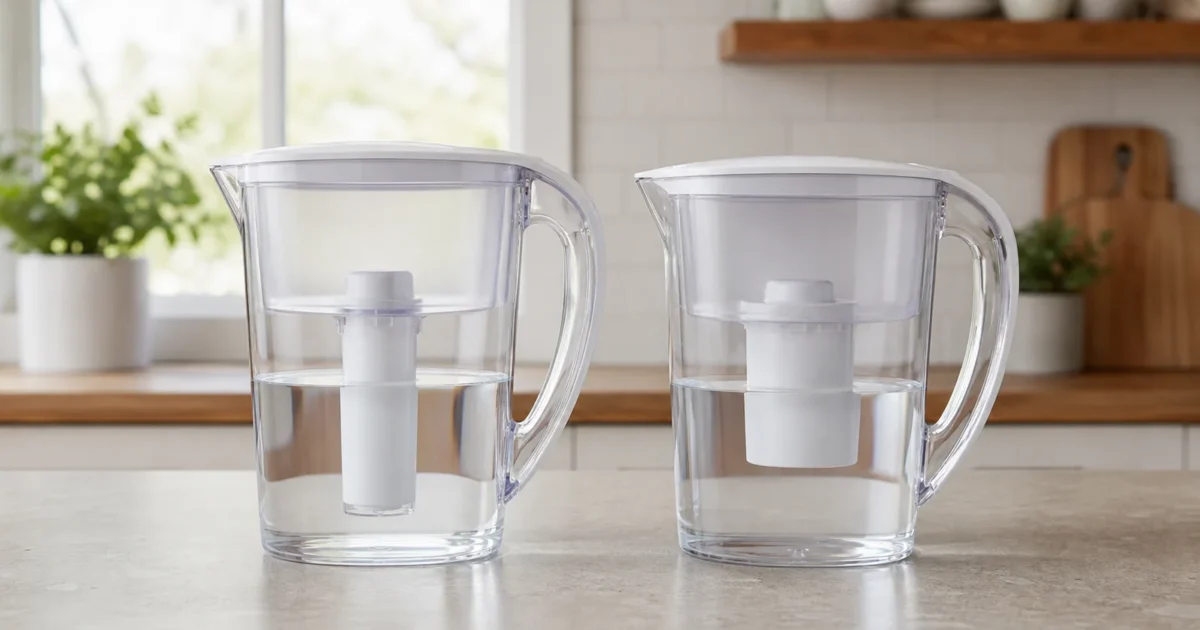
ZeroWater vs Brita comes down to one question: do you want a low number on a TDS meter, or a certified reduction of a specific contaminant? Those are not the same thing. ZeroWater pulls your water down toward 000 total dissolved solids and hands you a meter to prove it. Brita’s Elite filter leaves more dissolved minerals in the glass but carries a broader, more conventional certification picture. Both can reduce lead. Neither result is read off the TDS number.
Here is the short version. If your goal is the lowest possible mineral content and you do not mind frequent filter changes, ZeroWater wins on the meter. If your goal is reliable, certified contaminant reduction at a low cost per gallon with minimal fuss, Brita Elite is the steadier pick. The honest trade-off is filter life: ZeroWater’s filter is rated around 15 gallons, Brita Elite’s around 120. That gap drives almost everything else.
What the TDS meter actually measures
A TDS meter measures total dissolved solids, expressed in parts per million (ppm) or milligrams per liter (mg/L). It does this indirectly, by measuring the electrical conductivity of the water and converting it to an estimated dissolved-solids figure. The reading goes up when there are more dissolved ions in the water and down when there are fewer.
That is the whole of what it tells you. It does not tell you what is dissolved. Calcium and magnesium, the harmless minerals that make water “hard,” register on the meter. So does sodium. So do nitrates. The meter cannot tell a beneficial mineral from a problem ion, because it never identifies any of them. It only counts the total.
The U.S. Environmental Protection Agency treats TDS as a secondary drinking water standard, with a non-enforceable guideline of 500 mg/L. “Secondary” is the key word: secondary standards are based on aesthetics – taste, color, staining, scaling – not on health effects. The EPA sets that 500 figure because high-TDS water tastes off and leaves deposits, not because crossing it makes water toxic.
Why a low TDS number is not a safety reading
This is the central misunderstanding ZeroWater’s meter can create, so it is worth stating plainly: TDS is not toxicity. A reading of 000 does not mean the water is safe, and a reading of 250 does not mean it is dangerous.
Several of the contaminants people most want gone do not move the meter in a way you can interpret. Lead, at the concentrations that matter for health, is measured in parts per billion – far too small a contribution to read off a TDS meter that works in parts per million. Many pesticides, pharmaceuticals, and PFAS “forever chemicals” are organic compounds that a conductivity meter does not register meaningfully at all. Bacteria, viruses, and cysts are not dissolved solids and do not show up. You could have a 006 reading and still have a lead problem, and you could have a 300 reading that is entirely harmless dissolved calcium. The Safe Drinking Water Foundation makes the same point: TDS reflects how much is dissolved, not whether any of it is harmful.
So the meter is real, and the number is real. It just answers a different question than the one most buyers think they are asking. For a health claim, the document that matters is the certification, not the meter.
How to read the certifications: NSF 42 vs NSF 53
Two certification standards do most of the work in this category, and they are not interchangeable.
NSF/ANSI 42 is the aesthetic standard. It covers chlorine taste and odor, and similar nuisance effects. A filter certified only to NSF/ANSI 42 makes water taste better. It makes no health claim.
NSF/ANSI 53 is the health standard. It covers contaminants with health effects – lead, chromium, cysts, certain other heavy metals. When a filter says it reduces lead, the claim is only as good as an NSF/ANSI 53 listing that names lead specifically.
This is where buyers get tripped up. Brita’s two main pitcher filters are not equal here:
- The Brita Standard filter is certified to NSF/ANSI 42 only – chlorine taste and odor, plus some metals like mercury and copper. It is not certified for lead.
- The Brita Elite filter (model
OB06) is certified to NSF/ANSI 42, 53, and 401 – so taste/odor, lead and heavy metals, and an emerging-contaminant set including some PFAS, per Brita’s Elite performance data sheet.
If lead is your reason for buying, the Standard filter does not do the job and is not certified to. You need the Elite. Confirm the model printed on the filter you actually own before assuming you are protected – the two filters look broadly similar in the same pitcher.
One more rule that matters for aftermarket and off-brand filters: an NSF claim is SKU-specific. A filter that fits your Brita pitcher is not certified just because Brita’s own filter is. Verify the exact filter’s listing at info.nsf.org before trusting any lead claim on a third-party cartridge.
ZeroWater’s certification, read honestly
ZeroWater (now sold under the Culligan brand) uses a 5-stage filter built around ion-exchange resin plus activated carbon and other media. The ion-exchange stage is what drives the TDS reading toward 000 – it strips dissolved ions broadly, which is exactly what a conductivity meter measures. That is the design’s whole pitch, and on the meter it delivers.
On the health certifications, two honest details matter. First, the certifying body is IAPMO R&T, not NSF International. IAPMO certifies against the NSF/ANSI 53 standard, which is a legitimate accredited path – but if you go looking on info.nsf.org specifically, you should know the listing lives with IAPMO, per ZeroWater’s stated certifications. The 5-stage filter is certified to reduce lead, chromium (hexavalent), mercury, and PFOA/PFOS.
Second, that certification is rated for roughly 15 gallons of capacity. This is the trade-off the meter does not show you. The aggressive ion-exchange that produces a 000 reading also exhausts quickly. ZeroWater itself advises changing the filter when the meter climbs to about 006, which for many households on ordinary tap water arrives in a matter of weeks.
Filter life and real cost per gallon
This is where the two diverge most, and it is the number to decide on.
| ZeroWater 5-Stage | Brita Elite (OB06) |
|
|---|---|---|
| Rated filter life | ~15 gallons |
~120 gallons |
| Certified for lead | Yes (NSF/ANSI 53, via IAPMO) | Yes (NSF/ANSI 53) |
| TDS reduction | Near 000 |
Modest |
| Certifying body | IAPMO R&T | NSF International |
Brita Elite is rated for about 120 gallons, or roughly six months for an average household, per Brita’s replacement guidance. ZeroWater’s 15-gallon rating is roughly one-eighth of that. So even when a single ZeroWater filter costs less than a single Brita Elite filter, you buy many more of them. On a cost-per-gallon basis – the only fair way to compare – ZeroWater is usually the more expensive water over time, sometimes substantially.
That does not make ZeroWater wrong. If you are on a private well or a supply with genuinely high dissolved solids that taste bad, the aggressive reduction may be worth the cost and the frequent swaps. But buy it with eyes open: you are paying for the meter reading and the broad ion stripping, not for a health outcome the meter can prove.
If you want to map your own water’s hardness and dissolved-solids picture before choosing – or to size up whether a pitcher is even the right tool versus a point-of-entry system – start with our filter finder. If you are weighing a pitcher against a permanent system, the reverse osmosis cost calculator puts the long-run numbers side by side, and high hardness specifically may point you toward the water softener sizing calculator instead.
Which one should you buy
Lead off the answer, then the why.
Buy Brita Elite if you want certified lead and PFAS reduction at the lowest practical cost per gallon, with filter changes you only think about twice a year. It is the default recommendation for most municipal-water households. Just make sure it is the Elite, not the Standard – only the Elite carries the lead certification.
Buy ZeroWater if you specifically want the lowest dissolved-solids number, you have water that genuinely tastes mineral-heavy, and you accept frequent filter changes and a higher running cost. The included TDS meter is a useful gauge of when this filter is exhausting – it is not a safety instrument.
Do not buy either expecting the TDS number to certify anything. The meter tells you how much is dissolved. The NSF or IAPMO listing tells you what was tested and reduced. Decide on the certification that matches your actual concern, and treat the number as the gauge it is.
Does a 000 reading on the ZeroWater meter mean my water is pure or safe?
No. It means the total dissolved solids are very low. It does not measure lead at health-relevant parts-per-billion levels, and it does not detect PFAS, pesticides, pharmaceuticals, or bacteria at all. A 000 reading and a certified-lead-reduction claim are two separate things; only the certification speaks to safety.
Does the regular Brita filter remove lead?
No. The Brita Standard filter is certified to NSF/ANSI 42 (taste and odor) and is not certified for lead. Only the Brita Elite filter (model OB06) carries NSF/ANSI 53 lead certification. Confirm the model printed on your filter before assuming you have lead reduction.
Why does ZeroWater’s filter run out so much faster than Brita’s?
The ion-exchange media that drives the TDS reading toward 000 removes dissolved ions aggressively and exhausts quickly – around 15 gallons rated, versus about 120 for Brita Elite. The fast TDS reduction and the short filter life are two sides of the same design.
Is IAPMO certification as trustworthy as NSF?
Yes, for the standard it covers. IAPMO R&T is an accredited certifier that tests products against the same NSF/ANSI standards. ZeroWater is certified by IAPMO against NSF/ANSI 53; Brita is certified by NSF International. Both are legitimate – just know that ZeroWater’s listing lives with IAPMO, not on info.nsf.org.
Which is cheaper over a year?
Brita Elite is almost always cheaper per gallon. Even if one ZeroWater filter costs less than one Brita Elite filter, the roughly 8-to-1 difference in rated filter life means you buy far more ZeroWater cartridges. Compare on cost per gallon, not per filter.
Related guides
Boil-Water Advisory Checklist: What to Do During and After [2026]
A boil-water advisory checklist only works if you follow it in the right order, and the order is…
Boil-Water Advisory: What Your Filter Can and Cannot Do
Your phone buzzes with a boil-water advisory, and your first instinct is to check the pitcher filter on…
NSF Filter Certifications Explained: 42 vs 53 vs 58 vs 401 vs P473
NSF filter certifications only mean something when two conditions are both true: the exact product is listed by…