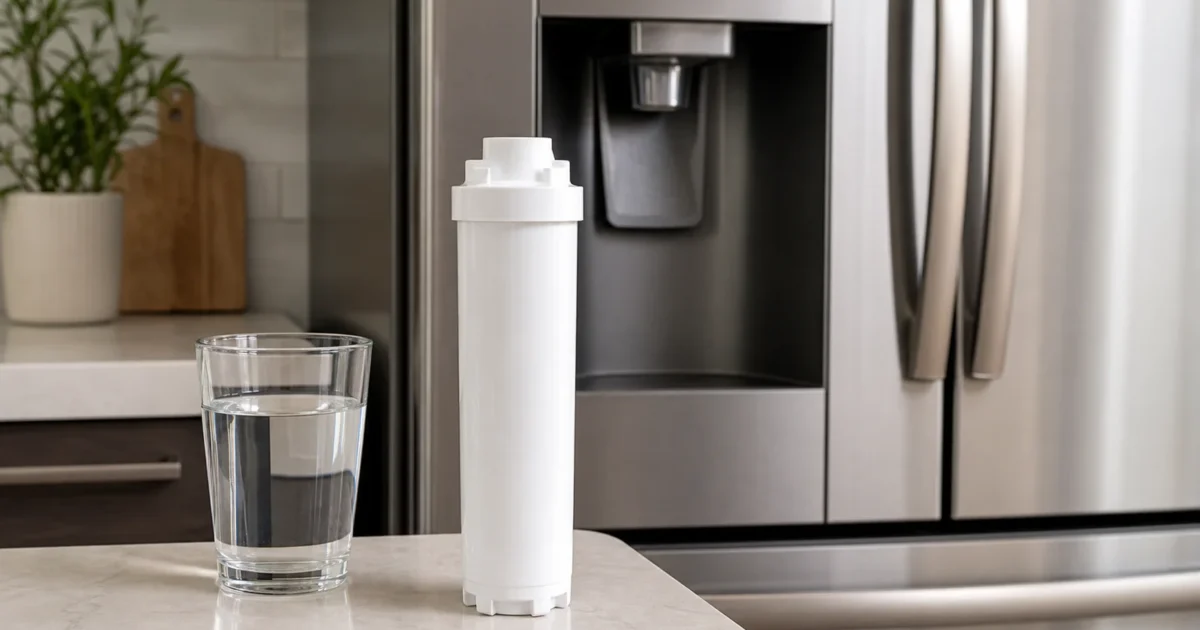
Does a refrigerator filter remove PFAS? Not in any certified sense we can find. We checked every refrigerator filter in our certification registry – 47 entries spanning the OEM filter families and the recurring aftermarket brands, verified against the official NSF, IAPMO, and WQA listings on 2026-06-24 – and zero of them carry a PFOA/PFOS reduction claim of any kind. The refrigerator filter PFAS record is, as of that check, empty.
That is not the same as saying your fridge water is dangerous, and it is not the same as saying the carbon inside does nothing. It means the specific, tested, independently verified claim – the one that historically lived under protocol NSF P473 and now lives inside NSF/ANSI 53 and 58 – does not exist for the fridge cartridges we could verify. Here is what those certifications actually say, what your filter is certified for instead, and how to check your own model in about two minutes.
What PFAS Are, in One Calm Paragraph
PFAS – per- and polyfluoroalkyl substances – are a family of thousands of synthetic chemicals used in consumer, commercial, and industrial products for decades. They break down very slowly, which is why they are often called “forever chemicals,” and the EPA notes they are now found at low levels in water, soil, and food across the country, per its PFAS overview. The two most studied members are PFOA and PFOS. In 2024 the EPA set enforceable drinking water limits (MCLs) of 4.0 parts per trillion for each, per the final PFAS drinking water regulation. Public water systems have until 2029 to comply, and the EPA has since proposed extending that to 2031 and rescinding the separate limits it set for three other PFAS compounds. So this is a real, regulated contaminant class – and also one with a compliance timeline still in motion. Both halves of that sentence are true.
What Your Fridge Filter Is Actually Certified For
A standard refrigerator filter is a carbon-block cartridge, and its certifications cluster around two standards. NSF/ANSI 42 is the aesthetic standard – chlorine taste and odor, particulates. NSF/ANSI 53 is the health standard – lead, cysts, certain other contaminants, each granted as a separate claim.
Our OEM data shows how that plays out in practice: of the 39 OEM refrigerator filter families we cross-referenced, 28 – about 72% – carry an NSF/ANSI 53 lead claim line-wide, certified either by NSF International or by WQA Gold Seal against the same standard. The aftermarket is thinner: of the 9 recurring aftermarket brands in our study, zero carry an NSF 53 listing across their full line – four hold it on select SKUs only, and two more claim the standard through IAPMO rather than an NSF listing. If lead is your question, we walked through that whole exercise in does a refrigerator filter remove lead.
PFAS is a different claim again – and this is where the record goes quiet. An NSF/ANSI 53 lead claim tells you nothing about PFOA or PFOS. Certification is granted contaminant by contaminant, and the PFAS line item is one almost no fridge cartridge has.
Refrigerator Filter PFAS Claims: The Honest Count
Here is the count from our registry, stated plainly. Of 68 filter entries across every category we track, exactly one carries any PFAS claim at all: the LifeStraw Home pitcher filter – and even that one is manufacturer-claimed rather than a listing we verified. Among the 47 refrigerator entries – OEM and aftermarket both – the number of PFOA/PFOS claims on the record is zero. Every one of the nine recurring aftermarket brands we checked shows the same line: no P473 or equivalent PFAS claim on record.
Data vintage matters here: we verified those listings on 2026-06-24 against the official NSF database and the IAPMO/WQA listings. Manufacturers add claims over time, so the count can change – which is exactly why the checking procedure below is more useful than any snapshot.
To be precise about what “zero” means: it means no certified claim. It does not mean we tested fridge water for PFAS, and it does not mean every cartridge passes PFAS through untouched. It means no manufacturer has put a fridge cartridge through the PFOA/PFOS certification test and published the listing – so nobody can honestly print that claim on the box.
What NSF P473 Actually Certifies – and Where It Went
NSF P473 was a standalone test protocol NSF developed in 2016, specifically for PFOA and PFOS reduction in residential water treatment devices. To pass, a device had to reduce PFOA and PFOS below the EPA’s then-current health advisory level of 70 parts per trillion, and NSF’s joint committee later folded the protocol’s test method into the permanent standards – NSF/ANSI 53 for carbon and ion-exchange devices, NSF/ANSI 58 for reverse osmosis systems, per the National Ground Water Association’s summary of the change.
The standards kept moving. The 2022 editions of NSF/ANSI 53 and 58 added five more PFAS compounds – PFHxS, PFNA, PFHpA, PFBS, and PFDA – revised the PFOA/PFOS pass levels to track updated health advisories, and created a “Total PFAS” reduction claim covering all seven, per WaterWorld’s report on the joint committee’s update.
So the practical translation: if you see P473 on an older product, it is the ancestor of today’s claim, not a different animal. If you are shopping now, the claim to look for is PFOA/PFOS reduction (or Total PFAS) under NSF/ANSI 53 or 58 – named explicitly in the product’s listing. One honest footnote: the certification pass levels and the EPA’s new 4.0 ppt regulatory limit are different numbers set at different times for different purposes. That is one more reason to read the actual listing instead of the front of the box.
| Standard | What it covers | PFAS claim? |
|---|---|---|
| NSF/ANSI 42 | Aesthetic – chlorine taste/odor, particulates | No |
| NSF/ANSI 53 | Health – lead, cysts, and (since P473 merged in) PFOA/PFOS | Only if the listing names it |
| NSF/ANSI 58 | Reverse osmosis system performance | Only if the listing names it |
| NSF/ANSI 401 | Emerging contaminants – some pharmaceuticals, pesticides | No |
| NSF P473 | The original PFOA/PFOS protocol (2016), now folded into 53/58 | Yes – historical marking |
Can Carbon Reduce PFAS at All? Yes – and That Is Not the Point
Activated carbon genuinely can reduce PFAS. The EPA lists granular activated carbon, ion exchange, and high-pressure membranes as the treatment technologies with demonstrated PFAS effectiveness, usable all the way down to point-of-use filters in a home, per its treatment technologies research. A fridge cartridge is activated carbon. So it is plausible – likely, even – that a fresh fridge filter takes out some fraction of the PFOA and PFOS passing through it.
The distinction that matters is between what a filter may do and what it is certified to do. A certified claim means an independent lab challenged the filter with a defined PFAS concentration and verified the reduction held for the filter’s full rated capacity – so you know how many gallons the claim is good for. Without the certification, there is no tested capacity, no verified percentage, and no way to know whether the reduction holds in month five of a six-month cartridge. Reduction without a listing is a manufacturer claim, not a listed reduction. Our whole filter certification registry exists to keep that line bright.
How to Check a Specific Refrigerator Filter PFAS Claim
Two minutes, three steps, no chemistry degree:
- Read the model number off the filter itself – not the fridge. It is printed on the cartridge body:
EDR1RXD1,W10295370A,LT1000P,XWFE, and so on. The fridge model and the filter model are different numbers, and one fridge line can use different filters across model years. - Search our registry. The filter certification registry shows, for every filter we track, what the official record actually lists – standard by standard, with the honest gaps marked as “no published claim on record” rather than “not certified.”
- Confirm against the primary source. NSF publishes its certified-product listings free at info.nsf.org – search the model number and read the reduction claims the listing names. If PFOA/PFOS is not named there (or in the equivalent IAPMO or WQA listing), the filter does not have the claim, whatever the marketing copy implies.
What Actually Is Certified for PFAS Reduction
Certified PFOA/PFOS reduction exists – just mostly not in the refrigerator door. Under-sink reverse osmosis systems certified to NSF/ANSI 58 with a named PFAS claim are the most thorough household option. Several pitcher and under-sink carbon filters carry a genuine NSF/ANSI 53 PFOA/PFOS claim, tested to a defined gallon capacity. We keep the full walkthrough of those options – including which formats hold which claims – in how to remove PFAS from water, and the trade-offs of going the RO route in our reverse osmosis guide.
The honest trade-off cuts both ways. An RO system costs more, sends water to drain, and takes up cabinet space. A certified pitcher costs little but has a small rated capacity, and the claim expires when the capacity does. The fridge filter’s job – taste, odor, and (on certified models) lead – is still worth doing. It just is not, on today’s record, a PFAS strategy.
Your Water First
Before spending anything, find out whether PFAS is even your problem. In our national study of EPA UCMR5 monitoring data (the February 2026 release, roughly 95% complete), 1,693 of 10,299 public water systems tested – 16.4% – reported a maximum PFOA or PFOS result above the 4.0 ppt limit. That is occurrence data, not compliance data: the limits are measured as running annual averages, the compliance date has not arrived, and a system reporting above the limit is a flag for attention, not a verdict. The full numbers, state by state, are in our PFAS national data study.
And a system-level result is not your tap. Monitoring describes what a utility reported, not what comes out of your faucet. Look up your own system’s reported results with the Water Watchdog ZIP lookup, and decide from your data – not from a national headline.
The Bottom Line
The certified answer to the refrigerator filter PFAS question, as of mid-2026, is no – zero verified PFOA/PFOS claims across the 47 refrigerator filters in our registry. The carbon inside may reduce some PFAS; nobody has certified that it does, or for how many gallons. If PFAS reduction is the goal, buy the certification: an NSF/ANSI 58 RO system or an NSF/ANSI 53 filter whose listing names PFOA/PFOS. And whatever you buy for the fridge itself, confirm the exact model printed on your current filter before ordering – one fridge line uses different filters across model years. Our filter finder will match your model to the filters that actually fit, with the certification record beside each one.
Does any refrigerator filter remove PFAS?
None that we can verify. As of our 2026-06-24 registry check, zero of the 47 refrigerator filters we track – OEM or aftermarket – carry a certified PFOA/PFOS reduction claim. The carbon inside may reduce some PFAS, but no fridge cartridge has a listed, tested claim. Check your exact model at info.nsf.org in case that changes.
What is NSF P473?
A test protocol NSF created in 2016 specifically for PFOA and PFOS reduction in home water filters. Its test method was later folded into the permanent standards – NSF/ANSI 53 for carbon and ion-exchange filters and NSF/ANSI 58 for reverse osmosis – so a modern PFAS claim is certified under those standards rather than under P473 itself.
My filter’s box says “NSF certified.” Doesn’t that cover PFAS?
No. NSF certification is granted claim by claim. Most fridge filters are certified to NSF/ANSI 42 (taste and odor), many to NSF/ANSI 53 for lead – and neither implies any PFAS reduction. A PFAS claim only exists if the listing names PFOA/PFOS specifically.
My water system reported PFAS above the limit. Is my fridge filter protecting me?
There is no certified basis for saying so. A system-level monitoring result also is not a measurement of your tap – start by looking up your own system’s reported results, then choose a filter whose listing actually names PFOA/PFOS, which today means certain RO systems and certified carbon filters rather than fridge cartridges.
Can activated carbon reduce PFAS at all?
Yes – the EPA lists activated carbon among the treatment technologies with demonstrated PFAS effectiveness, including in point-of-use filters. The catch is capacity and verification: without a certification, nobody has tested how much a given cartridge reduces or for how many gallons the reduction holds.
Related guides
Midea Refrigerator Water Filter: MIWF6200 vs MIWF8200 vs MIWF8900
Midea currently sells three refrigerator water filters – MIWF6200, MIWF8200, and MIWF8900 – and mixing them up is…
Kenmore Refrigerator Water Filter: Cross-Reference by Model
Kenmore doesn’t build refrigerators. It’s a private-label brand, so your Kenmore refrigerator water filter is actually determined by…
Are Water Filters Interchangeable? Fit, Certification, and the Wrong-Filter Trap
Are water filters interchangeable? Sometimes physically, rarely equivalently. A third-party cartridge can seat and seal in your housing…