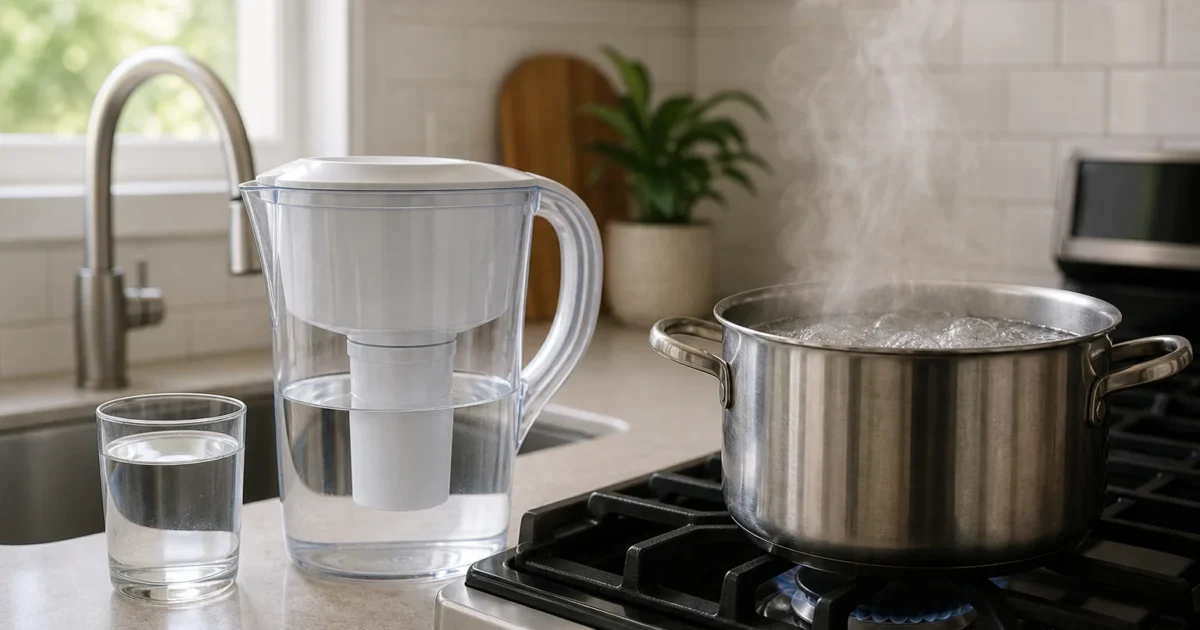
Your phone buzzes with a boil-water advisory, and your first instinct is to check the pitcher filter on the counter or the cartridge in the fridge door. Reasonable instinct, wrong answer: a boil water advisory filter question has one correct starting point, and it isn’t your filter at all. CDC is direct about it – during an advisory, households should boil tap water (or use bottled water) even if that water has already passed through a home filter or pitcher filter, for drinking, cooking, brushing teeth, making ice, or preparing drinks, until the advisory is lifted by the local water system or health authority.
That single rule surprises a lot of people, because most home filters are genuinely good at their actual job – taste, odor, some metals – and it’s easy to assume “filtered” and “safe during an advisory” mean the same thing. They don’t. This guide covers why boil-water advisories happen, what CDC’s boiling instructions actually say, what your everyday filter is and isn’t certified to do about germs, what device categories genuinely do count as microbiological protection, and the flushing and filter-replacement steps for after the advisory ends.
What a Boil-Water Advisory Actually Means
A boil-water advisory is a notice from local officials that your tap water has, or could have, disease-causing germs in it, and that households should use bottled water or boil tap water before drinking it, cooking with it, brushing teeth, making ice, or preparing drinks, until the advisory is lifted. Under the Safe Drinking Water Act’s Public Notification Rule, EPA requires drinking-water utilities to notify customers whenever a drinking-water problem creates a public-health risk – a boil-water advisory is one form that notice takes.
It’s worth separating a boil-water advisory from two related notices that sound similar but call for different action. A “do not drink” advisory or a “do not use” advisory is typically issued for chemical, toxin, or broader exposure concerns, and CDC notes that boiling may not make that water safe – so the boil-anyway rule below applies specifically to microbial boil-water advisories, not to a do-not-use notice.
Why Boil-Water Advisories Are Issued
Boil-water advisories are used when water is, or may become, contaminated with microbial pathogens such as Giardia, Cryptosporidium, E. coli, or viruses, per EPA. EPA’s own analysis lists the likely causes as source-water contamination, inadequate treatment, treatment failures, and damage to water-system infrastructure.
In practice, EPA’s national report to Congress found that most U.S. boil-water advisories in its analyzed data were issued because of main breaks, distribution-system repairs, or loss-of-pressure events – often issued as a precaution while the utility sampled for fecal contamination, measured by E. coli. That’s a useful thing to know before your own advisory arrives: most of the time, the trigger is a pressure or infrastructure event that could let germs in, not a confirmed outbreak. The advisory is precautionary by design, and the boiling instruction is the same either way.
Boil Water Advisory Filter Rule: CDC Says to Boil Anyway
Here’s the boil water advisory filter rule in plain terms: CDC’s instruction is to bring clear water to a full rolling boil for 1 minute – or 3 minutes at elevations above 6,500 feet – then let it cool before use. EPA gives the same emergency instruction for most users and states that a 1-minute (or 3-minute, at elevation) rolling boil is sufficient to kill pathogenic bacteria, viruses, and protozoa.
If the water is cloudy, CDC says to filter it first through a clean cloth, paper towel, or coffee filter – or let it settle and draw off the clear water – before boiling, since sediment can shield some organisms from the heat. During the advisory itself, CDC says to use bottled or boiled water for drinking, cooking, food preparation, and pets, and specifically says not to use water or ice from appliances connected to the water line, such as refrigerator dispensers or icemakers, while the advisory is active.
One more boundary worth stating plainly: boiling and disinfecting are not solutions for water contaminated with fuel, toxic chemicals, radioactive materials, heavy metals, salts, or most other chemicals. Those situations call for bottled water and local-agency instructions instead – which is exactly why the do-not-drink/do-not-use notice above is a different category from a boil-water advisory.
What Common Filters Do Not Do During an Advisory
This is the part a boil water advisory filter question usually hinges on: what does NSF/ANSI 42 or 53 actually certify, and does either one cover germs?
NSF/ANSI 42 certification covers aesthetic effects – chlorine taste and odor reduction – and NSF lists pitcher, under-sink, whole-house, and similar systems among the product types that can carry it. That’s a taste-and-odor claim, full stop; it says nothing about pathogens. CDC’s own guidance on choosing home water filters notes that pitcher filters and refrigerator filters typically use activated carbon and are mainly intended to improve taste and smell, not to make unsafe water safe.
The manufacturers say the same thing about their own products. Brita states that its filters should be used only with water that is already potable, and not with microbiologically unsafe water or water of unknown quality without adequate disinfection first. PUR states that its filters are certified to reduce chemical and physical contaminants – sediment, chlorine taste and odor, and some byproducts – but that PUR filters do not filter microbes. Two of the largest consumer filter brands, in their own words, rule their standard products out for advisory use.
NSF/ANSI 53 is a step up – it can cover health-effect contaminants, and CDC notes that an NSF 53 or NSF 58 certification specifically naming cyst reduction or cyst removal can reduce parasites such as Cryptosporidium and Giardia. But a cyst-reduction claim is not full microbiological purification: CDC is explicit that a filter certified to remove Cryptosporidium will remove that parasite but will not eliminate other possible disease-causing microorganisms, including bacteria and viruses. A cyst claim covers one category of germ, not all three (bacteria, viruses, protozoa) that a boil-water advisory is written to guard against.
What Actually Counts as Microbiological Protection
If NSF 42 and a plain NSF 53 listing don’t cover an advisory, what does? A narrower, specific set of certifications and device classes.
NSF P231 is the key NSF protocol for microbiological water purifiers, and NSF says P231 certification is based on EPA’s 1987 Guide Standard and Protocol for Testing Microbiological Water Purifiers. EPA’s protocol defines a purifier as a unit that treats or removes bacteria, viruses, and protozoan cysts, with specific performance targets: 99.9999% bacteria reduction, 99.99% virus reduction, and 99.9% cyst reduction. CDC’s Yellow Book adds an important caveat – products claiming an EPA “purifier” designation must run their own testing to those targets, and EPA does not independently verify those claims itself. NSF’s own P231 listings identify which products are currently certified and what they claim, so checking the listing (not the marketing copy) is the way to confirm a specific purifier’s status.
Ultraviolet treatment is a second real path, but only one class of it. NSF/ANSI 55 Class A UV systems are designed to inactivate or remove bacteria, viruses, Cryptosporidium oocysts, and Giardia cysts from contaminated water. NSF/ANSI 55 Class B systems are a different product entirely – they’re built only for supplemental treatment of water that’s already disinfected, and are not intended for microbiologically unsafe water. NSF’s listings distinguish “Disinfection Performance, Class A” products from “Disinfection Performance, Class B” ones, so the class printed on the listing is the detail that actually matters, not just the letters “UV” on the box. CDC separately notes that UV can kill parasites, bacteria, and viruses in small amounts of clear water, but that cloudy water should be pre-filtered before UV treatment, since sediment can block germs from the light.
Reverse osmosis is the third path, with a similar catch. CDC says RO filters remove parasites, bacteria, and viruses – but NSF’s own standard, NSF/ANSI 58, only mandates TDS reduction; cyst reduction and other microbiological claims are optional and have to be verified for the specific product and listing, not assumed from “RO” as a category. The honest, precise version of this whole section: a boil-water advisory isn’t defeated by the generic words “RO” or “UV.” It’s defeated by a specific, verified certification – NSF P231 for microbiological purifiers, or NSF/ANSI 55 Class A for UV, operated within its rated conditions. Anything short of that verified listing, boil the water.
Practical Filter Guidance During an Advisory
A few concrete habits carry you through the advisory itself, on top of the boil-and-cool rule above.
Shut off appliance water lines if the manufacturer instructs it. GE Appliances specifically tells owners not to use refrigerator dispenser water or new icemaker ice while the area is under a boil-water alert, and that instruction is a good default for any appliance drawing straight from the supply line during an advisory. It lines up with CDC’s broader instruction above to avoid water-line-connected appliances entirely for the duration.
Your existing pitcher, fridge, faucet, or carbon-block filter isn’t wasted equipment during this window – it’s just not doing the advisory’s job. Once you’ve boiled or sourced bottled water, running that water through your normal filter afterward is fine for the usual reasons (taste, chlorine, or whatever certified nonmicrobial claim it carries). NSF is clear on the broader point here too: certification to one standard never implies a system reduces every possible contaminant, which is exactly why a boil-water advisory filter question needs a specific answer, not an assumption from the brand name on the cartridge.
After the Advisory Is Lifted: Flush Lines and Replace Filters
The advisory ending doesn’t mean the plumbing is instantly back to normal, and this is the step people skip most.
EPA says the water system itself should tell customers whether they need to flush plumbing or appliances once an advisory is lifted, and how much flushing is needed – so check for that notice from your utility first. CDC’s own recovery guidance for commercial and childcare settings is specific: flush cold-water pipes and faucets continuously for at least 5 minutes after the advisory ends, and clean and sanitize any equipment with water-line connections according to the manufacturer’s instructions.
Filters get special treatment in that guidance, and for good reason: CDC notes that germs which grow in pipe slime can also live and multiply inside water filters, which is why household filters need regular maintenance and replacement in general. Specific to a boil-water event, CDC says to change all point-of-entry and point-of-use water filters after the advisory lifts, including filters built into equipment that uses water. CDC’s healthcare water-system recovery guidance goes step by step: remove point-of-use filters, flush the outlets for several minutes, then install new filters – a sequence that translates directly to a home fridge or pitcher filter.
GE Appliances gives the fridge-specific version of that sequence: replace the water filter once the water is confirmed drinkable again, discard all ice currently in the bin, throw out the next three to five batches the icemaker produces, flush the water dispenser for three to five minutes, and wash and sanitize the ice bin and dispenser chute. That’s a longer list than “swap the cartridge,” and every step on it matters – old ice and an unflushed dispenser line can hold onto whatever the advisory was about even after the filter itself is new.
Quick Reference: Boil-Water Advisory Filter Dos and Don’ts
| Situation | During the advisory | After it’s lifted |
|---|---|---|
| Drinking, cooking, brushing teeth | Boil 1 min (3 min above 6,500 ft) or use bottled water – even if filtered | Follow your utility’s flushing notice before resuming normal use |
| Fridge dispenser / icemaker | Don’t use – shut off if the manufacturer instructs | Discard ice, run 3-5 batches, flush dispenser 3-5 min, sanitize bin/chute |
| Pitcher, faucet, or carbon-block filter | Not a substitute for boiling – keep boiling regardless | Replace the cartridge; the old one may harbor germs from the event |
| Household pipes and faucets | No special action mid-advisory | Flush cold-water taps continuously for at least 5 minutes |
| RO system or UV unit | Only trust it if verified NSF/ANSI 58 cyst claim or NSF/ANSI 55 Class A | Replace any point-of-use filter stage per the schedule above |
| Cloudy water | Filter through cloth/coffee filter or let settle, then boil | – |
What to Do Next
The single habit that answers a boil water advisory filter question correctly, every time, is to check the certification instead of assuming the brand or category covers it. For your everyday cartridge – fridge, pitcher, or faucet-mount – our NSF filter certifications guide walks through exactly what NSF/ANSI 42, 53, 58, and P231 each actually certify, so you can read your own filter’s listing instead of guessing from the box. If you’re weighing whether a permanent reverse osmosis system is worth adding to your household specifically for stronger day-to-day protection, our reverse osmosis guide covers the trade-offs. And once any advisory is behind you, our filter finder matches your exact fridge or fixture model to a certified replacement cartridge, so the post-advisory filter swap is a confirmed match rather than a guess.
Does a refrigerator or pitcher filter protect me during a boil-water advisory?
No. CDC’s instruction is to boil tap water (or use bottled water) during an advisory even if it has passed through a home filter or pitcher filter. Standard carbon filters are certified for taste, odor, and sometimes specific metals or cysts – not for the full range of bacteria and viruses a boil-water advisory guards against.
How long do I need to boil water during an advisory?
CDC and EPA both instruct a full rolling boil for 1 minute, or 3 minutes at elevations above 6,500 feet, then letting the water cool before use. If the water is cloudy, filter it through a clean cloth or coffee filter, or let it settle, before boiling.
Does reverse osmosis or a UV filter count as protection during a boil-water advisory?
Only specific, verified certifications do – not the category name. NSF/ANSI 58 reverse osmosis systems only mandate TDS reduction; cyst and other microbiological claims are optional and must be checked on the specific listing. For UV, only NSF/ANSI 55 Class A systems are rated for microbiologically unsafe water; Class B units are supplemental only. Absent a verified P231, NSF 58-with-cyst-claim, or 55 Class A listing, boil the water regardless.
Do I need to replace my water filter after a boil-water advisory ends?
Yes. CDC recommends changing all point-of-entry and point-of-use water filters after an advisory is lifted, because germs that grow in plumbing can also live inside filter cartridges. For refrigerators specifically, GE also recommends discarding existing ice, running out several batches of new ice, and flushing the dispenser line.
Is a “do not drink” advisory the same as a boil-water advisory?
No. A boil-water advisory is for microbial contamination, where boiling makes the water safe. A “do not drink” or “do not use” advisory usually covers chemical, toxin, or other exposure concerns, and CDC notes boiling may not fix those – follow local instructions and use bottled water instead.
Sources
- CDC: Drinking water advisories, an overview
- EPA: National report on boil-water advisories
- EPA: Water decontamination FAQs for customers
- EPA: Emergency disinfection of drinking water
- CDC: Water emergency preparedness overview
- CDC: Cryptosporidium prevention during a home boil-water advisory
- CDC: Cryptosporidium prevention in commercial settings
- NSF: Standards for water treatment systems
- CDC: Choosing a home water filter
- Brita: Replacement filter FAQ
- PUR: Filter support
- EPA: Guide standard and protocol for microbiological water purifiers
- CDC Yellow Book: Water disinfection for travelers
- NSF: P231 certified product listings
- ANSI/NSF 55-2004 standard summary
- NSF: NSF/ANSI 55 certified product listings
- CDC: Water treatment for hiking, camping, and traveling
- NSF: NSF/ANSI 58 reverse osmosis systems
- GE Appliances: Boil-water advisory guidance
- CDC: Water system repair after reopening a health facility
- CDC: Preventing waterborne germs at home
Related guides
Boil-Water Advisory Checklist: What to Do During and After [2026]
A boil-water advisory checklist only works if you follow it in the right order, and the order is…
NSF Filter Certifications Explained: 42 vs 53 vs 58 vs 401 vs P473
NSF filter certifications only mean something when two conditions are both true: the exact product is listed by…
How to Read Your Water Quality Report (CCR): A Plain-English Guide
If an annual water quality report showed up in your mail or inbox recently, that is your CCR…