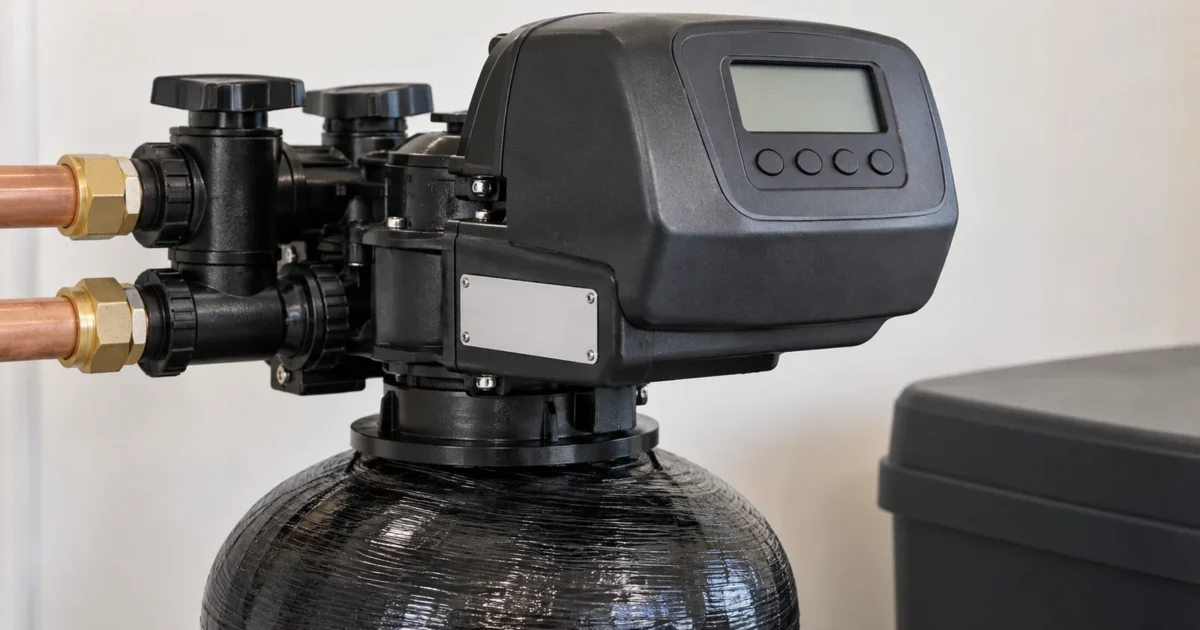
Which water softener control valve do you have? Start with the model and serial number on the rating label, then identify the valve family and its configuration before you order anything. A softener has no disposable cartridge with a part number printed on it. The part you need is usually a seal kit, piston, spacer stack, injector or rotor, and which one fits depends on the valve underneath. This guide shows where each maker says the label is, how to read a dealer-built valve, and why two valves that look alike can take different parts.
Start With the Label, Not the Look
For a cabinet-style retail softener, the useful identifier is the appliance’s model and serial number. For a dealer-built system with a separate mineral tank and brine tank, it is the control-valve family plus its configuration. Appearance narrows the search. It does not finish it.
Here is where the makers say to look:
- Whirlpool. The model and serial number are on the rim below the salt-lid hinges. Its WHES40/44 manual tells parts callers to give the model and serial number from the rating decal (Whirlpool model and serial help, Whirlpool WHES40/44 manual).
- Rheem. Its help page puts the model and serial number on the underside of the salt lid, and its manual says the rating decal is inside the salt lid (Rheem model and serial help, Rheem manual).
- GE. GE publishes a water-softener model and serial locator, and model-specific support pages such as the one for the
GXSHC40N(GE water-softener model/serial locator, GE GXSHC40N support). - EcoWater. EcoWater publishes a help page on where to find the model and serial number and how to read it (EcoWater model and serial help).
- North Star. According to its NST30ED manual, parts callers give the model and serial number from the rating decal on the back of the controller top cover (North Star NST30ED manual).
- Culligan. According to Culligan’s Medallist owner guide, the serial is on the back of the timer case (Culligan Medallist guide).
One scope note. If you landed here for a refrigerator or under-sink cartridge, that is a different lookup. Here we stay with the softener.
Dealer-Built Systems: Name the Valve Family and Its Configuration
If your softener is a dealer-built system, a brand sticker on the tank may tell you little. What matters is the control valve on top. Our own rule of thumb, not a manufacturer’s wording: a resemblance alone (“it looks like a Fleck 5600,” “it looks like a Clack WS1,” “it has an Autotrol Logix face”) is not enough to order parts.
Pentair’s Fleck documentation separates valves by softener or filter use, downflow or upflow, meter type, injector, brine-line flow control, voltage, piston and other assemblies (Pentair Fleck 5600 softener meter, Pentair Fleck 5600SXT downflow manual, Pentair Fleck 5600SXT upflow manual). Clack’s WS1/WS1.25 manual has an identification section ahead of its parts tables, which tells you that similar-looking Clack valves still need exact identification (Clack WS1/WS1.25 manual).
The current part number comes from the maker’s parts list, service manual or exploded diagram. Pentair’s Fleck service manual, for example, lists specific piston, seal-and-spacer, injector, drain, brine, meter and adapter assemblies (Pentair Fleck 5600 service manual).
Water Softener Control Valve: The Chart
Same valve family does not mean same rebuild parts. These examples come from the manufacturers’ own manuals and parts pages. Treat them as proof of the pattern, not a lookup table for your valve.
| What you see | What it is | What follows |
|---|---|---|
| Fleck 5600SXT, downflow softener | Downflow configuration | Pentair’s manual lists 60125 as the seal-and-spacer kit and 60102-71 as the downflow piston assembly |
| Fleck 5600SXT, upflow softener | Upflow configuration | The upflow manual lists 60125 again, but 60102-62 as the upflow piston assembly |
| Clack WS1 | 1.050-inch distributor-tube opening, gray spacers | The manual lists V3005-02 for the WS1 spacer stack |
| Clack WS1.25 or WS1.5 | Larger distributor opening, black spacers | The manual lists V3430-01 for the WS1.25/WS1.5 spacer stack |
| Whirlpool-style cabinet softener | Standard flow or high flow | According to Whirlpool’s parts pages, 7238468 is the Standard Rotor & Seal Kit and 7257535 is the High Flow Rotor & Seal Kit |
| GE cabinet softener | Model-specific parts | GE’s page for WS35X10001, an O-ring seal kit, tells buyers to search by appliance model number to ensure fit |
| Fleck-style or Clack-style head on a filter tank | A backwashing filter, not a softener | Pentair’s Fleck 5600 product page lists both filter and water-softener as valve applications |
Sources for the table: Pentair Fleck 5600 softener meter, Pentair Fleck 5600SXT downflow manual, Pentair Fleck 5600SXT upflow manual, Clack WS1/WS1.25 manual, Whirlpool replacement parts, Whirlpool 7238468, Whirlpool 7257535, GE Appliances Parts WS35X10001.
The Fleck rows are the clearest case. The seal-and-spacer kit is the same number in both manuals, and the piston is not. A specialist retailer, Fleck Systems, lists a standard mechanical Fleck 5600 downflow rebuild kit with a different piston again, 60102-00, alongside 60125 and brine valve 60032 (Fleck Systems 5600 downflow rebuild kit). So a “5600 rebuild kit” is not one product. Match your exact configuration.
Identified your valve family and configuration above? Order only the part your valve's own manual or parts diagram lists — these are the examples named in the chart, not universal parts:
As an Amazon Associate, WaterByTheBook earns from qualifying purchases. Links below are affiliate links — they cost you nothing extra.
From Model Number to Part Number
The order is: exact identifier first, parts diagram second, purchase third.
For a cabinet softener, take the model and serial from the rating decal to the maker’s manual or parts support. Whirlpool and Rheem each publish model-code help pages that connect a softener’s identity to the right documentation (Whirlpool model-code help, Rheem model-code help). For a dealer valve, take the valve family and configuration to the maker’s service manual.
Clack shows why the physical check matters. According to its manual, a WS1 has a 1.050-inch distributor-tube opening and gray spacers, while WS1.25 variants have larger openings and black spacers. That is a different spacer stack, so the two valves take different parts (Clack WS1/WS1.25 manual).
Be careful with cross-brand claims. If a retailer’s cross-reference shows a part for your model, confirm it against your model-specific diagram before ordering. GE’s WS35X10001, for example, is an O-ring seal kit (GE Appliances Parts WS35X10001). We did not find a safe manufacturer supersession table that works across brands. When a part number has been replaced, trust only the exact manufacturer page or manual that says so.
When the Numbers Are Gone: Visual Clues as Triage
If the label is missing or unreadable, visual cues can narrow the valve family. They cannot select every internal part.
The most useful cues are the control face, the valve-body shape, the bypass type, a meter dome or cable, the drain fitting, the brine-line fitting, the tank adapter and where the injector sits. The manuals list those as separate assemblies, so photograph all sides of the head and the bypass, not just the display (Pentair Fleck 5600 service manual, Clack WS1/WS1.25 manual).
A Fleck SXT digital face tells you the controller family, not the hidden configuration. Pentair publishes separate 5600SXT manuals for downflow and upflow softeners, with separate valve-body listings, and its 5600 product page lists filter and water-softener applications (Pentair Fleck 5600SXT downflow manual, Pentair Fleck 5600SXT upflow manual, Pentair Fleck 5600 softener meter). Our inference from that: the piston and body behind a similar faceplate can differ. Autotrol shows the same problem from another angle. According to Pentair’s Autotrol 742/762 manual, one controller family covers the 255 and Performa 263, 268 and 268FA valve bodies, so the controller face alone is incomplete (Pentair Autotrol 742/762 manual).
Proprietary dealer brands add a wrinkle. According to the brands’ own support pages, Culligan, Kinetico and EcoWater may route parts and support through their own channels rather than a universal cross-brand lookup (Culligan product manuals, Kinetico customer support, EcoWater owner manuals).
Which Lookup to Trust
Use this order when sources disagree: the maker’s model and serial locator or manual, then the maker’s parts page, then a reputable retailer or specialist supplier. Retailers help with availability and price. They should not override a service manual or a model-specific diagram.
Official starting points include GE’s softener locator (GE water-softener model/serial locator), Whirlpool and Rheem model-and-serial help (Whirlpool model and serial help, Rheem model and serial help), Pentair’s valves page for Fleck and Autotrol (Pentair valves), and Clack’s technical support (Clack technical support). Once you know the exact model or part number, parts lookups at Sears PartsDirect, Home Depot Repair Parts, Lowe’s Appliance Parts and RepairClinic accept model or part-number searches (Sears PartsDirect water softener parts, Home Depot water-softener parts, Lowe’s Appliance Parts, RepairClinic parts search). Use them as lookup aids, not as the final word.
Fits Is Not Certified
A part that fits your valve does not make the whole softener certified, and a certified softener does not prove that every aftermarket repair part is the right service part. Keep two questions apart: manuals and parts diagrams answer “does it fit,” and listing databases answer “is it certified.”
For residential ion-exchange softeners, the main standard is NSF/ANSI 44. According to NSF, it covers residential cation-exchange water softeners regenerated with sodium or potassium chloride to reduce hardness in public or private water supplies (NSF/ANSI 44 technical requirements). To verify a specific system, search the listing, not the box. NSF, WQA and IAPMO each keep a directory (NSF Standard 44 listings, WQA Find Products, IAPMO directory). Do not call a particular softener certified unless that exact model appears there. For more on the standards, see our NSF certifications explainer.
If You Still Cannot Identify It
Document first. Do not take the valve apart to find out what it is.
Photograph the front control face, the back of the valve, the bypass, the drain line, the brine line, the transformer label, the tank label, any sticker under the salt lid, and any dealer sticker or partial serial number. Then send the photos and whatever partial identifier you have to the manufacturer, a retailer’s parts support, or a local water-treatment dealer. Whirlpool and Rheem publish help pages on finding the model and serial number, and Whirlpool’s WHES40/44 manual asks parts callers for them (Whirlpool model and serial help, Rheem model and serial help, Whirlpool WHES40/44 manual). Clack’s technical-support page refers users to their Clack representative or local dealer (Clack technical support), and Kinetico’s support page points customers to its service line and a local Kinetico dealer (Kinetico customer support).
Safety comes before curiosity. Fleck’s service instructions require unplugging the unit, isolating or bypassing the conditioner, and relieving pressure before internal service. Whirlpool’s rotor and seal instructions start with bypassing and unplugging the softener. Culligan’s guide warns against disassembling the valve while it is under pressure and against reaching internal control parts while it is energized (Pentair Fleck 5600 service manual, Whirlpool rotor/seal replacement, Culligan Medallist guide).
Repair steps are not universal. Lubrication, for one, differs by maker: Whirlpool’s older sheet calls for FDA-approved silicone grease on specified O-rings and seals, while Clack’s instructions are more limited (Whirlpool rotor disc seal kit instructions, Clack WS1/WS1.25 manual). So follow the manual for your exact valve, or the sheet in the kit. Professional procedures vary by valve family.
An honesty check on water, too. A sediment, carbon or drinking-water filter can address specific contaminants, but it does not replace the valve that regenerates a softener’s resin. EPA’s overview of treatment technologies notes that treatment capacities for different contaminants vary with the treatment media used, and CDC says a home water treatment system may not be needed if tap water has no harmful chemicals or germs (EPA overview of drinking-water treatment technologies, CDC home water treatment systems). If you are weighing a whole-system change rather than a repair, see our softener vs whole-house filter guide.
What to Do Next
Find the model and serial number on the rating label, name the valve family and configuration, and confirm each part in the maker’s manual or parts diagram before you order. If you are replacing the whole softener instead of repairing it, our water softener sizing calculator covers grain capacity. And always confirm your model on the label and your parts against the manual before buying – one valve family can take different parts across configurations.
Where is the model number on a water softener?
On a cabinet softener, usually under or around the salt lid. Whirlpool says it is on the rim below the salt-lid hinges, and Rheem says it is on the underside of the salt lid. Other brands differ, so check your maker’s help page.
Are Fleck 5600 rebuild parts all the same?
No. Pentair’s 5600SXT manuals list 60125 as the seal-and-spacer kit for both downflow and upflow, but 60102-71 is the downflow piston and 60102-62 is the upflow piston. Confirm your configuration first.
How do I tell a Clack WS1 from a WS1.25?
Clack’s manual identifies the WS1 by a 1.050-inch distributor-tube opening and gray spacers. WS1.25 variants have larger openings and black spacers. The spacer stacks have different part numbers, V3005-02 and V3430-01.
Can a part that fits my valve make my softener NSF certified?
No. Fit and certification are separate claims. Check the exact softener model in the NSF, WQA or IAPMO listing before treating it as certified.
What if the label is gone and I cannot tell the valve brand?
Photograph every side of the valve, the bypass, the drain and brine lines and any stickers. Send them with any partial serial number to the manufacturer, a parts retailer or a local water-treatment dealer. Do not open a pressurized or energized valve just to identify it.
Sources
- Pentair: Valves
- Pentair: Fleck 5600 softener meter
- Pentair: Fleck 5600 service manual
- Pentair: Fleck 5600SXT downflow manual
- Pentair: Fleck 5600SXT upflow manual
- Pentair: Autotrol 742/762 manual
- Clack: WS1/WS1.25 drawings and service manual
- Clack: Technical support
- Whirlpool Water Solutions: Model and serial number
- Whirlpool Water Solutions: Programming the softener’s model code
- Whirlpool Water Solutions: WHES40/44 manual
- Whirlpool Water Solutions: Replacement parts
- Whirlpool Water Solutions: 7238468
- Whirlpool Water Solutions: 7257535
- Whirlpool Water Solutions: Rotor and seal kit replacement
- Whirlpool Water Solutions: Rotor disc seal kit instructions
- Rheem Water Treatment: Model and serial number
- Rheem Water Treatment: Programming the model code
- Rheem Water Treatment: Manual
- GE Appliances: Water-softener model and serial locator
- GE Appliances: GXSHC40N support
- GE Appliance Parts: WS35X10001
- EcoWater: Where to find the model and serial number
- EcoWater: Owner’s manuals
- North Star: NST30ED manual (7366546 Rev. F, the copy hosted by InspectAPedia)
- Culligan: Medallist softener guide
- Culligan: High Efficiency softener owner’s guide
- Culligan: Product manuals
- Kinetico: Customer support
- Fleck Systems: 5600 downflow rebuild kit
- Home Depot Repair Parts: GE water-softener parts
- Home Depot Repair Parts: Water-softener parts
- Sears PartsDirect: Water softener parts
- Lowe’s: Appliance parts
- RepairClinic: Parts search
- NSF: NSF/ANSI 44 technical requirements
- NSF: Standard 44 listings
- NSF: Standards for water treatment systems
- WQA: Find products
- IAPMO: Product listing directory
- EPA: Overview of drinking water treatment technologies
- CDC: Home water treatment systems
Educational content only. Not a substitute for water testing or evaluation by a certified water-treatment professional or your local health department. Product compatibility, certifications, and prices change – always verify the current status with your softener manufacturer and the official NSF/WQA/IAPMO listing before you buy. Use of any guidance from this guide is at your own risk.
As an affiliate, WaterByTheBook may earn from qualifying purchases – it costs you nothing and never changes which filter we say fits.
Parts for this repair
As an Amazon Associate, WaterByTheBook earns from qualifying purchases. Links below are affiliate links — they cost you nothing extra.
- Fleck 5600 seal-and-spacer kit 60125 (search by part number) — Pentair's 5600SXT manuals list 60125 as the seal-and-spacer kit for both the downflow and the upflow configuration; the piston assembly differs between them, so match that part separately.
- Clack WS1 spacer stack V3005-02 (search by part number) — Clack's manual lists V3005-02 for the WS1 (1.050-inch distributor-tube opening, gray spacers); the WS1.25 and WS1.5 take V3430-01 instead, so check the opening and spacer colour first.
- Whirlpool Standard Rotor & Seal Kit 7238468 (search by part number) — Whirlpool's parts pages list 7238468 as the Standard Rotor & Seal Kit and 7257535 as the High Flow kit; confirm which flow your cabinet softener is against its model diagram before ordering.
Related guides
Salt-Free Water Softeners: What TAC Systems Do (and Don’t)
Salt-free water softeners promise scale control without salt, brine tanks, or a drain line – and the honest…
Water Softener vs Whole-House Filter: Which Problem Do You Actually Have?
Water softener vs whole-house filter is the wrong first question if you skip the step before it: what…