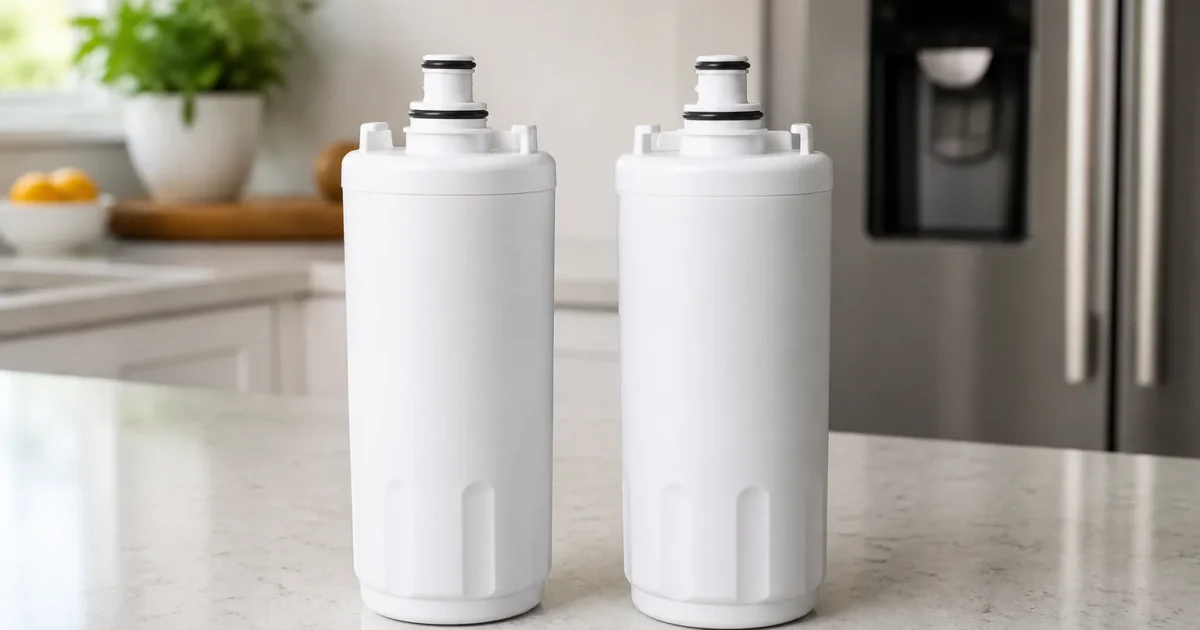
EveryDrop filter compatible alternatives exist for every common Whirlpool, Maytag, KitchenAid, and Amana fridge filter, but two questions decide whether one is worth buying: does it physically fit your refrigerator, and does it carry a real NSF certification at the claim level you actually need. Those are separate questions. A filter can fit perfectly and still be certified for almost nothing.
This guide maps the EveryDrop part numbers (EDR1 through EDR4, plus their longer Whirlpool numbers) to their common aftermarket equivalents, then shows you how to read an NSF listing so you can tell a serious filter from a sticker. The one rule before you buy anything: confirm the model printed on your current filter or in your owner’s manual first. One fridge line uses different filters across model years, so the cartridge that came with your refrigerator is the only reliable source of truth.
What “EveryDrop” Actually Is
EveryDrop is Whirlpool’s own filter brand. It is the factory-authorized replacement line for Whirlpool, Maytag, KitchenAid, Amana, and JennAir refrigerators. When Whirlpool simplified its catalog, it collapsed dozens of older filter part numbers into four “EDR” numbers, each of which still maps back to a longer original part number.
- EveryDrop Filter 1 =
EDR1RXD1, original partW10295370A(also sold asFilter 1). Fits many side-by-side Whirlpool and Maytag models. - EveryDrop Filter 2 =
EDR2RXD1, original partW10413645A(theFilter 2, formerlyW10186668). Fits many French-door Whirlpool, Maytag, and Amana models. - EveryDrop Filter 3 =
EDR3RXD1, original part4396841/4396710(theFilter 3). Fits older PUR-style push-button bottom-grille and some in-grille models. - EveryDrop Filter 4 =
EDR4RXD1, original part4396395/UKF8001(theFilter 4, the well-known MaytagUKF8001). Fits many Maytag and Amana bottom-freezer French-door models.
The longer numbers matter because aftermarket brands often list compatibility by the original part (W10295370A, UKF8001) rather than the newer EDR shorthand. If you only know one of the two, the other is printed on the filter housing or in the manual. You can confirm a match with the WaterByTheBook filter finder, but always check it against the printed model.
The “Fits But Is It Certified” Distinction
This is the heart of the matter, and it is where most buying decisions go wrong.
“Fits” means the cartridge has the correct cap geometry, length, and indexing tabs to seat and seal in your refrigerator’s filter head. A filter that fits will dispense water without leaking. That is all “fits” guarantees.
“Certified” means an independent body, almost always NSF International, has tested the filter against a specific NSF/ANSI standard and verified two things: that the filter does not add anything harmful to the water (material safety and structural integrity), and that it actually reduces the contaminants it claims to reduce. Those are different standards:
- NSF/ANSI 42 covers aesthetic effects: chlorine taste and odor, and particulates. Most aftermarket fridge filters carry an NSF 42 certification, and many carry only this one.
- NSF/ANSI 53 covers health-related contaminants: lead, cysts (like Cryptosporidium), certain VOCs, and others. This is the harder, more expensive certification, and far fewer aftermarket filters hold it.
- NSF/ANSI 401 covers “emerging contaminants” such as certain pharmaceuticals and pesticides. Rarer still.
Here is the trade-off, stated plainly: aftermarket EveryDrop alternatives are usually cheaper, sometimes dramatically so, but many of them are NSF 42 only. If your only concern is chlorine taste, an NSF 42 filter is genuinely fine. If you are buying a filter to reduce lead, an NSF 42 certification does nothing for you, no matter what the box implies. You need an NSF 53 lead claim, listed and verifiable. Genuine EveryDrop filters are certified to NSF 42, 53, and 401, per Whirlpool’s documentation, which is the baseline an aftermarket filter is asking you to give up or match.
How to Read an NSF Listing (So You Aren’t Fooled)
Marketing copy uses words that sound like certification but are not. “Tested to NSF standards,” “NSF-grade,” and “meets NSF 53” are not the same as certified by NSF and listed. The only claim that counts is one you can look up yourself.
NSF maintains a free, public database of every product it certifies. You search by brand or model and read exactly which standards and which specific claims are listed.
- Go to the NSF certified product listings for drinking water treatment units.
- Search the aftermarket brand name or the model number.
- Read the “Reduction Claims” column. A filter “certified to NSF/ANSI 53” might be listed only for cyst reduction, not lead. The standard number alone is not the claim; the specific contaminant is.
If a brand is not in the NSF database at all, it is not NSF certified, regardless of what the listing says. Some brands instead cite WQA (the Water Quality Association), which runs its own legitimate certification program under the same NSF/ANSI standards; a WQA Gold Seal is a real, verifiable certification. Be wary of any filter whose only “certification” is the manufacturer’s own lab, or a vague “tested by an independent third party” with no searchable record.
Which Aftermarket Brands Carry a Real Certification
Brand certification status changes over time and varies by specific model, so the durable advice is the method, not a frozen list: look up the exact model in the NSF or WQA database before you buy. That said, here is how the landscape generally breaks down.
A handful of aftermarket brands maintain genuine, searchable NSF or WQA certifications on at least some of their EveryDrop-compatible models, frequently to NSF 42 and 53 for chlorine, particulates, lead, and cysts. These are the ones worth paying a little more for if you want health claims.
Many more brands carry NSF 42 only. They will reliably improve taste and odor and reduce sediment. They are a reasonable budget choice if taste is your goal and you have confirmed your municipal water does not have a lead concern. Check your utility’s annual Consumer Confidence Report, which the EPA requires every community water system to publish, to see what is actually in your water – measured against the EPA’s national drinking water standards – before deciding which claim level you need.
And a large tail of generic, unbranded filters carry no verifiable certification at all. They may fit and dispense clear water, but you have no independent assurance of what they remove or whether their materials are safe in contact with drinking water. That is the category to avoid when health claims matter.
When an Aftermarket Filter Is the Right Call (and When It Isn’t)
Buy an NSF 42 aftermarket alternative when: your water is on a well-run municipal supply, your Consumer Confidence Report is clean for lead and your main goal is chlorine taste, and you want to cut per-filter cost. This is a legitimate, money-saving choice, and there is nothing second-rate about a properly certified NSF 42 filter for that job.
Insist on a genuine EveryDrop or an NSF 53-certified aftermarket filter when: anyone in the home is pregnant or there is an infant, your home has older plumbing or a lead service line, or your Consumer Confidence Report flags lead, cysts, or specific VOCs. Per the EPA, there is no safe level of lead exposure, so this is not a corner to cut to save a few dollars.
A separate note for GE owners who land here by mistake: GE’s RPWFE filter uses an RFID chip that the refrigerator reads, and many aftermarket RPWFE filters are rejected or require you to cover the sensor with a workaround. That RFID gate does not apply to the Whirlpool EveryDrop line, so EveryDrop alternatives do not have that specific problem, but it is a reminder that “compatible” is brand-specific.
If you are weighing a fridge filter against a whole-home or under-sink system for a real contaminant problem, the fridge filter is the wrong tool. A reverse-osmosis system removes far more, at the cost of water sent to drain; you can estimate that with the reverse osmosis cost calculator. And a fridge filter does nothing for hardness or scale; that is a softener’s job, which you can size with the water softener sizing calculator.
Are aftermarket EveryDrop-compatible filters safe?
A properly NSF- or WQA-certified aftermarket filter is safe for the claims it is certified for; the certification is the assurance of material safety and contaminant reduction. An uncertified generic filter may fit and produce clear water, but you have no independent verification of what it removes or whether its materials are safe in contact with drinking water. The safety question is really a certification question. Look the model up in the NSF or WQA database before buying.
Do aftermarket filters void my refrigerator warranty?
In the United States, the Magnuson-Moss Warranty Act generally prevents a manufacturer from voiding your warranty simply because you used a third-party filter, unless the manufacturer provides that filter free of charge. A manufacturer can, however, decline to cover damage that a defective aftermarket filter actually caused. A leak or contamination traced to a bad filter is a different matter from the warranty being “voided” outright.
What is the difference between NSF 42 and NSF 53?
NSF/ANSI 42 certifies aesthetic reduction: chlorine taste and odor, and particulates. NSF/ANSI 53 certifies health-related reduction: contaminants like lead, cysts, and certain VOCs. A filter can be certified to 42 only, to both, or, less commonly, to 401 for emerging contaminants as well. The standard number alone does not tell you which specific contaminants are covered; you have to read the listed reduction claims for that exact model.
How do I know which EveryDrop number my fridge needs?
Read the model printed on your current filter, or check your refrigerator’s owner’s manual. The EveryDrop numbers run EDR1RXD1 through EDR4RXD1, each mapping to a longer original part number such as W10295370A or UKF8001. One fridge line can use different filters across model years, so the cartridge in your fridge right now is the only reliable answer. You can cross-check a match with the filter finder.
Is the genuine EveryDrop filter worth the higher price?
It depends on what you need. Genuine EveryDrop filters are certified to NSF 42, 53, and 401, so you are paying for verified health-contaminant reduction and a guaranteed fit. If you only need chlorine-taste improvement and your water is clean for lead, a properly NSF 42-certified aftermarket filter can do that job for less. If you need lead or cyst reduction, buy either the genuine filter or an aftermarket one with a verifiable NSF 53 listing for that specific claim.
The Bottom Line
EveryDrop filter compatible alternatives are real and often worth buying, but “compatible” and “certified” are two separate promises. Confirm the model printed on your current filter first, match it to the right EDR number, then look the aftermarket candidate up in the NSF or WQA database and read the actual reduction claims, not the box. If the claim you need is lead reduction, accept nothing less than a listed NSF 53 lead certification. If you only need better-tasting water, a properly certified NSF 42 filter is an honest way to spend less.
Related guides
Midea Refrigerator Water Filter: MIWF6200 vs MIWF8200 vs MIWF8900
Midea currently sells three refrigerator water filters – MIWF6200, MIWF8200, and MIWF8900 – and mixing them up is…
Kenmore Refrigerator Water Filter: Cross-Reference by Model
Kenmore doesn’t build refrigerators. It’s a private-label brand, so your Kenmore refrigerator water filter is actually determined by…
Does a Refrigerator Filter Remove PFAS? What NSF P473 Actually Certifies
Does a refrigerator filter remove PFAS? Not in any certified sense we can find. We checked every refrigerator…