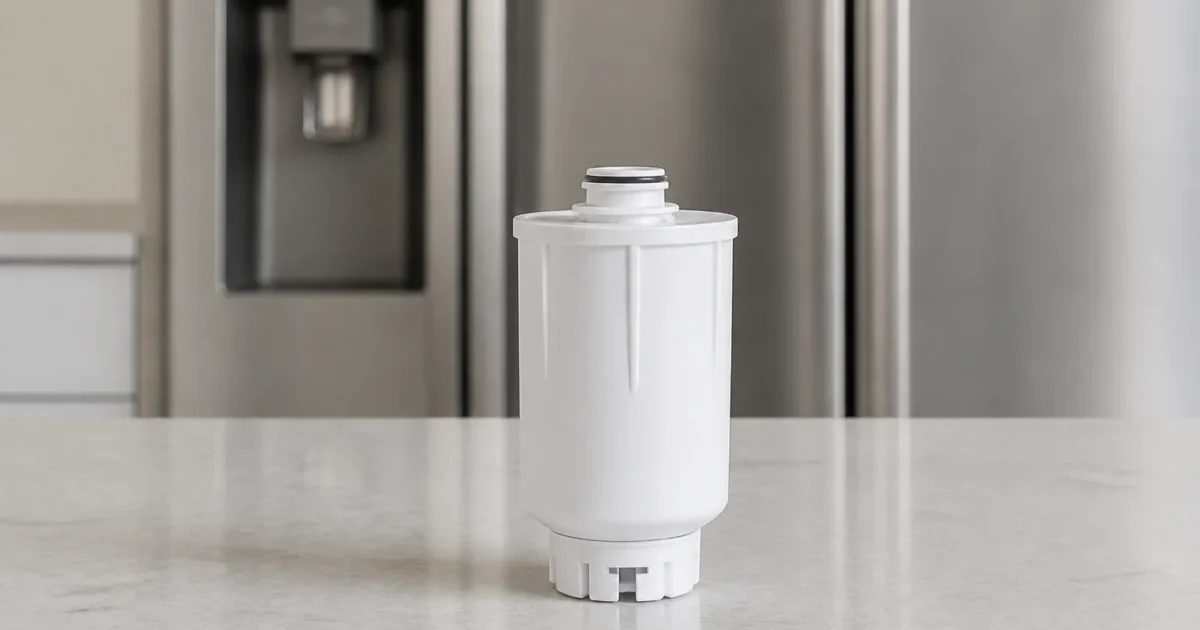
The GE refrigerator water filter RPWFE has a tiny RFID chip on its housing that your fridge reads. That chip is the whole story. It is why a RPWFE and a RPWF look almost identical but are not interchangeable, and it is why a wrong filter can make your dispenser flash Leak Detected and stop pouring water. This guide tells the three GE filter families apart – RPWFE, RPWF, and XWFE – so you buy the right one once.
Before anything else, one rule: confirm the model printed on your current filter or in your owner’s manual first. One GE fridge line uses different filters across model years, and a RPWFE and a RPWF housing can sit in the same-looking slot. The printed model number is the only source of truth.
The Short Answer: What the Chip Does
The RPWFE carries an RFID (radio-frequency identification) chip molded into the filter housing. Newer GE refrigerators read that chip to track filter life and, per GE, to “detect leaks and monitor the filter status.” The chip is small enough that you can see it through the filter’s wrapper.
Here is the part that catches people. GE states plainly that “the ID chip on the filter housing detects when a wrong or non-genuine GE Appliances part is used.” When the fridge does not get the chip handshake it expects, “the dispenser will not work and the display may read ‘Leak Detected’.” So that alarming message often is not a leak at all – it is the fridge rejecting the filter you installed. (GE Appliances: RPWFE Operation and Troubleshooting)
The RPWF, by contrast, has no chip. The XWFE has a chip but a different one. Mixing them up is the single most common GE filter mistake.
RPWFE vs RPWF: One Letter, One Chip
These two are the pair people confuse most, because the part numbers differ by a single E.
- RPWFE – has the RFID chip. Fits GE refrigerators built for chip communication (many GE Profile and French-door units, model prefixes like
GFE26,GNE29,GYE22, andGFD28). - RPWF – no chip. Fits the non-RFID version of the same housing.
The compatibility runs one direction with a catch. A RPWFE will physically seat in a RPWF-only fridge, but a RPWF will not satisfy a fridge that expects the chip – that fridge wants the handshake and will protest without it. GE sells these as distinct SKUs for exactly this reason. Always match the letter printed on your old filter.
If you are not sure which housing you have, GE’s own refrigerator filter finder cross-references by appliance model number, and our Which Filter Fits finder does the same lookup with the trade-offs spelled out.
XWFE and XWF: The Newer, Separate Family
The XWFE is a different lineage. GE introduced it in 2019, and on GE’s spec page it is described as replacing the older XWF filter – not the RPWFE. It also uses an RFID sensor “that can actually be seen through the wrapper on the filter,” reading filter status and remaining life. (GE Appliances: XWFE filter)
Two directional rules matter here, and GE states both:
- The
XWFEis backward compatible – it works in refrigerators originally designed for theXWF. - The
XWFis not forward compatible – an olderXWFwill not work in a newer fridge built for theXWFE, because those models are “designed to have the filter interact with the control panel.”
GE has also positioned the XWFE as an upgrade path for some RPWFE refrigerators, adding PFOA/PFOS reduction. In practice that swap is not universal: some RPWFE-era control boards do not recognize the XWFE chip pattern and the dispenser stays dark. Treat any RPWFE-to-XWFE substitution as “verify on your exact model first,” not a guarantee.
The Bypass Plug: A Legitimate Off-Ramp
If you would rather not buy a genuine GE filter, GE supplies an official answer: the filter bypass plug. Install it in place of a cartridge and, per GE, the display shows Unfiltered Water (or “Filter Bypass”) and water flows unfiltered. The plug carries its own RFID signature so the fridge stops nagging for a replacement. If your refrigerator did not come with one, GE will ship a bypass plug at no charge through its customer line. (GE Appliances: RPWFE Operation and Troubleshooting)
The honest trade-off: with the bypass plug installed, you are drinking unfiltered tap water. That is fine if your municipal supply already meets your taste and safety bar – you can check your annual water quality report, which the EPA explains here – and not fine if you bought the fridge specifically to reduce lead or chlorine taste. Bypass is a convenience tool, not a filtration strategy.
A note on the aftermarket “chip relocation” hacks you will find online (moving the RFID chip from a bypass plug onto the fridge’s sensor so cheaper third-party cartridges work): they exist, but the fridge then believes no filter is present and reports Unfiltered Water even while a third-party cartridge is doing the filtering. You lose the life-tracking and leak-detection the chip was there to provide. We are documenting that these methods exist; we are not recommending them.
Certifications: Read the Filter’s Actual Listing
Do not assume all four GE filter families clean the same water. Certification scope differs by SKU, and the two NSF/ANSI standards mean different things:
- NSF/ANSI 42 is aesthetic – chlorine taste and odor.
- NSF/ANSI 53 is health – lead, cysts, and similar contaminants.
GE markets the RPWFE and XWFE against NSF/ANSI 42, 53, and 401 (the 401 standard covers “emerging contaminants” such as certain pharmaceuticals), with the XWFE adding PFOA/PFOS reduction. The lower-tier legacy filters claim less: the GSWF is typically marketed to NSF/ANSI 42 only. Standards definitions are published by NSF.
Two cautions, both in keeping with how we do things here. First, manufacturer marketing is not the same as a third-party certified listing – before you trust a specific lead-reduction claim, look up the exact filter model in the official NSF certified products database and read what that SKU is actually listed for. Second, this matters most with aftermarket “compatible” filters: a generic cartridge that fits the RPWFE slot is not automatically NSF 53 certified for lead just because the GE original is. NSF 53 certification is SKU-specific. Verify the listing for the exact part you are about to buy.
The MWF, MSWF, and GSWF Legacy Lines
Older GE refrigerators use an entirely different housing shape and a different filter family. If your current cartridge is a stout cylinder rather than the slim RPWFE-style cassette, you are likely on one of these:
- MWF – the long-running GE/SmartWater filter for many side-by-side and French-door units; typically marketed against NSF/ANSI 42 and 53.
- MSWF – a separate cylindrical filter for select GE side-by-side models. It looks similar to the
MWFbut is not the same part. - GSWF – another legacy cylinder, generally a taste-and-odor (NSF/ANSI 42) class filter.
None of these carry an RFID chip, so you will not see Leak Detected from a filter mismatch on these older fridges – but you can still buy the wrong cylinder, since MWF, MSWF, and GSWF are not cross-compatible. Same rule applies: read the model on the old filter.
If a fridge filter is not actually solving your water problem – hard-water scale, whole-home chlorine, well-water sediment – a point-of-use cartridge may be the wrong tool entirely. Our reverse osmosis cost calculator and water softener sizing calculator help you compare what a whole-home approach would actually cost before you keep replacing $50 cassettes.
How to Identify Your Filter in 60 Seconds
- Pull your current filter (or open the manual). Read the model number printed on the label:
RPWFE,RPWF,XWFE,XWF,MWF,MSWF, orGSWF. - Look for the chip.
RPWFEandXWFEshow an RFID chip visible through the wrapper;RPWFdoes not. - Note the shape. Slim cassette = the
RPWFE/RPWF/XWFEera. Tall cylinder = theMWF/MSWF/GSWFera. - Match exactly, or confirm a substitution against your appliance model number using GE’s finder or our finder.
When in doubt, buy the model your old filter printed. The few dollars you might save guessing are not worth a dispenser that reads Leak Detected for a month.
Why does my GE fridge say “Leak Detected” after I changed the filter?
Most often the new filter is not the genuine part the fridge’s RFID system expects. GE states the chip “detects when a wrong or non-genuine GE Appliances part is used,” and when that happens “the dispenser will not work and the display may read ‘Leak Detected’.” Reinstall the correct RPWFE (or the official bypass plug) and the message typically clears. If it persists with a verified-genuine filter, then check for an actual water leak.
Can I use a RPWF filter in a RPWFE refrigerator?
Not reliably. The RPWFE housing has an RFID chip your fridge reads; the RPWF has no chip. A fridge built to expect the chip handshake may refuse the RPWF and stop dispensing. Match the exact model printed on your current filter.
Is the XWFE the same as the RPWFE?
No. GE’s own documentation lists the XWFE as the replacement for the XWF, not the RPWFE. Both XWFE and RPWFE use RFID chips, and GE has offered the XWFE as an upgrade for some RPWFE fridges – but compatibility is not universal, so verify against your specific appliance model before substituting.
Are aftermarket GE-compatible filters NSF certified for lead?
Only if that exact SKU is listed. NSF/ANSI 53 (the lead and cyst standard) is certified per product, not per fit. A generic cartridge that physically fits the RPWFE slot is not automatically certified just because the GE original is. Look up the precise model in the NSF certified products database before trusting any lead claim.
What if I don’t want to pay for genuine filters at all?
GE makes the filter bypass plug for exactly that. It seats where the cartridge goes, the display reads Unfiltered Water, and the fridge stops asking for a replacement. GE ships one free if yours is missing. The trade-off is real: you are then drinking unfiltered tap water, so weigh that against your local water quality.
WaterByTheBook is a reference, not a sales page. Always confirm the filter model printed on your current cartridge or in your owner’s manual before buying, and verify any health claim against the exact product’s NSF listing.
Related guides
Midea Refrigerator Water Filter: MIWF6200 vs MIWF8200 vs MIWF8900
Midea currently sells three refrigerator water filters – MIWF6200, MIWF8200, and MIWF8900 – and mixing them up is…
Kenmore Refrigerator Water Filter: Cross-Reference by Model
Kenmore doesn’t build refrigerators. It’s a private-label brand, so your Kenmore refrigerator water filter is actually determined by…
Does a Refrigerator Filter Remove PFAS? What NSF P473 Actually Certifies
Does a refrigerator filter remove PFAS? Not in any certified sense we can find. We checked every refrigerator…