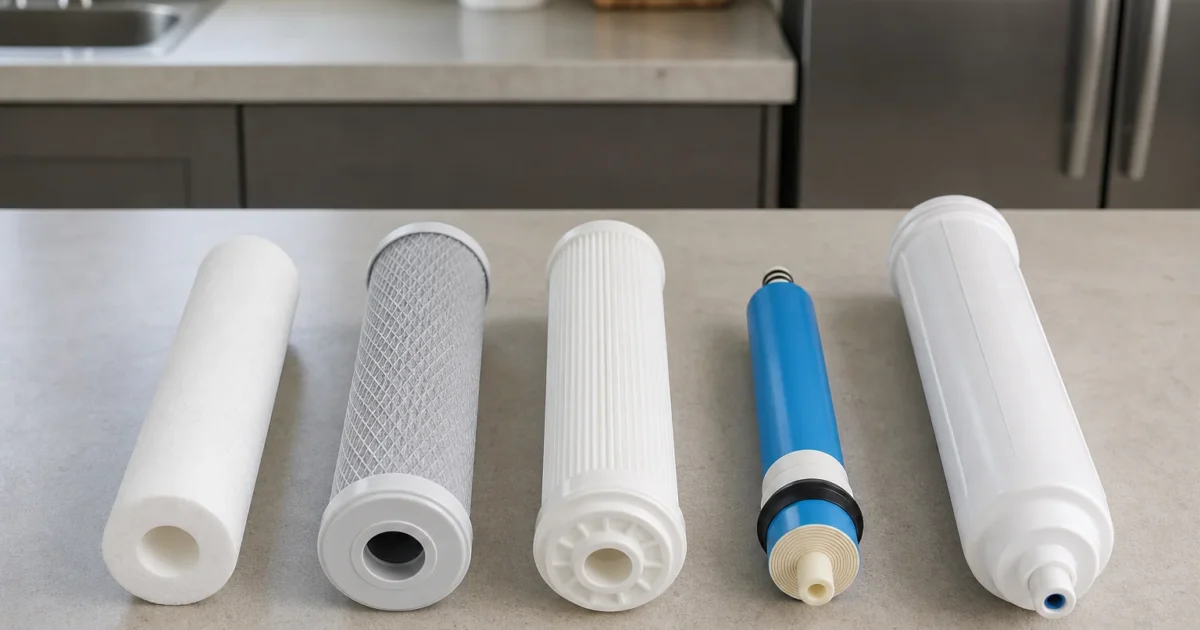
A reverse osmosis system is not one filter. It is a stack of three to five filters, each with its own job and its own clock. The single most common maintenance mistake is treating them as a set and swapping everything once a year. That either wastes money on stages that were fine or, worse, runs a stage past the point where it stops protecting the one expensive component in the system: the membrane.
So here is the short answer to how often to change reverse osmosis filters, by stage, before the why:
- Sediment pre-filter: every 6-12 months
- Carbon pre-filter: every 12 months (some systems combine sediment and carbon into one cartridge changed every 6-12 months)
- RO membrane: every 2-3 years
- Carbon post-filter (polishing filter): every 12 months
Those are starting points, not guarantees. Your real cadence depends on your water and how much you run. Below is what each stage does, what failing to change it actually causes, and how to set a schedule you will keep.
How Often to Change Reverse Osmosis Filters, Stage by Stage
A typical under-sink RO unit runs water through the stages in order: sediment, carbon, membrane, then a final carbon polish on the way to the faucet. Each upstream stage exists partly to protect the stage behind it. That is the key to the schedule. The cheap filters are sacrificial. They wear out on purpose so the membrane does not.
Sediment pre-filter (6-12 months). This is usually a 5-micron spun or pleated cartridge. It catches rust, sand, silt, and scale so they never reach the carbon or the membrane. If your municipal or well water carries visible particulate, or you are downstream of frequent main breaks, lean toward 6 months. On clean city water, 12 is realistic.
Carbon pre-filter (12 months). Activated carbon adsorbs chlorine and chloramine. This matters more than most owners realize: most RO membranes are thin-film composite (TFC), and free chlorine oxidizes and destroys a TFC membrane permanently. The carbon block is the membrane’s bodyguard. Run it dead and you are not just getting worse taste, you are exposing a $50-$90 membrane to the one chemical that kills it.
RO membrane (2-3 years). The semipermeable membrane is what actually removes dissolved contaminants. The EPA notes that point-of-use RO can reduce lead, VOCs, PFAS, arsenic, and more by forcing water through this membrane under pressure. Manufacturers commonly rate residential membranes for 2-3 years, sometimes up to 5 on gentle, well-protected water. It outlives the carbon stages precisely because those stages shield it.
Carbon post-filter (12 months). The final polish removes any residual taste from the storage tank before water reaches your faucet. It is inline and cheap. A neglected post-filter is the usual culprit behind “my RO water tastes flat or stale” even when everything upstream is fine.
Your water and usage shift all of these. Higher sediment, higher chlorine, hard water, or a large household pushes every interval shorter. Filter maintenance guides consistently land on the same 6-12 month pre-filter and 2-3 year membrane windows, with the caveat that water quality is the deciding variable.
If you want to see the dollars-per-year your specific stack costs at different replacement cadences, run your model and water profile through our reverse osmosis cost calculator. It is the honest way to decide whether a budget system with a cheap filter stack is actually cheaper over five years.
What Happens If You Skip a Filter Change
Skipping is not a soft failure. Each stage fails in its own specific, predictable way.
Skip the sediment filter and particulate loads up the carbon and membrane. Flow drops first. Then the trapped sediment can become a substrate for bacterial growth, and you are pushing grit toward a membrane that costs more than every pre-filter combined.
Skip the carbon pre-filter and this is the expensive one. Once the carbon is exhausted, chlorine passes straight through to the membrane. A TFC membrane has no chlorine tolerance to speak of, so the damage is cumulative and permanent. You will not see it as a leak. You will see it as rising total dissolved solids (TDS) in your output water months later, by which point the membrane is already degraded. A $15 carbon filter protects a $50-$90 membrane. The math is not close.
Skip the membrane change and contaminant rejection quietly declines. The membrane does not stop working all at once. It just removes less. This is why a cheap TDS meter is worth owning: rising output TDS is your early warning that the membrane is aging or has been chlorine-damaged.
Skip the post-filter and you get stale-tasting water and, over a long enough neglect, biofilm in the line between the tank and the faucet.
There is also a flow penalty that hits every clogged stage. RO is already water-intensive. The EPA reports that a typical point-of-use RO system sends five gallons or more down the drain for every gallon it produces, and WaterSense-labeled units must hold that to 2.3 gallons or less. Clogged pre-filters make the ratio worse, so neglect costs you in wasted water too, not just in parts.
Setting a Schedule You Will Actually Follow
Calendars beat guesswork. Most people overestimate how often they will remember and underestimate how their water changes seasonally. Three practical approaches:
-
Anchor to a date you already track. Tie pre-filter changes to a birthday or a season (“the first weekend of spring and fall”). A fixed twice-a-year ritual covers the 6-month pre-filter case for most homes.
-
Buy filters in a kit and stage them. Many systems sell an annual replacement kit that bundles the sediment, carbon pre, and post filters, with the membrane sold separately on its longer 2-3 year cycle. Buying the kit makes the annual change a single, undeniable task.
-
Measure, do not just count. A TDS meter (
$15-$20) reads your output water. If output TDS climbs noticeably above its baseline (which you should record the day you install a fresh membrane), the membrane stage is your signal regardless of the calendar. This is the single most useful upgrade to a maintenance routine.
One honest caveat on fit, the same rule we apply to every cartridge claim: confirm the model printed on your current filter or in the manual first before you order replacements. RO systems are not standardized the way a fridge filter line is. Cartridge length, end-cap style, and thread vary between brands and even across model years of the same brand. A filter that “looks the same” can leak or not seat. Match the part number, not the silhouette.
How Water Quality Changes Your Cadence
The schedule above assumes typical treated municipal water. Three conditions push every interval shorter.
High chlorine or chloramine. Heavily disinfected city water exhausts the carbon stage faster. If you taste or smell chlorine at your other taps, shorten the carbon pre-filter interval and consider it the limiting stage for membrane protection.
Hard water. High mineral content scales the membrane and shortens its life. Hardness is measured in grains per gallon (gpg); above roughly 7 gpg you are in hard-water territory and the membrane works harder. If you also run a softener, the membrane lasts longer because it sees softened water. Not sure of your hardness or softener size? Our water softener sizing calculator helps you reason about the upstream side.
Well water and high sediment. Private wells vary enormously. Sediment, iron, and bacteria all shorten pre-filter life, sometimes to a few months. Test first, then set intervals from the test, not from a generic chart.
The standard worth knowing is NSF/ANSI 58, the American National Standard for point-of-use RO systems. It is the one that covers the complete RO unit, including the membrane’s recovery rating and TDS-reduction performance. Note the difference between certifications: NSF/ANSI 42 covers aesthetic claims like taste and odor, while NSF/ANSI 53 covers health claims like lead and cyst reduction. If you bought your system for lead, the relevant claim is SKU-specific. Verify the exact system’s listing at info.nsf.org rather than trusting the box.
Not sure which replacement cartridges your system takes, or shopping a new unit? Start with our filter finder to match by model before you buy.
How often should I change all the filters in my reverse osmosis system?
Not all at once. Change sediment and carbon pre-filters every 6-12 months, the post-filter every 12 months, and the RO membrane every 2-3 years. The pre-filters are sacrificial and protect the longer-lived membrane, so they wear out faster by design. Shorten every interval if your water carries heavy sediment or chlorine.
How do I know when my RO membrane needs replacing?
Use a TDS meter. Record your output total dissolved solids reading the day you install a fresh membrane, then check it periodically. A meaningful rise above that baseline means the membrane is removing less and is your signal to replace it, independent of the calendar. A drop in water production or pressure can also point to an aging membrane.
Will skipping the carbon filter really ruin the membrane?
Yes, on most systems. Residential RO membranes are usually thin-film composite, which has essentially no tolerance for chlorine. The carbon pre-filter removes that chlorine. Once it is exhausted, chlorine reaches the membrane and degrades it permanently. A roughly $15 carbon filter is what protects a $50-$90 membrane, so the carbon stage is the one you least want to neglect.
Can I use generic replacement filters instead of the brand’s?
Often, but verify two things. First, confirm the model and dimensions printed on your current filter or in the manual; RO cartridges are not standardized across brands or even model years. Second, if you rely on a specific contaminant claim like lead reduction, that claim is SKU-specific. Check the exact filter’s listing at info.nsf.org before trusting it.
How much does a year of RO filter replacements cost?
For a typical under-sink system, budget roughly $40-$80 per year for the pre- and post-filters, plus the membrane amortized over its 2-3 year life (commonly $50-$90 each time). Your real number depends on your model and water. Run it through our reverse osmosis cost calculator for a figure specific to your system.
Related guides
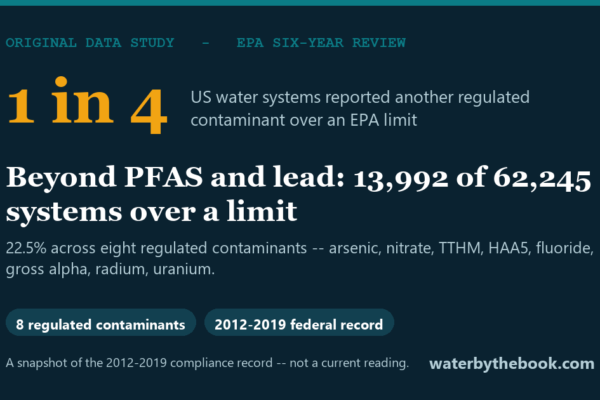
Beyond PFAS and Lead: About 1 in 4 US Systems Reported Another Contaminant Over a Limit
Correction (2026-06-29): a watchdog data-integrity audit corrected two things in the underlying data – the EPA Six-Year Review’s…
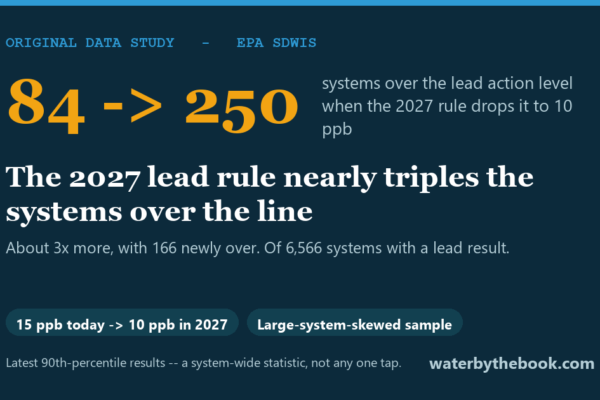
The 2027 EPA Lead Rule Nearly Triples the Water Systems Over the Line
Here is the honest national picture of lead in tap water, and it is not the one either…
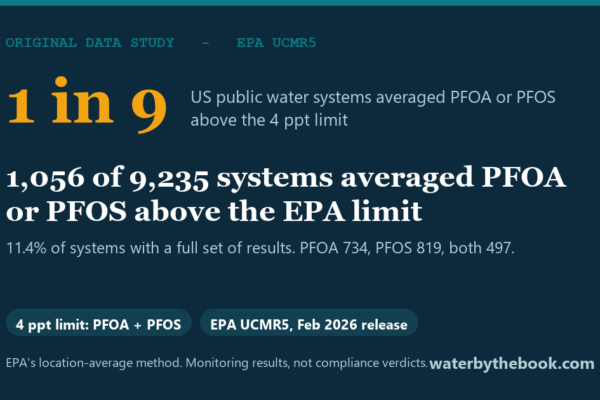
About 1 in 9 US Water Systems Averaged PFOA or PFOS Above the EPA Limit
About 1 in 9 US public water systems -- 1,056 of the 9,235 that reported a full set…