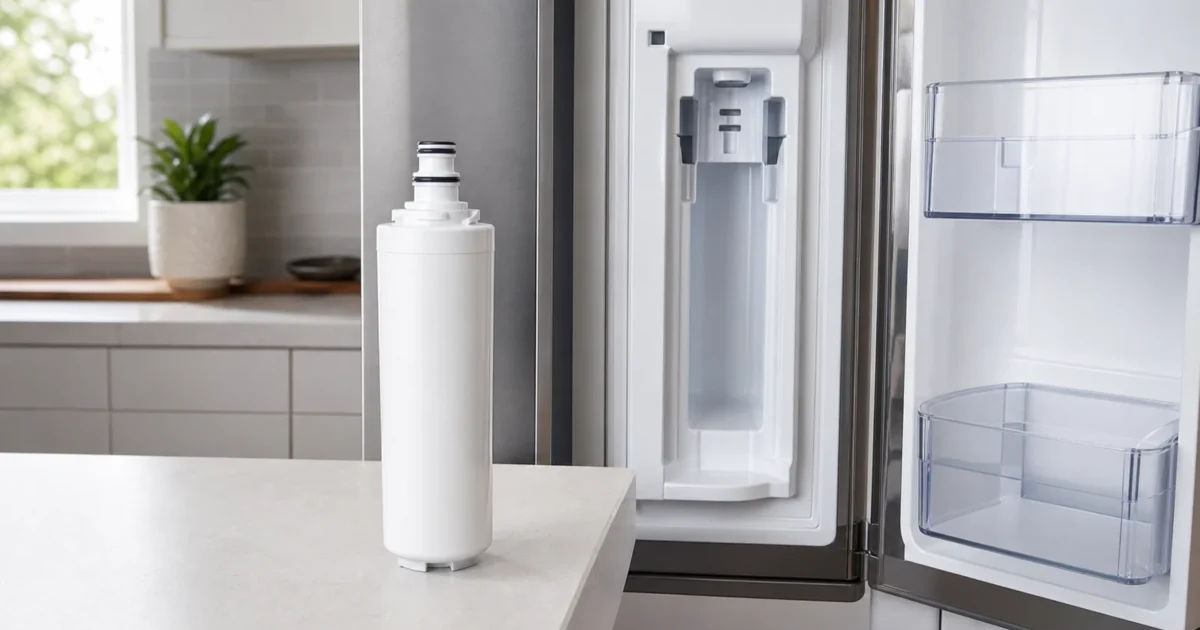
Finding the right refrigerator water filter by model starts with one number, not a guess. Every fridge filter carries a printed part number, and that number is the only reliable way to match a replacement. Brand name, fridge color, and “it looks the same” all fail often enough to waste a purchase. So before anything else: read the model printed on your current filter or in the manual first. One fridge line uses different filters across model years, and that single fact is responsible for most wrong orders.
This guide explains exactly where to read that number, walks through the five major OEM lines at a glance, and points you to a tool that matches your fridge for you.
Where to read your filter’s model number
You have three reliable places to look, in order of preference.
- The current filter itself. Pull it out. The part number is printed on the cartridge body or the cap end. It reads as a code like
W10295370A,LT1000P,DA29-00020B,RPWFE, orULTRAWF. Write it down exactly, including trailing letters. A trailingAorBcan mark a revision. - The filter housing or sticker. Look inside the fridge where the old filter seats. Many manufacturers print the compatible filter number on a sticker near the housing, the top-right of the fresh-food compartment, or the base grille.
- The owner’s manual or model plate. Find your refrigerator’s model number first (a sticker inside the fridge, on the door frame, or behind a crisper drawer), then look up the matching filter. The fridge model is the anchor; the filter follows from it.
If you only have the fridge model number and not the old filter, that is fine. Our refrigerator water filter finder takes a fridge model and returns the OEM filter plus verified-compatible alternatives, so you do not have to cross-reference spec sheets by hand.
The one rule worth repeating: confirm the model printed on your current filter or in the manual before you buy. Manufacturers re-spec the same fridge line across model years, and a filter that fit a 2016 unit may not fit the 2020 version of the “same” refrigerator.
The five major OEM lines at a glance
Most refrigerators sold in North America take a filter from one of five brand families. Here is how to recognize each and what it is certified to do.
Whirlpool / Maytag / KitchenAid: EveryDrop
Whirlpool’s filters are branded EveryDrop, and they are numbered EDR1RXD1 (Filter 1), EDR2RXD1 (Filter 2), EDR3RXD1 (Filter 3), and so on. The same Filter 1 also carries the legacy part number W10295370A. EveryDrop replaced older Whirlpool, Maytag, KitchenAid, and Kenmore filters, so a single EveryDrop number often covers several older codes. Whirlpool’s EveryDrop Filter 1 listing shows the cross-reference. The “1, 2, 3” numbering refers to the housing shape, not quality, so you must match the exact number your fridge takes.
LG: LT-series
LG’s current French-door filter is the LT1000P (OEM part ADQ74793501), and you will also see LT1000P2 and LT1000P3 multi-packs of the same cartridge. Older LG units use LT700P or LT800P. The LT1000P fits most LG French-door refrigerators from 2017 forward and is certified by NSF to standards 42, 53, and 401, per LG’s product page. Rated life is roughly 200 gallons or six months.
Samsung: DA29 / HAF series
Samsung’s most common cartridge is the DA29-00020B, also labeled HAF-CIN or HAF-CIN/EXP. It fits a wide range of Samsung French-door and side-by-side models. Samsung also uses DA29-00003G (HAF-CU1) on older lines and HAF-QIN on newer four-door Flex units, so the DA29 prefix alone is not enough; read the full number. The DA29-00020B is rated for six months or about 300 gallons.
GE: MWF, RPWF, RPWFE, XWFE
GE is the line that trips up the most buyers, because the numbers look alike but are not interchangeable. The common families are MWF, RPWF, RPWFE, and the newer XWFE. The catch: the RPWFE has an RFID chip in the cartridge that the refrigerator reads to confirm the filter. Per GE Appliances’ own support documentation, if the fridge does not detect a valid chip, the dispenser can stop working and the display may read “Leak Detected.” This is the honest trade-off with aftermarket GE filters: a cheaper non-OEM RPWFE filter only works if it includes a working RFID chip, and not all of them do. Confirm the listing explicitly states “RFID chip included” before you buy aftermarket for an RPWFE fridge. The plain RPWF (no E) has no chip and is more forgiving.
Frigidaire / Electrolux: PureSource
Frigidaire’s main cartridge is the ULTRAWF (PureSource Ultra). Older units use WF3CB (PureSource 3) or WF2CB (PureSource 2). The ULTRAWF is certified by NSF to standards 42, 53, and 401, uses a 0.5 micron carbon block, and is rated for six months or 200 gallons, per Frigidaire’s product page. The PureSource numbers are not cross-compatible with each other, so the “2 / 3 / Ultra” distinction matters.
What the NSF numbers on the box actually mean
Once you have the right model, the certification claims tell you what it removes. Three NSF/ANSI standards appear on most refrigerator filters, and they are not the same thing. NSF International, the independent body that tests and lists certified products, defines them in its filtration standards summary:
- NSF/ANSI 42 (aesthetic effects) covers taste, odor, chlorine, and particulates. It does not certify any health-contaminant removal.
- NSF/ANSI 53 (health effects) covers contaminants with a documented health risk, such as lead, cysts (Cryptosporidium, Giardia), asbestos, certain VOCs, and PFAS.
- NSF/ANSI 401 (emerging contaminants) covers substances not yet federally regulated, including trace pharmaceuticals, pesticides, and herbicides.
A filter certified to all three (42, 53, 401) is doing the most. A filter certified only to 42 is a taste-and-odor filter, which is fine if that is all you need but should not be sold to you as lead removal. You can verify any specific claim yourself by searching the manufacturer and model in NSF’s official certified-product listings. If a filter’s box prints “tested to NSF standards” but the model is not in that database, treat the claim as unverified.
For context on which contaminants actually matter for your home, the EPA’s drinking water resources explain what your utility already treats and what a point-of-use filter adds on top.
OEM versus aftermarket: the honest trade-off
Aftermarket filters are cheaper, often by half or more, and many are genuinely good. But “compatible” is a marketing word, not a certification. Two honest cautions:
- Check the certification, not just the fit. A filter that physically clicks into your housing may carry no NSF listing at all, or may be certified only to standard 42 while the OEM it replaces is certified to 42, 53, and 401. If you are filtering for lead or cysts, that gap matters. Look up the aftermarket model directly in the NSF database before trusting it.
- Watch the GE RFID case specifically. As noted above, an RPWFE-replacement without a working chip will disable your dispenser. This is the one line where “any compatible filter” advice is actively wrong.
A water filter is not a water softener and not a reverse-osmosis system. If your real problem is hard water scaling or heavy iron staining, a fridge filter will not fix it. Size a softener with our water softener sizing calculator, and if you are weighing a whole-home RO setup, the reverse osmosis cost calculator shows the running cost, including the water RO sends to drain.
How to confirm your exact match in two minutes
Put it together:
- Pull the current filter and read the printed number, or find your fridge’s model number in the manual.
- Enter it in the refrigerator water filter finder. It returns the OEM part plus compatible alternatives with their certification claims.
- Cross-check the certification claims that matter to you against the NSF certified-product database.
- Order the exact number. Do not substitute a near-match on the strength of the brand name alone.
That sequence costs a couple of minutes and saves the return shipping on a filter that does not fit.
How do I find my refrigerator water filter model number?
Pull your current filter and read the part number printed on the cartridge body or end cap, for example EDR1RXD1, LT1000P, DA29-00020B, RPWFE, or ULTRAWF. If you do not have the old filter, find your refrigerator’s model number on a sticker inside the fridge or on the door frame, then look up the matching filter. Always confirm the printed number before buying, because the same fridge line can use different filters across model years.
Are aftermarket refrigerator water filters safe to use?
Many are, but you have to verify the certification rather than assume it. A compatible filter that physically fits may be certified only to NSF/ANSI 42 (taste and odor) while the OEM it replaces is certified to 42, 53, and 401 (health and emerging contaminants). Look up the exact aftermarket model in NSF’s certified-product database before trusting any health claim. The one line to be especially careful with is GE RPWFE, which requires a working RFID chip.
Why won’t my GE refrigerator accept an aftermarket filter?
GE’s RPWFE cartridge contains an RFID chip that the refrigerator reads to confirm a valid filter. If the fridge cannot detect the chip, the dispenser can stop working and the display may show “Leak Detected,” per GE’s own documentation. Some aftermarket RPWFE filters include a working chip and some do not. Confirm the listing explicitly states “RFID chip included” before buying aftermarket for an RPWFE refrigerator.
How often should I replace my refrigerator water filter?
Most OEM cartridges are rated for six months or roughly 200 to 300 gallons, whichever comes first. LG’s LT1000P and Frigidaire’s ULTRAWF are both rated near 200 gallons or six months; Samsung’s DA29-00020B is rated near 300 gallons. If your water has high sediment, you may reach the gallon limit before the six-month mark, and flow will slow as the filter loads.
What do the NSF numbers on the filter box mean?
NSF/ANSI 42 certifies aesthetic reduction (taste, odor, chlorine, particulates) and does not cover health contaminants. NSF/ANSI 53 certifies health-related reduction such as lead, cysts, and certain VOCs and PFAS. NSF/ANSI 401 certifies reduction of emerging contaminants like trace pharmaceuticals and pesticides. A filter listed for all three does the most; one listed only for 42 is a taste filter, not a lead filter.
Related guides
Midea Refrigerator Water Filter: MIWF6200 vs MIWF8200 vs MIWF8900
Midea currently sells three refrigerator water filters – MIWF6200, MIWF8200, and MIWF8900 – and mixing them up is…
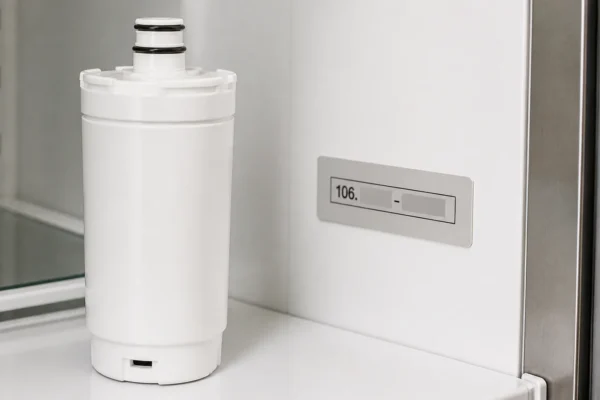
Kenmore Refrigerator Water Filter: Cross-Reference by Model
Kenmore doesn’t build refrigerators. It’s a private-label brand, so your Kenmore refrigerator water filter is actually determined by…
Does a Refrigerator Filter Remove PFAS? What NSF P473 Actually Certifies
Does a refrigerator filter remove PFAS? Not in any certified sense we can find. We checked every refrigerator…