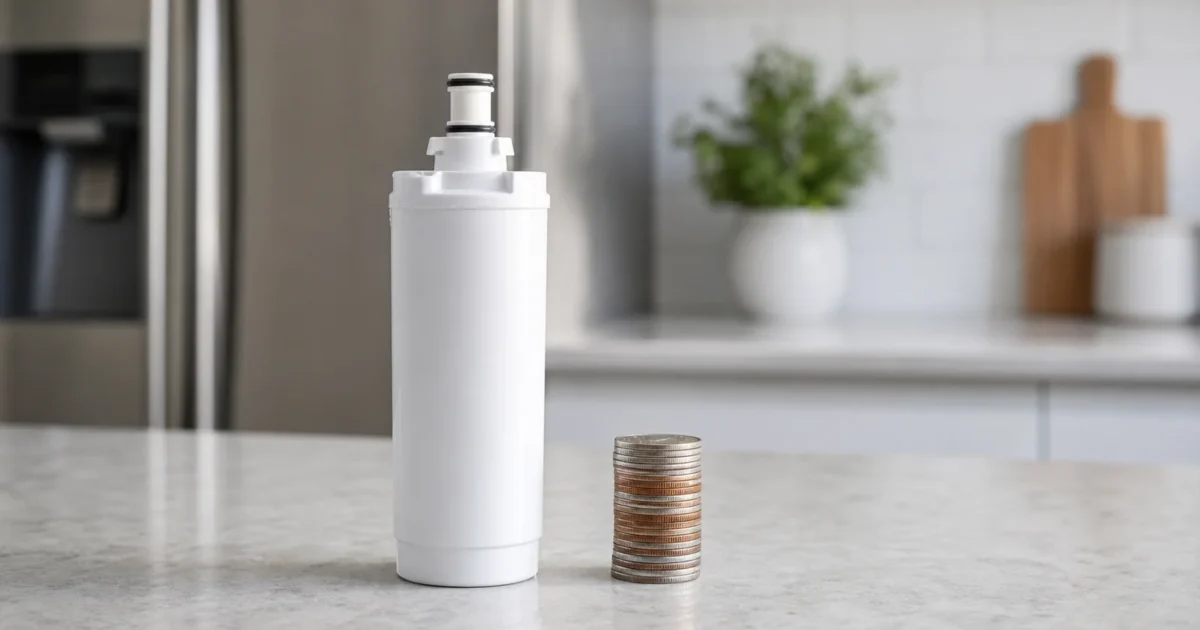
The honest refrigerator water filter replacement cost is $40-$55 for a genuine OEM cartridge and $15-$30 for a certified aftermarket one. Replace it about every six months. That puts your annual spend at roughly $80-$110 on OEM and $30-$60 on a certified aftermarket filter. The aftermarket option is cheaper, sometimes by half, but the saving only counts if the cartridge carries real NSF/ANSI certification and physically fits your fridge. This page lays out the actual numbers, the cadence, and the narrow set of cases where paying for OEM is the right call.
One rule sits above everything below. Confirm the model printed on your current filter or in the manual first. One fridge line uses different filters across model years, and a wrong cartridge either leaks, fits loose, or refuses to seat.
What you actually pay: OEM vs certified aftermarket
The two numbers people quote rarely match what you see at checkout, so here is the real spread.
A genuine EveryDrop Filter 1 (W10295370A / EDR1RXD1) retails around $49-$63 depending on the seller. The everydrop by Whirlpool listing is the OEM source; third-party appliance sellers price the same genuine cartridge anywhere from $49 to $63. A certified aftermarket equivalent, such as a Waterdrop EDR1RXD1 replacement, runs about $15-$18 per cartridge, often less in a three-pack.
As an Amazon Associate, WaterByTheBook earns from qualifying purchases. The Amazon link above is an affiliate link — it costs you nothing extra.
So the gap on this common filter is roughly $30-$45 per cartridge. That is the entire decision in one sentence: you are paying about an extra $30-$45 every six months for the OEM name and supply chain. Whether that is worth it depends on certification and fit, not on the brand printed on the box.
Two honest caveats on price. First, OEM cartridges occasionally go on genuine sale; if a real OEM filter drops under $35, the aftermarket advantage shrinks. Second, the cheapest aftermarket filters on the marketplace are not always certified. A $9 cartridge with no NSF listing is not a deal, it is an unknown.
The annual cost math, done plainly
Filters are a recurring cost, not a one-time purchase, so the number that matters is yearly, not per-cartridge.
At the standard six-month cadence you buy two cartridges a year. The arithmetic:
- OEM at $45-$55 each: about $90-$110 per year.
- Certified aftermarket at $15-$30 each: about $30-$60 per year.
Over the life of a refrigerator, say ten years, that difference compounds to roughly $600-$700. That is real money, and it is the strongest argument for certified aftermarket. It is also why the certification question is worth taking seriously: a cheaper filter that does not actually reduce what it claims is not saving you anything, it is just water through plastic.
If your household drinks heavily from the dispenser, the cadence can shorten and the annual figure rises proportionally. If you barely use it, the filter still ages on the calendar, not just on volume, because carbon media degrades and biofilm can develop over time.
Why six months, not “when it tastes funny”
The six-month cadence is the manufacturer standard, and it is built into how these cartridges are tested.
Most refrigerator filters use an activated carbon block rated for a fixed volume of water, commonly around 200 gallons, which maps to roughly six months of typical use. After that, the carbon’s capacity to adsorb chlorine, taste, and odor compounds falls off. The filter does not stop passing water; it stops doing the job it was certified to do. Taste is a lagging indicator, not a reliable one. By the time water tastes off, the media has usually been spent for a while.
There is a second reason to hold the cadence: a saturated carbon filter can become a place for bacteria to grow, which is the opposite of what you installed it for. Six months is the conservative, defensible interval. If your incoming water is sediment-heavy, sooner is reasonable. Later is a gamble.
When OEM is genuinely worth it (and when it is not)
Most of the time, a properly certified aftermarket filter is the rational choice. There are specific cases where OEM earns its premium.
OEM is worth it when your fridge uses RFID authentication. The clearest example is the GE RPWFE. Per GE Appliances’ RPWFE support documentation, this cartridge carries an RFID chip that the refrigerator reads to confirm the filter and to run leak detection. Install a cartridge without a compatible chip and the dispenser can refuse to run or throw a “Leak Detected” message. Some aftermarket RPWFE filters do include an RFID chip and work; many do not. If you go aftermarket on an RFID fridge, the listing must explicitly state the chip is included, and even then results vary. For an RFID-gated fridge, OEM is the low-friction path.
OEM is worth it when fit history has burned you. If a prior aftermarket cartridge leaked, seated loose, or dripped at the housing on your specific model, the OEM cartridge removes that variable. A slow drip behind the kickplate is not worth saving $35.
OEM is not worth it for the common, non-RFID filters where a certified aftermarket equivalent exists and fits. The EveryDrop Filter 1, most Samsung DA29 filters, and similar mainstream cartridges have certified aftermarket options that meet the same NSF standards for a fraction of the price. Paying OEM here buys you the brand, not better water.
How to read the certification before you buy
Price is easy. Certification is the part most people skip, and it is the part that actually determines whether the filter works.
Three NSF/ANSI standards matter for refrigerator filters, and they are not interchangeable. Per NSF’s own standards explainer:
- NSF/ANSI 42 covers aesthetic effects: chlorine, taste, and odor. Nearly every filter claims this.
- NSF/ANSI 53 covers health-related contaminants such as lead, certain VOCs, and cysts like Cryptosporidium and Giardia.
- NSF/ANSI 401 covers emerging contaminants, a set of up to 15 trace compounds including some pharmaceuticals and pesticides.
A filter “tested to” a standard is not the same as a filter certified to it. Certification means an accredited body verified the claim. You can confirm any model directly in the NSF certified product listings by searching the manufacturer or part number. If a cheap aftermarket cartridge does not appear there, treat its claims as unverified. For health-related reduction, the EPA’s guidance on home water filters is a useful sanity check on what a carbon filter can and cannot do.
The honest framing: NSF 42 is table stakes. If you specifically want lead or VOC reduction, you need 53, and you need it certified, on OEM and aftermarket alike. Do not assume the OEM filter covers 53 either; check the listing.
Confirm fit before you spend a dollar
The cheapest filter that does not fit is the most expensive one you will buy, because you pay for it twice.
The model number is printed on the current cartridge, behind the grille, inside the door, or in the manual. Match that exact number. The same fridge brand often runs several incompatible filter families across model years, which is why “it’s a Whirlpool” is not enough information. If you are unsure which cartridge your refrigerator takes, our Which Filter Fits finder walks the model number to the correct family so you do not guess.
If you are weighing whether a filtered fridge is even the right approach versus a point-of-use system, two calculators help size the alternatives honestly: the reverse osmosis cost calculator for under-sink RO economics, and the water softener sizing calculator if hardness, not contaminants, is your real complaint. A softener will not clean up taste or lead; a filter will not fix hard-water scale. Match the tool to the problem.
Is a certified aftermarket refrigerator water filter as good as OEM?
If it carries the same NSF/ANSI certifications (42, and 53 or 401 where you need them) and physically fits your model, it performs to the same verified standard for less money. The risk is buying an uncertified cheap filter or one that fits loosely. Confirm the NSF listing and the model match before you buy.
How much does a refrigerator water filter cost per year?
At the standard six-month replacement cadence you buy two cartridges a year. That is roughly $90-$110 annually for OEM and $30-$60 for certified aftermarket. Heavier dispenser use shortens the cadence and raises the figure.
Why do I have to use the genuine GE RPWFE filter?
The RPWFE carries an RFID chip the refrigerator reads for authentication and leak detection. A cartridge without a compatible chip can disable the dispenser or trigger a “Leak Detected” error. Some aftermarket RPWFE filters include a working chip; many do not, so read the listing carefully or use OEM.
Can I run the filter longer than six months to save money?
Not advisably. Carbon media is rated for a fixed volume, commonly around 200 gallons or about six months of typical use, after which it stops reducing what it was certified to reduce. A spent filter can also harbor bacteria. The savings from stretching it are not worth the loss of function.
How do I know which filter my refrigerator takes?
Read the model number printed on the current cartridge, behind the grille, or in the manual, and match it exactly. The same brand uses different filters across model years, so the brand name alone is not enough. The Which Filter Fits finder maps your model number to the correct cartridge family.
Related guides
Midea Refrigerator Water Filter: MIWF6200 vs MIWF8200 vs MIWF8900
Midea currently sells three refrigerator water filters – MIWF6200, MIWF8200, and MIWF8900 – and mixing them up is…
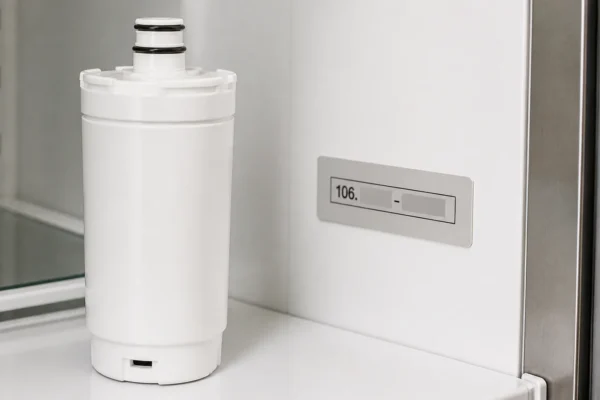
Kenmore Refrigerator Water Filter: Cross-Reference by Model
Kenmore doesn’t build refrigerators. It’s a private-label brand, so your Kenmore refrigerator water filter is actually determined by…
Does a Refrigerator Filter Remove PFAS? What NSF P473 Actually Certifies
Does a refrigerator filter remove PFAS? Not in any certified sense we can find. We checked every refrigerator…