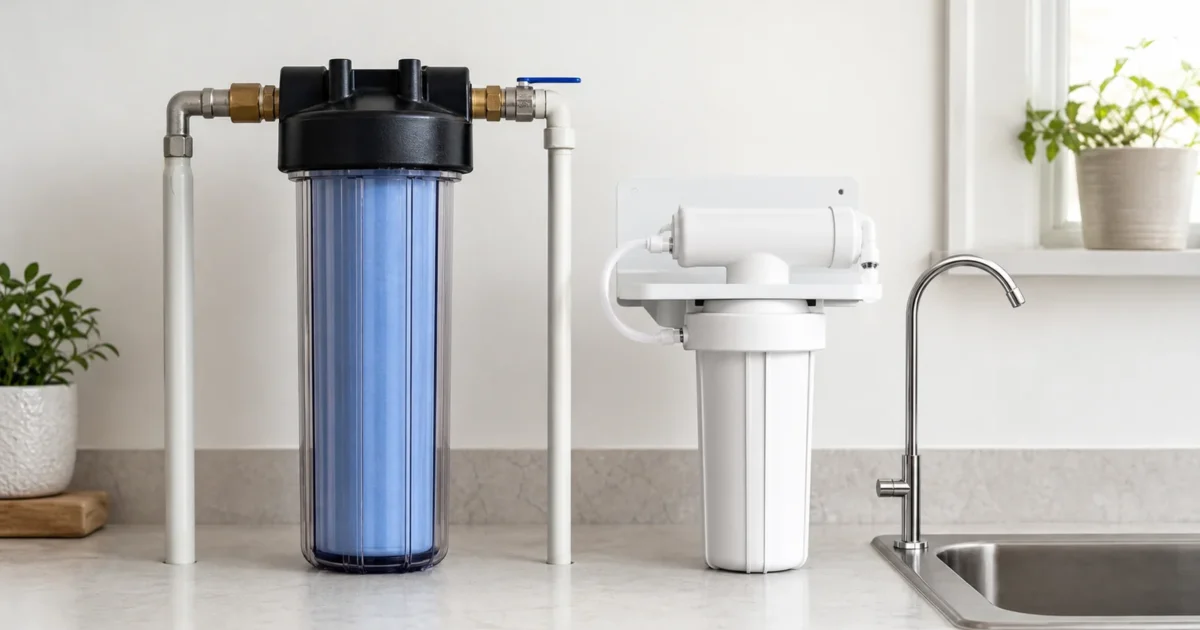
The short answer to whole house filter vs under sink RO: they solve different problems, and most homes that need one eventually want both. A whole house filter sits at your point of entry and treats every drop in the house – it is built for sediment, chlorine, taste, and odor. An under-sink reverse osmosis (RO) system sits at one faucet and strips out dissolved contaminants a whole-house carbon tank cannot touch: lead, PFAS, nitrate, arsenic, and total dissolved solids. One protects your plumbing and your shower; the other protects the glass of water you drink.
So this is not really a versus. It is a question of which job you are trying to do. Below is what each technology actually removes, what it does not, and how to pair them without overspending.
Point of Entry vs Point of Use: The Real Divide
The cleanest way to think about home water treatment is where it sits.
A whole house filter is point-of-entry (POE). It is plumbed into the main line, usually right after the meter or pressure tank, before the water splits to your fixtures. Everything downstream – kitchen, bathrooms, washer, water heater, hose bibs – gets the same treated water.
An under-sink RO system is point-of-use (POU). It treats water at a single tap, typically a dedicated faucet at the kitchen sink, and sends the rest of the house untreated water. It is small, it is slow, and it is precise.
The reason both exist is that no single technology does everything well at a sane cost. RO is the most thorough residential filtration available, but a whole-house RO system for a family is expensive, wasteful, and overkill for the water that flushes your toilet. Carbon and sediment media are cheap and high-flow, but they physically cannot remove dissolved solids. The split is not a marketing trick. It is physics and budget.
If you are unsure which contaminants you actually have, start with your water utility’s annual Consumer Confidence Report or a certified test before buying anything. Our which-filter-fits finder walks you from a contaminant to a filter class.
What a Whole House Filter Actually Solves
A standard whole-house system is a sediment stage plus an activated carbon stage, sometimes in one tank, sometimes two. Here is what that combination genuinely handles:
- Sediment – sand, rust, silt, and scale flakes, typically rated in microns (a
5 micronsediment filter is common;1 micronfor finer particulate). This is the stage that keeps grit out of your fixtures and appliances. - Chlorine and chloramine – activated carbon adsorbs the disinfectant your utility adds, which is the single biggest source of “city water” taste and smell.
- Taste and odor – including the sulfur “rotten egg” smell at low levels, and many volatile organic compounds (VOCs).
Carbon media certified to NSF/ANSI 42 covers aesthetic effects like chlorine, taste, and odor. Some carbon blocks also carry NSF/ANSI 53 for health-related contaminants such as lead and certain VOCs – but POE carbon at house flow rates rarely earns the full 53 lead claim, because contact time is too short. Confirm the specific certification on the spec sheet, not the marketing headline.
What a whole house carbon filter does not solve, on its own:
- Hardness. Carbon does not remove calcium and magnesium. Scale needs a water softener (ion exchange) or a template-assisted crystallization unit. If your water is hard, size the softener to your grains-per-gallon and household demand – our water softener sizing calculator does that math.
- Dissolved metals and chemicals. Lead, arsenic, nitrate, fluoride, and PFAS pass through standard carbon at house flow.
- Heavy iron. A softener helps with light iron, but a softener won’t fix heavy iron or sulfur alone – those need a dedicated oxidizing filter.
What Under-Sink RO Actually Solves
Reverse osmosis pushes water through a semipermeable membrane that rejects the overwhelming majority of dissolved solids. This is the technology you reach for when the problem is in solution, not suspended.
A residential RO system certified to NSF/ANSI 58 is tested to reduce:
- Lead – a primary reason households install RO, especially with older service lines.
- PFAS – the 2022 updates to NSF/ANSI 53 and 58 added broader PFAS reduction claims beyond just PFOA and PFOS. This matters now that the EPA’s 2024 PFAS National Primary Drinking Water Regulation set enforceable limits of
4 ppt(parts per trillion) for PFOA and PFOS individually. - Nitrate, arsenic, fluoride, and total dissolved solids (TDS) – the dissolved load that carbon cannot adsorb.
RO is thorough. It is also honest about its costs, and you should be too:
- RO wastes water to drain. Older systems sent 3-4 gallons to drain per gallon produced; modern systems with a permeate pump or zero-waste design do far better, but every RO system rejects some water. There is no waste-free membrane.
- It is slow. A typical under-sink unit is rated in gallons per day – a
50 GPDor75 GPDmembrane fills a small storage tank over time. It is not an instant high-flow source, which is exactly why you would not run your whole house on it. - It removes beneficial minerals too. The membrane does not distinguish. Some systems add a remineralization stage; whether you want one is a taste preference, not a health requirement.
Before you assume RO is the affordable answer, run the real numbers – membranes, pre/post filters, and the drain water add up. Our reverse osmosis cost calculator estimates the all-in annual cost so you compare like-for-like.
Side by Side: Which Solves What
| Problem | Whole House Filter | Under-Sink RO |
|---|---|---|
| Sediment / rust / silt | Yes | Yes (pre-filter) |
| Chlorine / chloramine taste | Yes (whole home) | Yes (one tap) |
| Hardness / scale | No (needs softener) | No |
| Lead | Limited | Yes (NSF/ANSI 58) |
| PFAS | No (standard carbon) | Yes (certified RO) |
| Nitrate / arsenic / TDS | No | Yes |
| Protects water heater + fixtures | Yes | No |
| Treats drinking + cooking water | Yes (untargeted) | Yes (targeted) |
Read this table as a division of labor, not a winner. The whole house unit protects the house. The RO unit protects the glass.
How to Pair Them Honestly
For many homes on municipal water, the most cost-effective setup is both, in sequence and at the right scale:
- A whole house sediment + carbon filter at the point of entry. It removes chlorine before it reaches your skin, hair, and laundry, and it protects every downstream filter – including the RO membrane – from chlorine damage and sediment fouling.
- An under-sink RO system at the kitchen tap for everything you drink and cook with. Let it do the precise, slow, thorough work on the small volume that actually goes into your body.
This pairing is efficient because the cheap, high-flow technology handles the bulk job and the expensive, slow technology handles only the gallons that need it. You are not paying to RO-treat your shower or your toilet.
Add a softener only if you have hardness, and size it correctly – an undersized softener regenerates constantly and wastes salt; an oversized one channels and wastes capacity. Hardness, iron, and sulfur are separate problems with separate hardware; do not expect one device to solve all three.
And the one rule we repeat on every fit claim: confirm the model printed on your current filter or in the manual first. One product line uses different cartridges across model years, and a spec that fits a 2019 unit may not fit a 2023 one. Read the part number, then buy.
Do I need both a whole house filter and an under-sink RO?
Not always. If your only concern is chlorine taste and sediment, a whole house carbon filter alone is enough. If your concern is lead, PFAS, nitrate, or other dissolved contaminants, you need RO at the tap regardless of what is upstream. Many homes benefit from both because they solve different problems – but buy for the contaminants you actually have, confirmed by a test or your utility’s report.
Can a whole house filter remove PFAS?
Standard whole-house sediment-and-carbon systems do not carry a certified PFAS reduction claim at house flow rates. PFAS removal requires a system certified to NSF/ANSI 53 or 58 for that specific contaminant – in practice, an under-sink RO unit or a dedicated certified carbon block at the point of use. The EPA’s list of filters certified to reduce PFAS is the place to verify a claim.
Why does reverse osmosis waste water?
The RO membrane separates clean “permeate” water from a concentrated “reject” stream that carries the rejected contaminants to the drain. Some waste is inherent to how the membrane works. Older systems wasted 3-4 gallons per gallon produced; newer permeate-pump and zero-waste designs reduce that substantially, but no residential RO system is truly waste-free. Factor the drain water into your cost comparison.
Will an under-sink RO system fix hard water in my whole house?
No. RO at the kitchen sink only treats that one tap, so it does nothing for scale in your water heater, showerheads, or dishwasher. Hardness is a whole-house problem that needs a point-of-entry softener sized to your grains-per-gallon and water use. RO and softening are complementary, not interchangeable.
Does RO remove the minerals I want in drinking water?
Yes, RO removes dissolved minerals along with the contaminants, because the membrane does not distinguish between them. The mineral content of drinking water is a minor part of a normal diet, so this is a taste preference rather than a health concern for most people. If you prefer the taste of mineralized water, choose a system with a remineralization post-filter.
The Bottom Line
Whole house filter vs under sink RO is the wrong frame if it makes you pick a side. The whole house filter is your point-of-entry workhorse for sediment, chlorine, and odor across every fixture. Under-sink RO is your point-of-use specialist for the dissolved contaminants – lead, PFAS, nitrate, TDS – that carbon cannot touch. Match the tool to the contaminant, confirm certifications on the spec sheet rather than the box, and size each stage to your actual water. Do that, and you spend money only where it changes the water you care about.
Related guides
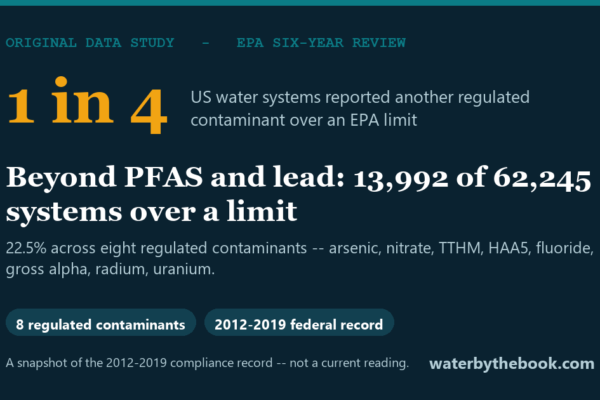
Beyond PFAS and Lead: About 1 in 4 US Systems Reported Another Contaminant Over a Limit
Correction (2026-06-29): a watchdog data-integrity audit corrected two things in the underlying data – the EPA Six-Year Review’s…
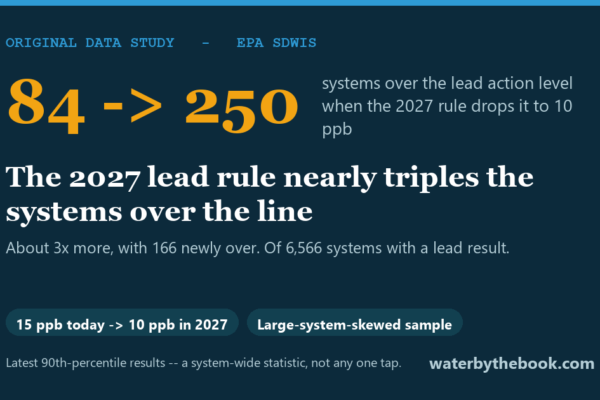
The 2027 EPA Lead Rule Nearly Triples the Water Systems Over the Line
Here is the honest national picture of lead in tap water, and it is not the one either…
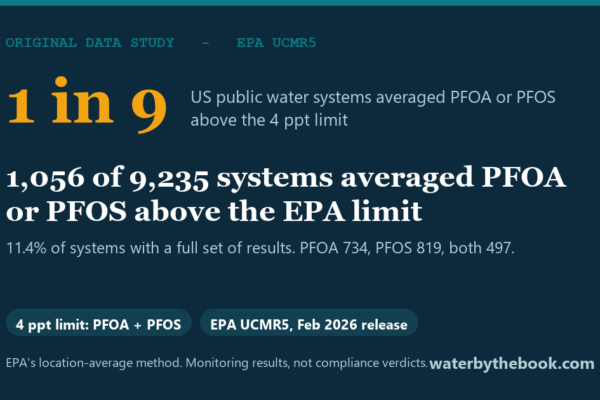
About 1 in 9 US Water Systems Averaged PFOA or PFOS Above the EPA Limit
About 1 in 9 US public water systems -- 1,056 of the 9,235 that reported a full set…