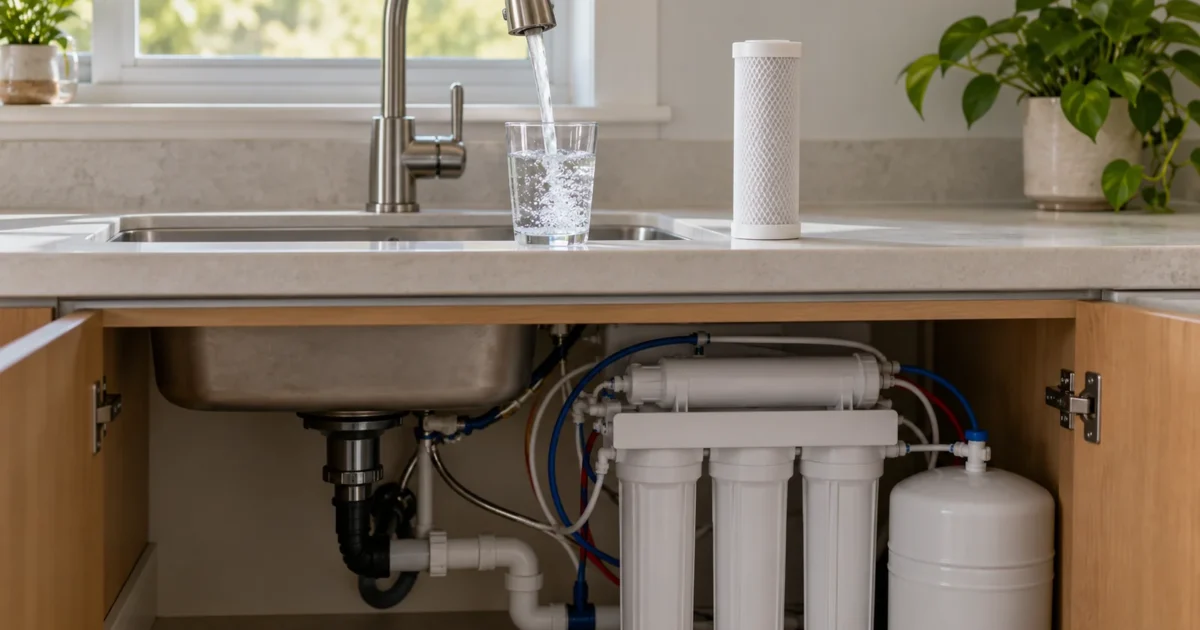
Fluoride is the one contaminant on this site that is genuinely contested, so we are going to do something different: lay out what each agency actually concludes and let you judge. There is an established dental benefit at the low fluoridation level (CDC), EPA limits that guard against harm at high levels, and developing research (NTP) about the in-between. The fix, if you want to remove it, is reverse osmosis or specialized media – not carbon. This guide is deliberately evenhanded; no fearmongering, no dismissiveness.
How to read this page: fluoride is both a public-health measure and a subject of active scientific and legal debate. We will attribute every claim to the agency that made it, separate what is established from what is developing, and not tell you what to conclude. The decision – including whether to filter it out – is yours.
What fluoride is
Fluoride is a naturally occurring ion present in most water at low levels, and it is also added by many U.S. communities (“community water fluoridation”) at a controlled low level to reduce tooth decay. So your tap fluoride may be natural, added, or both.
The health picture (each side, attributed)
The established dental benefit (CDC / U.S. Public Health Service). The CDC holds that fluoride at the recommended level reduces tooth decay by giving teeth frequent low-level contact with fluoride, and it counts community water fluoridation among the major public-health achievements of the 20th century. The U.S. Public Health Service recommended level for fluoridation is 0.7 mg/L. In fairness to both sides, the magnitude of that benefit is itself debated: a 2024 Cochrane review found the cavity-reduction effect of water fluoridation smaller in today’s era of widespread fluoride toothpaste than in the studies from earlier decades. (CDC: community water fluoridation)
The established high-exposure harms (EPA / ATSDR). At sustained high intake, fluoride causes skeletal fluorosis – a bone condition (denser bone, joint pain, reduced movement) that ATSDR calls “extremely rare in the United States” and associated with consuming many times the fluoridated level – and, during tooth formation, dental fluorosis (cosmetic discoloration or pitting). The EPA’s two limits below are set against exactly these.
The developing question (NTP 2024). In August 2024 the National Toxicology Program published a state-of-the-science review concluding, with “moderate confidence” (not high), that fluoride exposure above 1.5 mg/L in drinking water is associated with lower IQ in children. Two things the NTP itself stressed: the evidence came largely from higher-exposure populations outside the U.S., and there were insufficient data to determine whether the 0.7 mg/L U.S. fluoridation level affects IQ. (NTP: fluoride and neurodevelopment) It is a research review, not a regulatory limit.
The regulatory status. In its 2024 Six-Year Review, the EPA said the NTP’s final report would inform its future development of a health effects assessment for fluoride. (EPA: 2024 Six-Year Review) We state this as the current status, without predicting the outcome.
How fluoride gets into water
Two ways: naturally – the EPA frames its 2.0 mg/L secondary guideline around “areas which have high levels of naturally occurring fluoride” – and deliberately, where a utility adds it for dental health at the 0.7 mg/L target. Your Consumer Confidence Report says which applies to you and at what level.
What the EPA limits are
The EPA sets two numbers, both established in 1986:
- Primary MCL (enforceable) = 4.0 mg/L – health-based, to protect against skeletal fluorosis. The EPA reviewed and did not revise this enforceable limit in its 2024 (Fourth) Six-Year Review.
- Secondary standard (non-enforceable guideline) = 2.0 mg/L – to limit cosmetic dental fluorosis. As a secondary standard (SMCL), it is non-enforceable and is not part of the Six-Year Review, which covers primary standards only.
Neither is a running annual average; fluoride is a point-in-time concentration limit. (EPA: secondary drinking water standards) Note the recommended fluoridation level (0.7 mg/L) is far below the enforceable limit.
How to know what YOUR fluoride is
- Check your CCR and the level. Enter your ZIP in the water watchdog and read your annual Consumer Confidence Report – it states your fluoride level and whether your system fluoridates.
- On a private well? The EPA advises private well owners who think their well may be contaminated to have the water tested by a certified laboratory. It describes its secondary standards, including the 2.0 mg/L fluoride guideline, as guidelines to assist public water systems.
- Want to know whether your system fluoridates? The CDC’s My Water’s Fluoride site gives general information on fluoridated water systems in states that take part voluntarily; the CDC names your local water provider as the best source for your actual fluoride level.
How filtration helps (not carbon)
If you decide to reduce fluoride, the common filters do not do it:
- Reverse osmosis (NSF/ANSI 58) – the most common point-of-use fix, typically removing most fluoride; look for a specific fluoride-reduction claim.
- Activated alumina – a specialized adsorption media for fluoride (works best in slightly acidic water).
- Anion exchange and distillation – also effective.
- Does NOT work: standard activated carbon – a plain carbon pitcher or fridge filter improves taste but removes little to no fluoride.
Use the Which Filter Fits finder for a system that fits your setup, and the Filter Certification Registry to confirm a specific fluoride reduction listing.
Related guides
- Arsenic in drinking water – another contaminant that needs RO or specialized media, not carbon.
- Nitrate in drinking water – the same RO/ion-exchange answer for a different contaminant.
- Reverse Osmosis & Drinking Water – the system that reduces fluoride along with the rest.
What are the EPA limits for fluoride in drinking water?
An enforceable primary MCL of 4.0 mg/L (skeletal fluorosis) and a non-enforceable secondary guideline of 2.0 mg/L (dental fluorosis). The EPA reviewed and kept the primary 4.0 mg/L limit in its 2024 Six-Year Review (secondary standards are not part of that review). The recommended fluoridation level is 0.7 mg/L.
Does a carbon filter remove fluoride?
No – standard carbon does not. Use reverse osmosis (NSF/ANSI 58), activated alumina, anion exchange, or distillation.
Is fluoride in tap water safe?
It is contested. The CDC holds fluoridation at 0.7 mg/L reduces tooth decay; the EPA limits guard against fluorosis at higher levels; a 2024 NTP review found a moderate-confidence association between fluoride above 1.5 mg/L and lower childhood IQ, mostly from higher-exposure populations, with insufficient data on 0.7 mg/L. It is under active review and litigation – we present the agencies’ findings and leave the decision to you.
Sources
Related guides
Radium and Uranium in Drinking Water: Gross Alpha, Limits and Filters
Radium and uranium in drinking water, along with gross alpha activity, are the naturally radioactive side of your…
Disinfection Byproducts in Drinking Water (TTHM & HAA5): The Limits and the Tradeoff
Disinfection byproducts in drinking water are the trade you make for safe water. Utilities add chlorine or chloramine…
Arsenic in Drinking Water: The Limit, the Risk, and the Right Filter
Arsenic in drinking water is the contaminant you cannot see, taste, or smell, and the one most people…