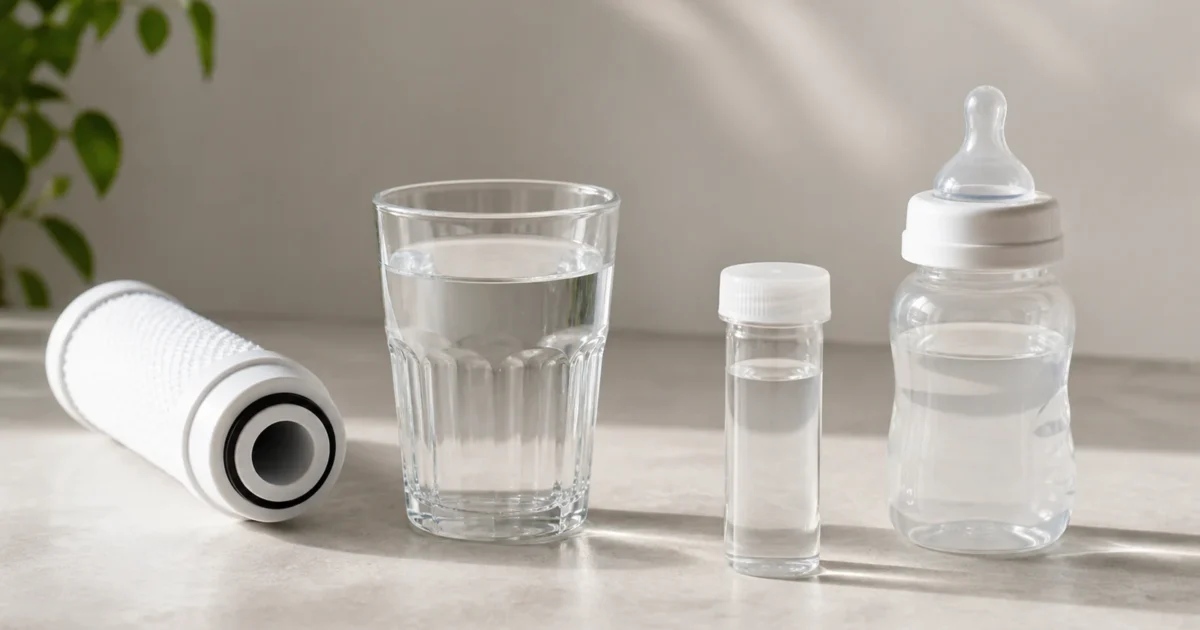
Nitrate in drinking water is one of the few contaminant stories with a genuine emergency dimension. For most water problems, “test it and plan a fix” is the right first move. For a household with an infant under six months, water above the EPA’s nitrate limit is a reason to switch to a safe source today, not after a lab report comes back. The U.S. EPA’s enforceable limit is 10 mg/L for nitrate measured as nitrogen, 1 mg/L for nitrite as nitrogen, and 10 mg/L for the two combined – and that limit exists almost entirely because of what nitrate can do to infants, not because of a vague “chemical in the water” worry.
This guide covers what the EPA limit actually means (and who it does and doesn’t cover), who’s genuinely at risk and what to do right now if you think your water is affected, where nitrate comes from and why private wells in farm country carry the most risk, the two things people wrongly assume remove nitrate, and the certified, verifiable methods that actually do.
Nitrate in Drinking Water: What Is the EPA Limit, and Why Does It Exist?
EPA’s National Primary Drinking Water Regulations set the Maximum Contaminant Level for nitrate at 10 mg/L measured as nitrogen, for nitrite at 1 mg/L as nitrogen, and for the two combined at 10 mg/L as nitrogen. That “as nitrogen” qualifier isn’t editorial fine print – it changes the number. ATSDR explains that 10 mg/L of nitrate-nitrogen is roughly the same as 44 mg/L measured as nitrate ion, and 1 mg/L of nitrite-nitrogen is roughly 3.3 mg/L as nitrite ion. Before you compare a lab result to the EPA limit, check whether your report says “nitrate as N,” “nitrate-nitrogen,” “NO3-N,” or “nitrate as NO3” – a “10” on the wrong basis is not the same “10.”
The limit is built around one specific, well-documented risk: infant methemoglobinemia, commonly called blue-baby syndrome. EPA states that infants below the age of six months who drink water containing nitrate in excess of the MCL “could become seriously ill and, if untreated, may die,” with symptoms including shortness of breath and blue-baby syndrome. In plain terms, the body can convert nitrate to nitrite, and nitrite interferes with blood’s ability to carry oxygen – an infant’s system handles that conversion less safely than an older child’s or adult’s. That’s the reason this contaminant is regulated, and it’s worth stating directly without dressing it up.
One limit that catches people off guard: EPA’s rule applies to public water systems, not to privately owned wells. If you’re on a private well, testing, interpreting your results, and arranging treatment or an alternate source are entirely on you – no agency is checking your water against this number for you.
Who’s Most at Risk, and What to Do Right Now
Infants under six months are the central at-risk group, and the guidance here is unambiguous: if your water tests above 10 mg/L nitrate as nitrogen, don’t use it for infant formula or infant food. That’s not an overreaction to a borderline number – it’s the specific scenario the EPA limit was set to prevent.
Pregnant people are a second group worth extra caution, though the evidence base is thinner than for infants and worth describing honestly. ATSDR’s toxicological profile identifies young bottle-fed infants as the primary susceptible subpopulation and does not classify pregnancy itself as an unusual susceptibility; it reviews case-control studies of prenatal nitrate exposure and birth defects without drawing a firm conclusion. State guidance is nonetheless cautious and specific: Wisconsin advises that people who are or may become pregnant immediately use a different drinking-water source once nitrate reaches 10 mg/L nitrate-nitrogen on a private well. Wisconsin’s guidance goes further on the practical side: use a different source for water-absorbing foods too, including rice, oatmeal, and gelatin, since those pull nitrate-contaminated water into the food itself.
The sequencing matters here, and it’s easy to get backwards. For routine well management, testing before buying anything is the right order – don’t spend money on treatment before you know what you’re treating for. But if there’s an infant in the house, someone is pregnant, or a result has already come back above 10 mg/L, that order flips: switch to bottled water or another verified-safe source now, and confirm with a certified lab next. EPA’s own guidance for water already known to exceed the MCL leads with finding a safe alternate supply – bottled water as the fastest option – before working through longer-term treatment.
One piece of reassurance in the middle of this: nitrate-affected water isn’t an all-or-nothing problem. Wisconsin’s health department is explicit that water above the nitrate action level can generally still be used for bathing, brushing teeth, and washing dishes. The restriction is specifically about drinking, cooking, and infant formula – not the whole household water supply.
Where Nitrate Comes From, and Who’s Most Exposed
Nitrate in drinking water mainly traces back to fertilizer runoff, septic systems, sewage, animal waste, and natural decaying organic material – and it’s not exclusively a farm-country or well-water problem, even though that’s where it shows up most often. USGS research describes nitrate contamination as a continuing concern for shallow domestic wells in agricultural regions, capable of persisting in groundwater for years or even decades once it’s there.
That agricultural/private-well pattern is the right starting point, but it isn’t the whole picture. Septic systems, seasonal shifts, and flooding all move nitrate levels too. EPA advises testing well water between April and July, noting that nitrate and nitrite levels are typically highest in those months, and to test wells again after flooding – both are useful triggers for scheduling a retest even if your last result looked fine.
The public-versus-private distinction is the one to keep straight. Public water systems are monitored and regulated under EPA rules, and if you’re a public-water customer, your utility’s Consumer Confidence Report is the place to start – our guide to reading a CCR walks through what that report does and doesn’t tell you. Private wells get none of that oversight; testing, interpreting the result, and deciding what to do about it fall entirely on the well owner.
Testing First: Cost, Frequency, and When to Retest
CDC recommends that private well owners test at least annually for total coliform bacteria, nitrate, total dissolved solids, and pH, using a state-certified laboratory – not a consumer TDS meter, which won’t tell you anything about nitrate specifically. Cost is genuinely not the barrier here: Washington State cites $25 to $50 at many certified labs for a nitrate test, and Dubuque County lists its nitrate test at $30, with some county programs offering free testing to eligible private-well owners. Mail-in consumer nitrate/nitrite kits run higher, commonly $79 to $115 in the examples available – convenient, but pricier than a certified lab for the same information.
Beyond the annual baseline, a few things should push you to retest sooner: recent flooding, the seasonal April-through-July peak, a new baby or a pregnancy in the household, or a result already close to the 10 mg/L limit. Washington’s guidance specifically suggests resampling within six months if a private-well result comes back at 5 mg/L or higher – treat that as an early-warning threshold, not just “fine because it’s under 10.”
If nitrate keeps coming back elevated, don’t assume a filter is automatically the answer. Minnesota’s Department of Agriculture recommends looking into well age, construction, and depth – shallow or sand-point wells are more exposed to surface-level contamination – before settling on treatment as the only fix. Professional opinions genuinely vary on the best long-term solution here: certified treatment, repairing or deepening the well, or drilling a new well can all be the right call depending on your specific water chemistry and well conditions, so this is a case where local expertise is worth the conversation.
One wording note if you’re looking at your utility’s public reporting rather than a private-well result: EPA’s compliance data (through its ECHO database) is state-reported and can lag real conditions, so “reported above the EPA limit” is the accurate phrase – “in violation” should be reserved for cases where a source specifically documents a legal violation.
What Doesn’t Remove Nitrate (the Common Mistakes)
Two habits people reach for instinctively both fail against nitrate in drinking water, and it’s worth being direct about both.
Boiling does not remove nitrate – and it can make the concentration worse. EPA’s own guidance is blunt on this point: as water boils and evaporates, the nitrate that was dissolved in it stays behind, so a boiled glass of contaminated water can have more nitrate per liter than it started with. That doesn’t mean “never boil well water” – boiling is still the right response to a bacterial or microbial contamination advisory. It just means boiling is not a nitrate fix, and treating it as one makes things worse, not better.
Standard activated carbon filters – including pitcher-style filters like Brita – do not remove nitrate either. EPA states plainly that carbon filters don’t remove nitrates, and Connecticut’s health department says granular activated carbon isn’t considered an effective nitrate treatment. Carbon filtration is genuinely useful for taste, odor, chlorine, and some organic chemicals – it’s just not doing anything for nitrate, no matter how good the pitcher looks on your counter.
Water softeners deserve a careful, non-absolute statement here. A standard cation-exchange softener built for hardness is not nitrate treatment – but that’s different from saying no softener-type system can ever address nitrate. CDC notes that some products, if specifically designed and labeled for it, can remove nitrate alongside hardness; the distinction is a dedicated anion-exchange process, not the calcium-and-magnesium swap an ordinary softener performs. Don’t assume your whole-house softener is doing double duty on nitrate unless the exact system is certified or verified for that claim.
One more mistake specific to anion-exchange systems: running the resin bed past its rated capacity doesn’t just stop working, it can actively dump previously captured nitrate back into your treated water. That’s the reason “install it and forget it” doesn’t work for nitrate treatment – more on maintenance below.
What Actually Removes Nitrate From Drinking Water
Three certified approaches genuinely reduce nitrate in drinking water, and in each case, the exact product’s documentation matters more than the category name.
Reverse osmosis can reduce nitrate, but “RO” by itself isn’t the claim you need. NSF/ANSI 58 covers point-of-use RO systems, and nitrate/nitrite reduction is an optional claim under that standard – plenty of NSF/ANSI 58-certified units carry no nitrate claim at all. Retailer listings often blur this: some product pages emphasize a system’s TDS reduction certification without making clear whether nitrate/nitrite is separately certified for that model. The reliable check is which NSF standard actually removes what, followed by confirming your exact model and finish variant in our filter certification registry rather than trusting a category label or a retailer’s paraphrase. For more on how RO systems work and where they fit, our reverse osmosis guide covers the tradeoffs in more depth.
Distillation removes nitrate too. CDC lists nitrate among the contaminants a distiller addresses, since the process boils water and collects the condensed vapor while nitrate and other dissolved substances stay behind in the boiling chamber. It’s effective, but slower and more energy-intensive than most home RO setups.
Anion exchange – a nitrate-specific process, not the same as a hardness softener – can also reduce nitrate when it’s properly designed, sized, and maintained. It works by swapping nitrate for chloride on a resin bed, but competing ions like sulfate can crowd out that exchange, and the resin needs regeneration on a schedule. This is where the “dumping” risk from the section above becomes relevant: a bed run past its capacity releases nitrate rather than continuing to hold it.
Whichever method you install, test the treated water afterward – collect before-and-after samples to confirm the system is actually performing, not just assume the label guarantees it. As a rough cost reference (verify current pricing before budgeting), a typical under-sink RO system runs about $150 to $400 for the unit, with whole-house and high-output models going higher, and roughly $50 to $120 a year in replacement filters and membranes – see our full RO cost breakdown.
What to Do Next
If your well shows elevated nitrate in drinking water, it’s worth checking for other well-water issues at the same time, since co-contaminants change which treatment makes sense – our iron-in-well-water guide is a good companion read if you’re also dealing with staining or odor. And before you buy any RO or anion-exchange system specifically for nitrate, confirm the certified claim on the exact model through our filter certification registry rather than relying on the box copy.
Does the EPA’s nitrate limit apply to my private well?
No. The EPA’s 10 mg/L nitrate-as-nitrogen limit is an enforceable standard for public water systems. Private wells aren’t covered by that rule – testing, interpreting results, and arranging treatment are the well owner’s responsibility.
Can boiling remove nitrate from drinking water?
No, and it can make it worse. Boiling doesn’t remove nitrate, and as water evaporates during boiling, the nitrate left behind becomes more concentrated. Boiling is still appropriate for a bacterial or microbial water advisory – just not for nitrate.
Will a standard pitcher or refrigerator filter remove nitrate?
No. Standard activated carbon filters, including pitcher-style filters, are not certified to remove nitrate. They can help with taste, odor, and chlorine, but nitrate passes right through them.
Is nitrate in drinking water dangerous for infants?
Yes, specifically for infants under six months. Water above the EPA’s 10 mg/L limit shouldn’t be used for infant formula or infant food, because of the risk of infant methemoglobinemia, or blue-baby syndrome.
Does reverse osmosis remove nitrate from drinking water?
It can, but only if the exact model carries a nitrate/nitrite reduction claim. NSF/ANSI 58 covers point-of-use RO systems, but that certification alone doesn’t guarantee a nitrate claim – check the specific model’s certified listing before assuming it works.
How much does it cost to test drinking water for nitrate?
Not much. Many certified labs charge $25 to $50 per nitrate test, with some county programs offering free testing to eligible private-well owners. Mail-in consumer kits typically cost more, often $79 to $115.
Sources
- EPA: National Primary Drinking Water Regulations
- EPA: Nitrate/Nitrite Technical Fact Sheet
- ATSDR/NCBI: Toxicological Profile for Nitrate and Nitrite
- EPA: Private Wells and Drinking Water Safety for Infants
- EPA: What to Do If Your Water Has Elevated Nitrates
- Wisconsin DHS: Nitrate in Private Wells
- USGS: Nitrate in Groundwater
- EPA: Estimated Nitrate Concentrations in Groundwater Used for Drinking
- Washington DOH: Nitrate
- CDC: Guidelines for Testing Well Water
- Minnesota Department of Agriculture: Nitrate Water Testing
- EPA: Will Boiling My Water Help? (Nitrate FAQ)
- EPA: I Use a Carbon Filter, Will It Help? (Nitrate FAQ)
- Connecticut DPH: Granular Activated Carbon Treatment
- CDC: About Home Water Treatment Systems
- NSF/ANSI 58: Reverse Osmosis Drinking Water Treatment Systems
- NSF: Official Nitrate/Nitrite Product Listings
- Penn State Extension: Nitrates in Drinking Water
- EPA: Nitrate Ion-Exchange Verification Protocol
Educational content only. Not a substitute for water testing or evaluation by a certified water-treatment professional or your local health department. Regulatory limits, state guidance, and product certifications can change – always verify current status with the EPA, your state health department, and the official NSF/WQA/IAPMO listing before making a decision. Use of any guidance from this guide is at your own risk.
As an affiliate, WaterByTheBook may earn from qualifying purchases – it costs you nothing and never changes which filter we say fits.
Related guides
What’s In My Tap Water? How to Check Your EPA Data and Pick a Filter
What’s in my tap water? is a question with a real, checkable answer for most U.S. households –…
Arsenic in Well Water: The EPA Limit, Health Risk, and Which Filters Actually Remove It
Arsenic in well water is dangerous precisely because nothing about your water will tell you it’s there. The…
Chloramine vs Chlorine: How to Tell What Your Utility Uses (and Why It Changes Your Filter)
Chloramine vs chlorine is not a question most homeowners think to ask – until a filter that used…