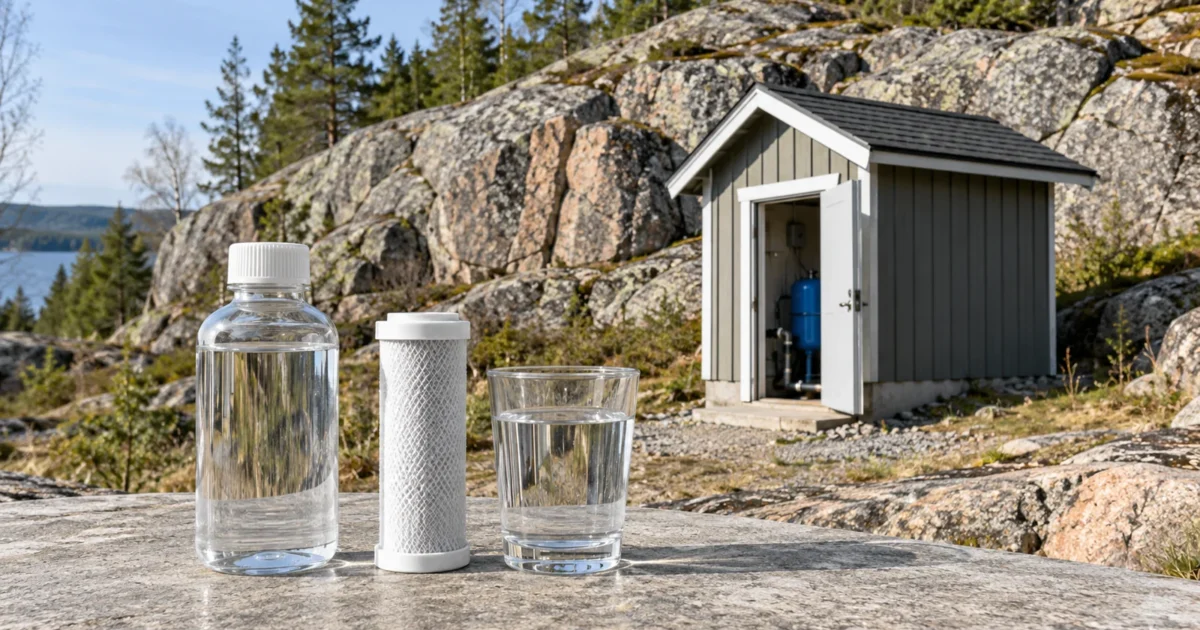
Radium and uranium in drinking water, along with gross alpha activity, are the naturally radioactive side of your tap – they dissolve into groundwater from certain rock and soil, with no taste, odor, or color to warn you. The EPA limits them (combined radium 5 pCi/L, uranium 30 ppb, gross alpha 15 pCi/L), and the fix is ion separation – reverse osmosis or ion exchange – not a carbon filter. This guide covers what they are, what the agencies say, and what removes them.
The one thing to get right: these are removed by reverse osmosis or ion exchange, not by carbon. And they split by charge: radium (a cation) comes out with a water softener’s cation resin, lime softening, or RO; uranium (an anion in water) needs anion exchange or RO. A standard carbon filter does nothing for either.
What they are
These are naturally occurring radionuclides:
- Combined radium – radium-226 plus radium-228, measured by radioactivity in picocuries per liter (pCi/L).
- Uranium – a heavy metal that is both radioactive and chemically toxic; its limit is set by mass (ug/L).
- Gross alpha particle activity – a screening measure of alpha-emitting radionuclides, by definition excluding radon and uranium.
The health basis (what the agencies actually say)
Attributing by agency: for radium, the EPA states that people who drink water with radium above the limit “over many years” may have an increased risk of cancer, and ATSDR attributes bone, liver, and breast cancer to high radium exposure (radium-226 and -228 are known to induce bone sarcomas). For uranium, the EPA pairs an increased cancer risk over many years with kidney toxicity, and notes the mass-based limit is set primarily to control that kidney effect. Here we are careful: ATSDR is more cautious on uranium and cancer, stating it is not known whether uranium causes cancer in humans while identifying kidney damage as uranium’s main health effect. (ATSDR: uranium) We present both and do not overstate the uranium-cancer link. These are long-term exposure risks, not acute ones.
How radium and uranium in drinking water get there
The source is natural geology – radium and uranium leach into groundwater from rock and soil in specific formations (certain granites and sandstones, for example). That makes them a private-well and groundwater concern concentrated in particular regions, rather than a uniform national one. Public systems in affected areas test and treat; private wells are on their own.
What the EPA limits are
Under the Radionuclides Rule (finalized 2000): combined radium-226 + radium-228 = 5 pCi/L; gross alpha particle activity = 15 pCi/L (excluding radon and uranium); uranium = 30 ug/L. Two nuances worth stating:
- Gross alpha is a screen, not a full answer. The EPA’s 15 pCi/L gross alpha limit excludes radon and uranium. Our reading: a system can pass gross alpha and still need separate radium and uranium testing, because the gross alpha number does not tell you which radionuclide is present.
- The units are not interchangeable. Radium and gross alpha are limited by radioactivity (pCi/L); uranium is limited by mass (ug/L), chosen largely for its chemical kidney toxicity. (EPA: Radionuclides Rule)
How to know if YOU have them
- On a public system? Enter your ZIP in the water watchdog and read your annual Consumer Confidence Report – public systems test for radium, uranium, and gross alpha and must report them.
- On a private well in a known radionuclide area? Test it – a certified lab test for gross alpha (as a screen) plus radium and uranium is the only way to know, since there is no taste or smell.
- A high gross alpha result? Follow it with specific radium and uranium tests – the screen does not tell you which radionuclide is present.
How filtration helps (ion separation, not carbon)
Removal is by physical/ionic separation:
- Reverse osmosis (NSF/ANSI 58) – removes radium and uranium both; the simplest single point-of-use answer.
- Ion exchange – but match the charge. Radium is a cation, removed by cation exchange (the same resin as a water softener) or lime softening. Uranium is anionic in water, removed by anion exchange.
- Does NOT work: standard activated carbon does not remove radium or uranium – this is removal by ion separation, not adsorption.
A note for softener owners: a conventional water softener’s cation resin already removes radium as a side effect, but does not remove uranium – so a softened home can still have a uranium problem. Use the Which Filter Fits finder and confirm the exact system in the Filter Certification Registry for the specific radionuclide you need to reduce.
Related guides
- Arsenic in drinking water – the other natural-geology contaminant that needs RO or ion exchange, not carbon.
- Nitrate in drinking water – another well-water contaminant with the same RO/ion-exchange answer.
- Whole-House & Water Softeners – the cation exchange that takes out radium (but not uranium), and Reverse Osmosis for both.
What are the EPA limits for radium and uranium?
Combined radium-226 + -228 = 5 pCi/L, gross alpha = 15 pCi/L (excluding radon and uranium), uranium = 30 ug/L. Radium and gross alpha are radioactivity limits; uranium is a mass limit set largely for kidney toxicity.
Does a carbon filter remove radium or uranium?
No – they are removed by ion separation. Radium (a cation) by cation exchange/softening or RO; uranium (an anion) by anion exchange or RO. Standard carbon does not work.
Where do radium and uranium in water come from?
Naturally, from certain rock and soil dissolving into groundwater – a private-well and regional concern, with no taste or smell, so testing is the only way to know.
Sources
Related guides
Fluoride in Drinking Water: The Limits, the Benefit, and the Debate
Fluoride is the one contaminant on this site that is genuinely contested, so we are going to do…
Disinfection Byproducts in Drinking Water (TTHM & HAA5): The Limits and the Tradeoff
Disinfection byproducts in drinking water are the trade you make for safe water. Utilities add chlorine or chloramine…
Arsenic in Drinking Water: The Limit, the Risk, and the Right Filter
Arsenic in drinking water is the contaminant you cannot see, taste, or smell, and the one most people…