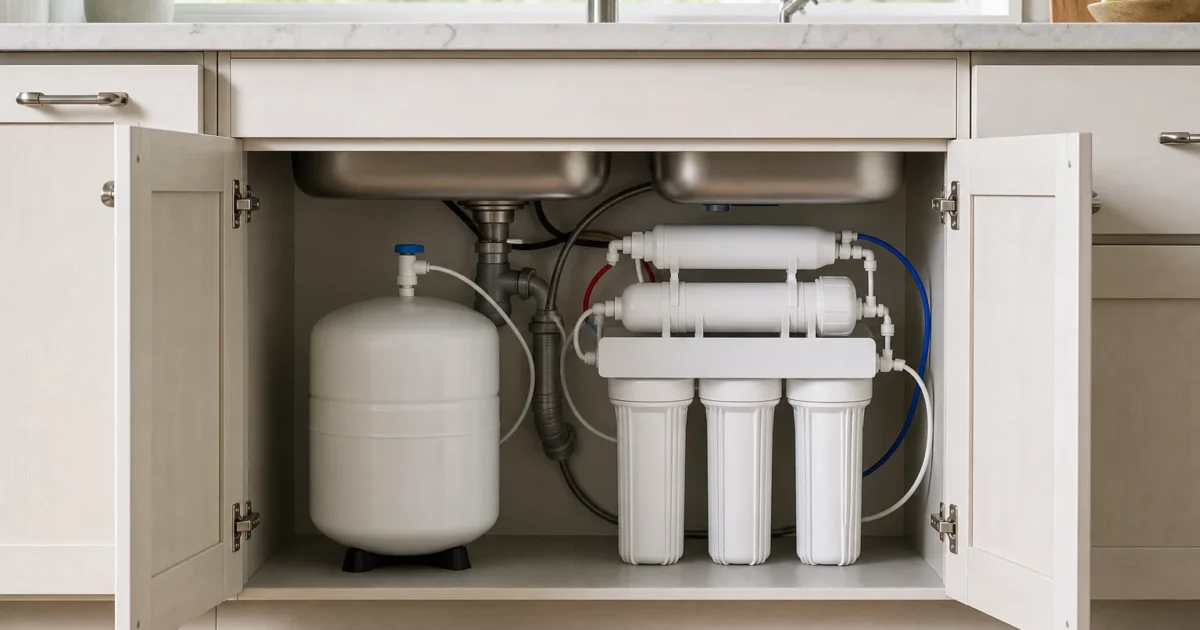
Is reverse osmosis worth it? For most people on a normal municipal supply, a reverse osmosis system is a nice-to-have, not a need-to-have – and whether it pays off depends almost entirely on what is actually in your water and how much bottled water you currently buy. RO is the most thorough point-of-use filtration you can install at a kitchen sink. It is also the most expensive to run and the only common method that sends water down the drain to do its job. This is an honest cost breakdown: the upfront price, the recurring filter cost, the water-waste ratio, and the short list of households for whom the math clearly works.
We will not tell you tap water is dangerous. For a lot of homes it is fine, and a $40 carbon pitcher solves the taste-and-odor complaint that sends most people shopping. RO earns its keep when you have a specific contaminant problem or you are replacing a steady bottled-water habit. Confirm what you are treating before you spend a dollar.
What Reverse Osmosis Actually Does
A reverse osmosis system pushes water through a semipermeable membrane with pores around 0.0001 micron. That membrane rejects dissolved solids that carbon filters pass straight through: it reduces total dissolved solids (TDS) and is the standard household method for contaminants like arsenic, nitrate, fluoride, hexavalent chromium, and – on many certified units – lead and PFAS. The performance standard to look for is NSF/ANSI 58, which covers point-of-use RO systems and tests both contaminant reduction and the system’s recovery ratio.
That breadth is the whole pitch. A carbon block certified to NSF/ANSI 53 handles taste, chlorine, and a defined list of contaminants like lead, but it does nothing for dissolved salts or nitrate. If your problem is dissolved, RO is often the only point-of-use answer. If your problem is taste, RO is overkill.
The trade-off is built into the physics. To push pure water across the membrane, the system flushes the rejected concentrate – everything the membrane blocked – to the drain. That reject water is the recurring cost nobody mentions in the showroom.
The Upfront Cost
A typical under-sink RO system runs $150 to $400 for the unit itself, with whole-house and high-output models going higher. Standard tankless and tanked under-sink units land in that range; you are paying for the number of stages, the storage tank, the faucet, and whether the membrane is certified.
Installation is the variable. If you have an accessible cold-water line under the sink, a dedicated faucet hole (or a sink with a spare knockout), and basic comfort with compression fittings, this is a DIY afternoon. If you need a plumber to add a faucet hole in a granite countertop or tee into the supply, budget $150 to $350 for labor. Add a drain saddle clamp for the reject line – it ships with most kits.
One honest caveat on the unit itself: aftermarket and house-brand systems are often a fraction of the name-brand price and can be perfectly good – but only buy one whose membrane and filters carry an actual NSF/ANSI 58 certification for the contaminant you care about. A system that “meets NSF standards” without a listed certification is making a marketing claim, not a tested one. Check the manufacturer’s listing, not the box copy.
The Recurring Cost: Filters and Membranes
This is where RO separates from a pitcher. A standard system has three replaceable wear parts on different schedules:
- Sediment and carbon pre-filters – replace roughly every
6to12months. These protect the membrane from chlorine and grit. Skipping them shortens membrane life. - The RO membrane – replace every
2to4years depending on water hardness and usage. - The post-filter (polishing carbon) – replace annually.
Plan on roughly $50 to $120 per year in filters for a typical four- or five-stage system, more if your water is hard or high-sediment. Over a 10-year life that is $500 to $1,200 in consumables on top of the upfront unit. That is still cheaper than a bottled-water habit – a household buying two $6 cases a week spends over $600 a year – which is exactly why the bottled-water replacement case is the strongest one for RO.
To put your specific upfront, filter, and waste numbers together, run your own figures through our reverse osmosis cost calculator before you buy. It is the fastest way to see whether RO beats your current spend.
The Cost Nobody Mentions: Water Sent to Drain
Every RO system produces reject water. According to the EPA WaterSense program, a typical point-of-use RO system sends five gallons or more down the drain for every gallon of treated water it produces, and inefficient units can waste up to 10 gallons per gallon delivered. That water shows up on your water and sewer bill.
The fix is to buy efficient. To earn the WaterSense label, an RO system must demonstrate that it sends 2.3 gallons or less to drain per gallon of treated water – less than half the waste of a typical unit. If you are on metered water, especially in a drought-prone or high-rate region, that ratio is a real line item, and a WaterSense-labeled system is the honest choice. Permeate-pump and tankless designs also cut waste versus old tank-and-float units.
Put the drain ratio in perspective: at the kitchen tap you are treating a few gallons a day, so even a wasteful unit adds gallons, not hundreds of gallons, to daily use. But it is a genuine cost, it is environmental as much as financial, and EPA is explicit that it does not promote RO over lower-waste filtration where a simpler method would do. Name the trade-off out loud: RO buys you thorough filtration and charges you in wasted water.
Who Reverse Osmosis Is Worth It For – And Who It Isn’t
RO is worth it if any of these describe you:
- You have a tested, dissolved-contaminant problem – high nitrate from agricultural runoff, arsenic, fluoride above your comfort level, or a water utility Consumer Confidence Report flagging something a carbon filter can’t catch. Test first; don’t guess.
- You are replacing bottled water. If you buy cases weekly, RO pays for itself inside a year or two and keeps paying.
- You have well water with elevated TDS and you have ruled out problems RO can’t fix alone (heavy iron and hardness usually need separate treatment upstream).
RO is probably not worth it if:
- Your only complaint is taste, smell, or chlorine. A carbon pitcher or an NSF/ANSI 53 under-sink carbon block costs less, wastes no water, and solves it. Use our which filter fits finder to match the cheaper tool to your actual problem.
- You have hard water and that’s the real issue. RO does not soften your whole house; it only treats the drinking tap. If scale on fixtures and appliances is the problem, you want a softener – size it with our water softener sizing calculator – and a softener won’t fix heavy iron alone either.
- You rent or can’t run a drain line. Countertop and tankless options exist, but the install constraints are real.
The honest summary: RO is a precision tool. Matched to a dissolved-contaminant problem or a bottled-water habit, it is clearly worth it. Bought to fix taste or hardness, you are overpaying in both dollars and drain water for a job a cheaper tool does better.
How much does a reverse osmosis system cost per year to run?
Budget roughly $50 to $120 per year in replacement filters and membranes for a typical under-sink system, plus the small added water cost from the drain ratio. Hard or high-sediment water pushes the filter cost toward the top of that range.
Does reverse osmosis really waste that much water?
A typical system sends five gallons or more to drain per gallon delivered, per EPA WaterSense. A WaterSense-labeled unit cuts that to 2.3 gallons or less per gallon treated, so buying for efficiency materially lowers the waste.
Is reverse osmosis worth it if my tap water tastes fine?
Usually not. If taste and chlorine are your only concerns, a carbon pitcher or an NSF/ANSI 53 carbon filter is cheaper and wastes no water. RO earns its cost when you have a dissolved contaminant a carbon filter can’t remove, or you are replacing bottled water.
What certification should an RO system have?
Look for NSF/ANSI 58 certification listing the specific contaminant you want reduced – not a vague “meets NSF standards” claim. Confirm the listing on the manufacturer’s certified-product page before you buy.
Can I install an RO system myself?
Often yes, if you have an accessible cold-water line, a faucet hole, and basic comfort with compression and push-fit connections. Drilling a faucet hole through granite or teeing a tight supply line is where most people call a plumber, adding $150 to $350 in labor.
Related guides
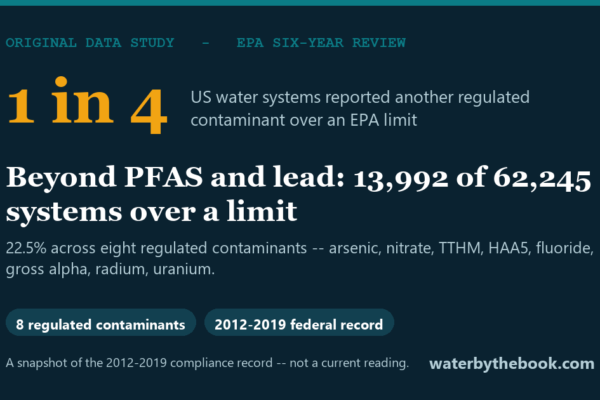
Beyond PFAS and Lead: About 1 in 4 US Systems Reported Another Contaminant Over a Limit
Correction (2026-06-29): a watchdog data-integrity audit corrected two things in the underlying data – the EPA Six-Year Review’s…
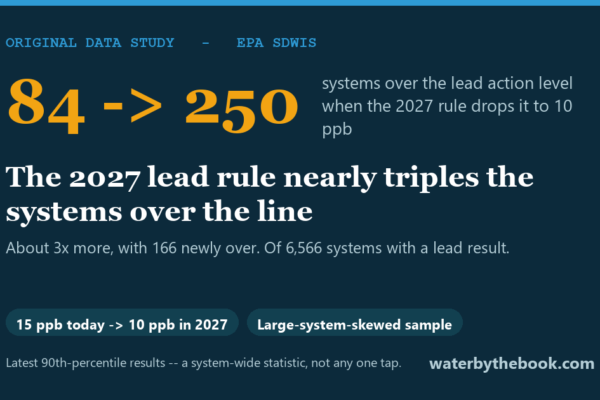
The 2027 EPA Lead Rule Nearly Triples the Water Systems Over the Line
Here is the honest national picture of lead in tap water, and it is not the one either…
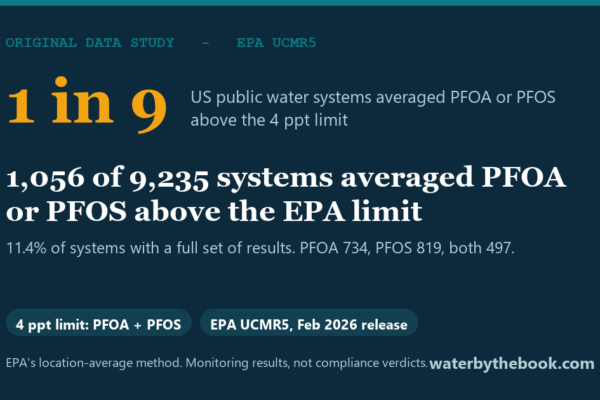
About 1 in 9 US Water Systems Averaged PFOA or PFOS Above the EPA Limit
About 1 in 9 US public water systems -- 1,056 of the 9,235 that reported a full set…