Does a refrigerator filter remove lead? Sometimes – but only if that exact filter carries an NSF/ANSI 53 lead-reduction certification. Most refrigerator filters do not. The standard fridge cartridge is built to fix taste and smell, which is a different certification (NSF/ANSI 42) and tells you nothing about lead. So the honest answer is: it depends entirely on the specific model number printed on your filter, and you have to verify it rather than assume it.
This guide is the field-guide version of that check. We will name the three certifications that get confused, show you how a real lead claim looks, and walk through verifying your own filter at the NSF database before you trust a single drop.
The Short Answer: Lead Removal Is a Specific Claim, Not a Default
A refrigerator water filter removes lead only when the manufacturer has had that filter independently tested and certified for lead reduction under NSF/ANSI 53. That is a narrow, contaminant-specific claim. It is not implied by “filtered water,” it is not implied by “NSF certified,” and it is not implied by a clean-tasting glass.
Here is the trap. Nearly every fridge filter on the market is certified to some NSF standard, and the box often says so in large type. But “NSF certified” by itself usually means certified to NSF/ANSI 42 – the aesthetic standard for chlorine taste and odor. According to NSF’s own standards overview, Standard 42 covers aesthetic effects, while Standard 53 covers health-related contaminants such as lead, cysts, and certain VOCs. A filter can proudly carry a 42 mark and reduce zero lead.
So the question is never “is my filter NSF certified.” The question is “is my filter NSF/ANSI 53 certified for lead specifically.” Those are not the same sentence.
The Three Numbers People Confuse: 42, 53, and 372
Three NSF/ANSI numbers show up on filter packaging, and they get blended together in marketing copy. They mean very different things.
- NSF/ANSI 42 – aesthetic. Taste and odor. Chlorine, chloramine, particulate, sometimes zinc or hydrogen sulfide. This is comfort, not safety. A 42-only filter makes water taste better and does nothing verified for lead.
- NSF/ANSI 53 – health. This is the lead standard. Per NSF, Standard 53 addresses contaminants with a health effect: lead, Cryptosporidium and Giardia cysts, VOCs, chromium, mercury, and more. Each claim is granted separately – a filter can be NSF 53 certified for cysts but not for lead. The lead claim is its own line item.
- NSF/ANSI 372 – lead-free materials. This is the sneaky one. NSF/ANSI 372 does not measure what the filter removes. It verifies that the filter’s own wetted materials meet the legal “lead-free” definition – no more than 0.25% lead by weighted average of wetted surfaces. In other words, 372 promises the filter housing will not add lead to your water. It says nothing about taking lead out.
That last distinction matters because “NSF/ANSI 372 lead-free” reads, at a glance, exactly like a lead-removal promise. It is not. Only an explicit NSF/ANSI 53 lead reduction claim confirms the filter pulls lead out of the water that passes through it.
| Standard | What it governs | Tells you about lead removal? |
|---|---|---|
NSF/ANSI 42 |
Taste, odor, aesthetics | No |
NSF/ANSI 53 |
Health contaminants (lead, cysts, VOCs) | Yes – if “lead” is a listed claim |
NSF/ANSI 372 |
Filter materials are “lead-free” | No – materials only, not performance |
Which Refrigerator Filters Actually Carry a Lead Claim
Some OEM fridge filters do carry a real NSF/ANSI 53 lead reduction claim. As one example, Whirlpool’s genuine everydrop refrigerator filters are tested and certified against NSF/ANSI 42, 53, and 401 for the specific contaminants listed on each filter’s individual Performance Data Sheet. The operative phrase is each filter’s data sheet – the claims differ by cartridge. EveryDrop Filter 1 (W10295370A) and the other numbered EveryDrop cartridges each have their own published list, and lead is not automatically on every one.
The aftermarket is where this gets genuinely risky. A flood of compatible-replacement cartridges advertise “NSF 53 Certified” and “Remove Lead” in their titles. Some are legitimately certified; many list NSF 53 for cysts only, or cite NSF 372 lead-free materials, while the listing photo implies lead removal. The certification is SKU-specific – the model number of the exact part you buy must appear in NSF’s database under a lead claim. A trusted brand name on the box is not the unit being certified; the specific cartridge SKU is. We checked how common this gap is: in our refrigerator-filter certification data study, not one of the recurring aftermarket brands carries NSF 53 across its full line – so “this brand is NSF 53 certified” is almost always true of a model, not necessarily the one in your cart.
This is the moment to apply the one rule we apply to every fit claim: confirm the model printed on your current filter or in your owner’s manual first. One fridge line frequently uses different filters across model years, and a lead claim that is true for one cartridge in that family can be false for the next.
If you are not certain which cartridge your refrigerator takes, our Which Filter Fits finder is built to map your appliance model to the correct OEM and compatible part numbers before you start checking certifications.
How to Verify a Lead Claim at info.nsf.org (Step by Step)
Do not trust the box. Trust the database. NSF publishes a public, searchable listing of every product it certifies, and the lead-reduction listings are their own category. Here is the check.
- Find your exact filter model number. Read it off the current cartridge or the owner’s manual – for example, an EveryDrop number like
W10295370A, a Whirlpool4396508, or a MaytagUKF8001AXX. The number on the part is the only thing that matters, not the marketing name. - Open the NSF certified-products listing for lead. Go to NSF’s Certified Product Listings for Lead Reduction. This page lists only products certified under NSF/ANSI 53 for lead specifically.
- Search the brand or model. Enter the manufacturer or trade-name designation. If your exact cartridge is certified for lead, it appears here with its claim. If it does not appear in this lead listing, it is not certified to reduce lead – full stop, regardless of what the packaging says.
- Confirm the claim wording. A real entry will state the reduction claim. “Lead reduction” under NSF/ANSI 53 is the phrase you want. “Chlorine, taste and odor” alone is Standard 42 and is not a lead claim.
- Cross-check the Performance Data Sheet. For OEM filters, the manufacturer’s data sheet (EveryDrop publishes these per cartridge) should list lead with a percent-reduction figure. If the data sheet omits lead, the filter does not claim it.
If your filter is not listed for lead, that is not a defect – it simply was not built or certified for it. It can be an excellent taste filter and a non-existent lead filter at the same time. Both things are true.
When a Lead Claim Still Is Not Enough
Even a properly NSF/ANSI 53 lead-certified fridge filter has limits worth stating plainly.
A certified filter reduces lead; it does not guarantee zero lead. NSF 53 lead testing is performed under defined laboratory conditions, with a defined cartridge life. Push the cartridge past its rated gallon capacity and reduction performance falls off. The certification is a promise about a fresh, in-spec filter – not a forever guarantee.
If you are on a known lead service line or an older home with lead solder, a single fridge filter may not be your best primary defense. The EPA’s guidance on lead in drinking water recommends point-of-use devices certified for lead and notes that lead enters tap water primarily through corrosion of lead-containing plumbing – which means lead can be present at every tap, not only the fridge dispenser. A certified pitcher, faucet-mount, or under-sink unit, or a reverse-osmosis system, may cover more of your water than a refrigerator line alone.
If a whole-home or under-sink solution is on your mind, the trade-off is cost and maintenance over time, not just sticker price. Our reverse osmosis cost calculator lays out the multi-year membrane and filter cost so you can compare an RO system honestly against the running cost of replacement fridge cartridges.
Does any standard refrigerator water filter remove lead by default?
No. The default refrigerator filter is built for taste and odor under NSF/ANSI 42, which does not address lead. Lead removal is a separate NSF/ANSI 53 claim that the specific cartridge must be tested and certified for. Always verify your exact model rather than assuming.
My filter box says “NSF certified” – doesn’t that cover lead?
Not necessarily. “NSF certified” most often refers to NSF/ANSI 42 (aesthetic) or NSF/ANSI 372 (lead-free materials), neither of which removes lead from water. Only an explicit NSF/ANSI 53 lead-reduction claim does, and you confirm it by finding your model in NSF’s lead-reduction listing at info.nsf.org.
What is the difference between NSF 53 and NSF 372 for lead?
NSF/ANSI 53 certifies that the filter removes lead from the water passing through it. NSF/ANSI 372 only certifies that the filter’s own materials are “lead-free” – no more than 0.25% lead by weighted average of wetted surfaces – so the unit does not add lead. Removal versus materials. They are not interchangeable.
Are aftermarket “compatible” filters that claim NSF 53 lead reduction trustworthy?
Some are; many overstate it. Certification is SKU-specific, so the exact compatible part number must appear in NSF’s lead-reduction database. Many aftermarket listings advertise lead removal while only carrying NSF 53 for cysts or NSF 372 for materials. Verify the precise model before trusting it.
How do I confirm my exact filter is certified for lead?
Read the model number off your current cartridge or manual, then search it in NSF’s Certified Product Listings for Lead Reduction. If your model appears there with a lead-reduction claim, it is certified for lead. If it does not appear, it is not – regardless of packaging language.
The Bottom Line
Does a refrigerator filter remove lead? Only if that specific cartridge carries an NSF/ANSI 53 lead-reduction certification, and only while it is fresh and in-spec. NSF/ANSI 42 is taste. NSF/ANSI 372 is lead-free materials. Neither removes lead. The single habit that protects you is this: read the model number off your filter, search it at info.nsf.org, and confirm the lead claim before you trust it. If it is not listed for lead, it does not remove lead – and that is worth knowing for certain rather than hoping.
Related guides
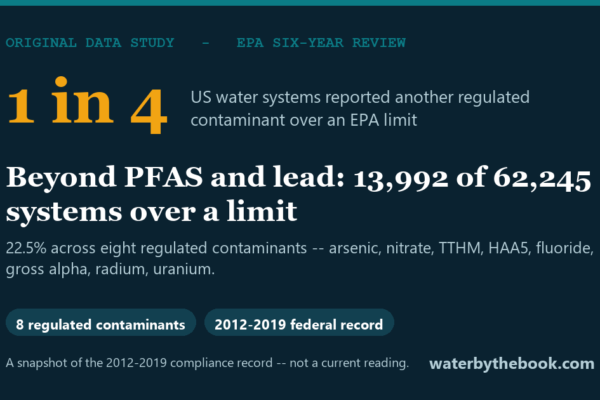
Beyond PFAS and Lead: About 1 in 4 US Systems Reported Another Contaminant Over a Limit
Correction (2026-06-29): a watchdog data-integrity audit corrected two things in the underlying data – the EPA Six-Year Review’s…
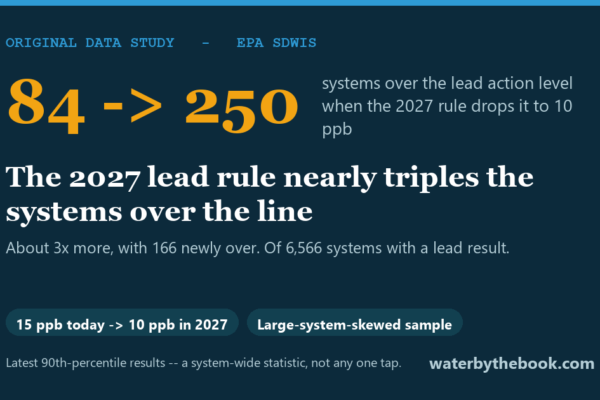
The 2027 EPA Lead Rule Nearly Triples the Water Systems Over the Line
Here is the honest national picture of lead in tap water, and it is not the one either…
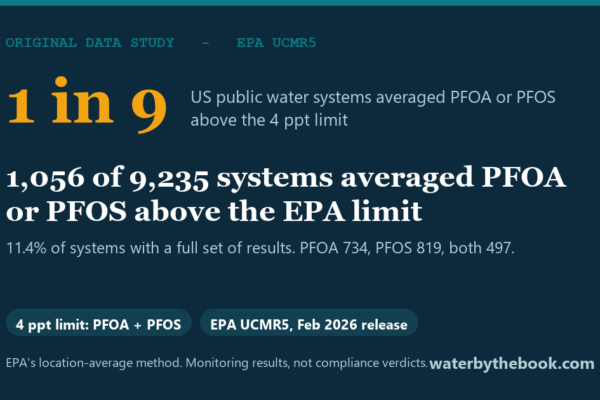
About 1 in 9 US Water Systems Averaged PFOA or PFOS Above the EPA Limit
About 1 in 9 US public water systems -- 1,056 of the 9,235 that reported a full set…