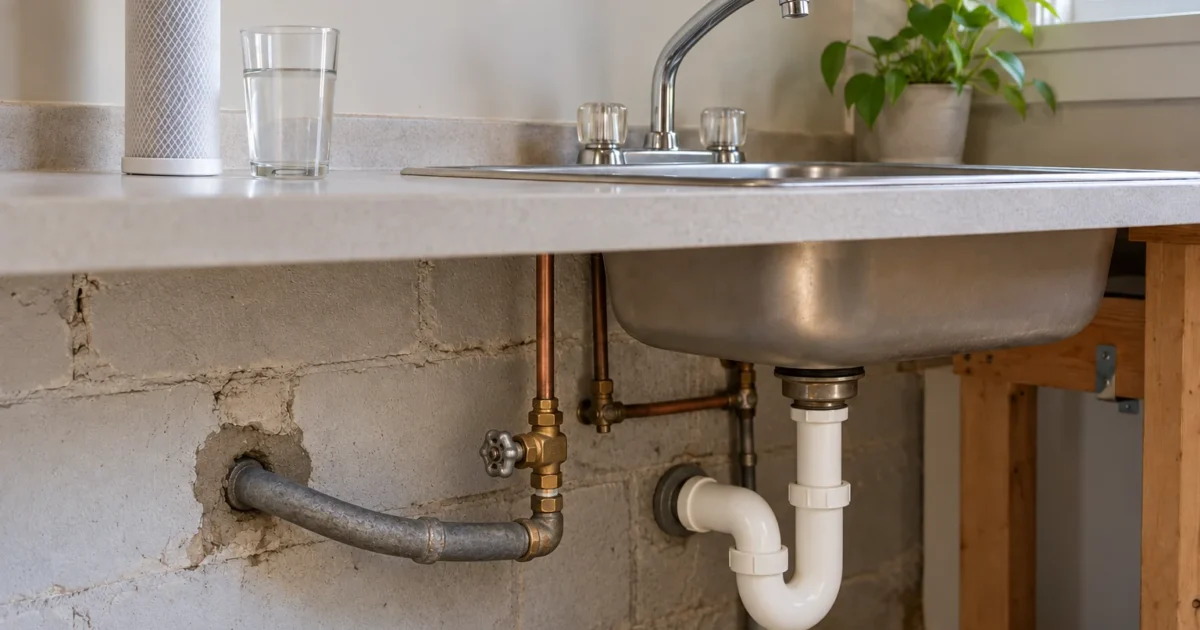
Lead in tap water almost never comes from the treatment plant – it comes from the pipes between the plant and your glass. That single fact changes everything about how you deal with it: it is a home-by-home problem, and the reliable fix is a filter certified to NSF/ANSI 53 for lead, right at the tap you drink from. This guide covers where lead comes from, what the EPA limit is, how to find out if you are at risk, and what actually filters it.
The one honest framing: there is no known safe level of lead, so the goal is “as low as reasonably possible,” not “under a number.” The EPA’s 15 ppb action level is a system-wide trigger for the utility to act – it is not a line below which your tap is guaranteed safe.
Where lead comes from
Lead is not in the source water and is not added at the plant. It dissolves into water from lead service lines (the pipe connecting the water main to older homes), from lead solder used on copper pipe before 1986, and from brass fixtures and faucets that legally contained small amounts of lead until 2014. Hot water and standing water leach more, which is why the advice is always: use cold water for drinking and cooking, and flush the tap after it has sat. (EPA: basic information about lead in drinking water)
The health basis (what the agencies actually say)
The EPA is blunt on this: there is no safe level of exposure to lead, and the EPA and the CDC agree there is no known safe level of lead in a child’s blood. (EPA: basic information about lead in drinking water) Lead is a cumulative toxicant. The CDC reports that in children, lead exposure is associated with effects on the developing brain and nervous system – lower IQ, attention and behavior effects – and that no safe blood-lead level has been identified. In adults, the EPA links lead to cardiovascular effects, increased blood pressure, and kidney problems. (CDC: lead) This is why the standard is a treatment trigger aiming for the lowest feasible level, not a “safe” concentration.
What the EPA limit is
Lead is regulated differently from most contaminants. Instead of a single maximum, the EPA uses an action level: 15 parts per billion (ppb), measured at the 90th percentile of a utility’s sampled homes. In plain terms: if more than 10% of sampled high-risk homes exceed 15 ppb, the system must take action (corrosion control, public education, and lead-line replacement). Two things to keep straight:
- It is a system-wide statistic, not your tap. Your home can be higher or lower than the system’s 90th percentile.
- It is getting stricter. The 2024 Lead and Copper Rule Improvements (LCRI) lower the action level to 10 ppb, with compliance expected in late 2027, and require most lead service lines to be replaced within 10 years or less. (EPA: LCRI questions and answers)
How to know if YOU have lead
- Check your utility’s record. Enter your ZIP in the water watchdog to see your system’s reported lead 90th-percentile result and any violations, graded against the action level and dated. Remember it is a system-wide number – a flag to investigate, not a verdict on your tap. Your utility’s annual Consumer Confidence Report is the official local record; confirm against it.
- Find out if you have a lead service line. Your utility is now required to maintain a service-line inventory; many publish a lookup. An older home (pre-1986) is the main risk factor.
- Test your own tap. Because lead is home-specific, a certified lab test of your actual tap is the only way to know your number. Many utilities offer free or low-cost test kits.
How filtration helps (and what does not)
For lead, point-of-use filtration is genuinely effective – if it is certified for it:
- NSF/ANSI 53 (lead reduction) – the certification that matters. Many under-sink, faucet-mount, and pitcher filters carry it, but it is model-specific: a brand can sell one filter that is NSF 53 lead-certified and another that is only NSF 42.
- Reverse osmosis (NSF/ANSI 58) – also certified for lead, and removes much more besides.
- Not enough: an NSF 42 (taste and odor) filter is not certified to reduce lead. Neither is a water softener – softeners are for hardness, not lead.
Verify before you buy. The Which Filter Fits finder gives you options that fit your system; the Filter Certification Registry confirms a specific model’s real NSF 53 lead listing. Our NSF data study found that across aftermarket fridge filters, a real lead certification is the exception you have to hunt for – which is exactly why you check the exact model.
Related guides
- PFAS in drinking water – the other contaminant the same NSF 53 / RO filters handle.
- Nitrate in drinking water – a different problem that needs RO or ion exchange, not carbon.
- Refrigerator & Under-Sink Filters – where many NSF 53 lead-certified options live.
What is the EPA action level for lead in drinking water?
15 ppb at the 90th percentile of a system’s sampled homes – a treatment trigger, not a safety threshold (the EPA says there is no safe level of exposure to lead, and the EPA and CDC agree there is no known safe level of lead in a child’s blood). The 2024 LCRI lowers it to 10 ppb effective November 2027.
Does my water utility add lead to my water?
Almost never – lead enters after the plant, from a lead service line or from lead solder and brass fixtures in older home plumbing. That is why it is a home-by-home problem and an at-the-tap filter is the fix.
What filter removes lead from drinking water?
One certified to NSF/ANSI 53 for lead reduction, or reverse osmosis (NSF/ANSI 58). A taste-and-odor-only (NSF 42) filter is not. Verify the exact model in the registry.
Sources
Related guides
Radium and Uranium in Drinking Water: Gross Alpha, Limits and Filters
Radium and uranium in drinking water, along with gross alpha activity, are the naturally radioactive side of your…
Fluoride in Drinking Water: The Limits, the Benefit, and the Debate
Fluoride is the one contaminant on this site that is genuinely contested, so we are going to do…
Disinfection Byproducts in Drinking Water (TTHM & HAA5): The Limits and the Tradeoff
Disinfection byproducts in drinking water are the trade you make for safe water. Utilities add chlorine or chloramine…