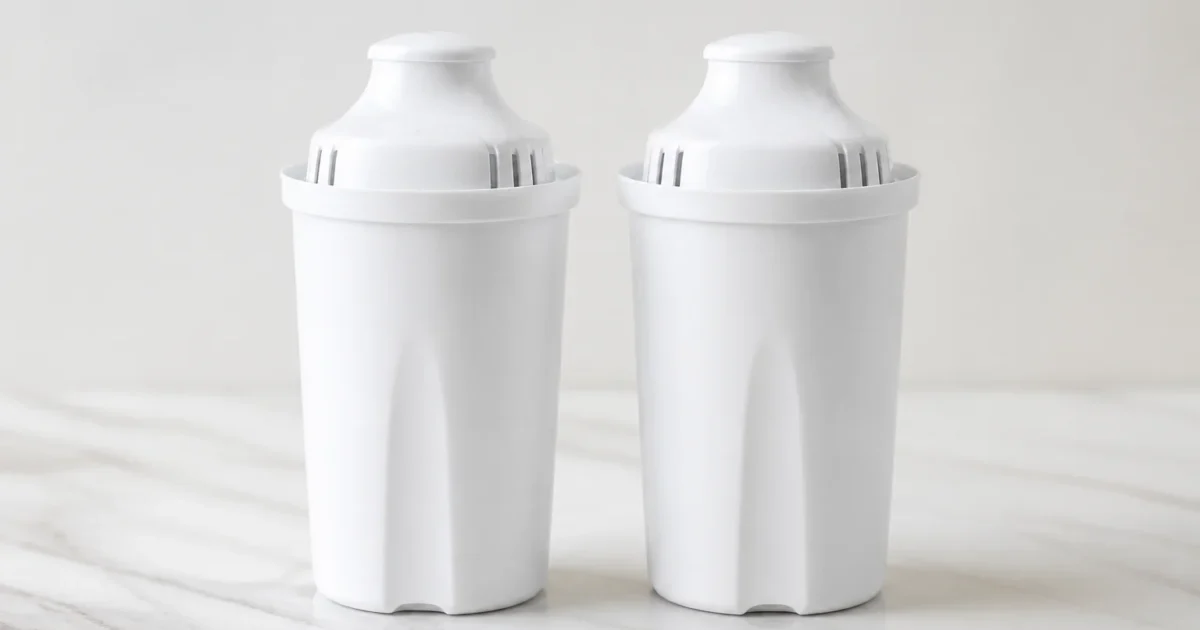
The difference between Brita Elite vs Standard comes down to one line on a certification sheet: the Elite filter is NSF/ANSI 53 certified to reduce lead, and the Standard filter is not. Everything else – price, capacity, the number on the box – follows from that. If you bought a Brita pitcher to take lead out of your water, only one of these two filters is tested and certified to do it.
This guide reads the actual certified claims for both filters, side by side. Not the marketing copy on the front of the box – the Performance Data Sheet and the NSF listing behind it. We will also be honest about what neither filter does, because that gap matters more than the difference between them.
Before anything else: confirm the model printed on your current filter or in your manual. Brita has renamed these products over the years (the Elite was sold as “Longlast+”), and a filter that fits the pitcher is not the same as a filter certified for the contaminant you care about.
The Two Filters: OB03 vs OB06
Brita sells two pitcher-filter lines that fit the same pitchers. The model number is the fastest way to tell them apart.
- Brita Standard – model
OB03(also sold as “Original”). The white-and-blue oval filter. Rated for40 gallons, about 2 months for an average household. - Brita Elite – model
OB06(formerly “Longlast+”). The blue filter. Rated for120 gallons, about 6 months.
The Elite costs more per filter but lasts three times as long, so the per-gallon cost is closer than the sticker price suggests. The capacity difference is real and verified on both Performance Data Sheets. But capacity is not the reason to choose between them. The certified-claim list is.
What the Standard Filter (OB03) Is Actually Certified to Remove
The Brita Standard filter is certified by WQA against NSF/ANSI Standards 42 and 53 – but only for the contaminants on its own data sheet, and lead is not one of them.
Here is the honest breakdown of what OB03 is certified to reduce:
- NSF/ANSI 42 (aesthetic): chlorine taste and odor, and zinc.
- NSF/ANSI 53 (health): mercury, cadmium, and copper.
That NSF 53 line surprises people, because NSF 53 is the health standard – the one that covers lead and cysts. The Standard filter does carry a real NSF 53 certification, just for mercury, cadmium, and copper, not lead. On its data sheet the Standard filter reduces cadmium by roughly 91-94% and mercury by roughly 82-86%, depending on water pH. Those are genuine health claims. They are also not the claim most buyers are after.
The takeaway: the Standard filter is a good chlorine-and-taste filter with a modest set of certified heavy-metal claims. If your concern is flavor, chlorine smell, or those three metals, it does the job at a low price.
What the Elite Filter (OB06) Is Actually Certified to Remove
The Brita Elite filter is the lead-certified one. It is certified to NSF/ANSI Standards 42, 53, and 401, and Brita states it reduces 99% of lead.
The certified claim list for OB06 is broader:
- NSF/ANSI 42 (aesthetic): chlorine taste and odor, plus particulates.
- NSF/ANSI 53 (health): lead, mercury, cadmium, asbestos, benzene, and more.
- NSF/ANSI 401 (emerging contaminants): select pharmaceuticals, microplastics, and other trace compounds.
The headline difference in Brita Elite vs Standard is that NSF 53 lead line and the NSF 401 standard, which the Standard filter does not carry at all. NSF/ANSI 401 covers “emerging” or “incidental” contaminants – trace pharmaceuticals, pesticides, and microplastics that show up in some municipal supplies. The Elite is tested against a panel of those compounds; the Standard is not.
If lead is your reason for filtering, the Elite (OB06) is the only one of the two Brita pitcher filters certified for the job. That is the whole decision, stated plainly.
How to Verify a Lead Claim Before You Trust It
A “reduces lead” line on a box is a marketing claim until you can match it to a certification listing. This matters most with the aftermarket Brita-compatible filters that flood online marketplaces – many are certified to NSF 42 and 53 for some contaminants but not lead, and the listing photo will not always tell you which.
Here is the discipline, and it applies to any pitcher filter, not just Brita:
- Find the exact model number on the filter or its packaging (
OB03,OB06, or the aftermarket equivalent). - Go to the NSF certified-products database at info.nsf.org and search the brand.
- Open the listing and read the reduction-claims table. NSF/ANSI 42 = aesthetic effects (chlorine, taste, odor). NSF/ANSI 53 = health effects (lead, cysts, certain metals). Confirm “lead” appears under the 53 claims for that specific model.
Certification under NSF 53 is SKU-specific. Two filters from the same brand can have different 53 claims, and “NSF 53 certified” alone does not mean “lead.” Read the claim, not the standard number.
If you are still deciding which pitcher or under-sink filter fits your situation, our which-filter-fits tool walks you from your water concern to the certified options.
What Neither Brita Filter Does
This is the part a sales page skips. Both Brita pitcher filters are activated-carbon filters with ion-exchange media. They are good at what they are certified for and silent on a lot of things they are not.
Neither the Standard nor the Elite is certified to meaningfully reduce:
- Dissolved minerals / hardness. Brita filters do not soften water. If you have scale on your fixtures, a pitcher will not fix it. Sizing a real softener is a different problem – our water softener sizing calculator is the right starting point.
- Total dissolved solids (TDS) broadly, nitrate, fluoride, arsenic, or PFAS at the level a dedicated system provides. For those, the certified answer is usually reverse osmosis. The reverse osmosis cost calculator shows what that actually costs over time.
- Bacteria or viruses. Neither is a microbiological purifier. Do not use either to make unsafe water safe.
The EPA is blunt about lead specifically: there is no known safe level of lead in drinking water, and the federal action level of 15 ppb is a system-management trigger, not a safety threshold. A certified pitcher filter is a reasonable point-of-use layer, but if you have lead service lines, the durable fix is line replacement, not a pitcher.
Does the Brita Standard filter remove lead?
No. The Brita Standard filter (OB03) is not certified to reduce lead. It carries NSF/ANSI 53 certification for mercury, cadmium, and copper, and NSF/ANSI 42 for chlorine and zinc – but lead is not on its certified-claims list. For certified lead reduction in a Brita pitcher, you need the Elite filter (OB06).
Are Brita Elite and Longlast+ the same filter?
Yes. “Longlast+” was the earlier name for the filter Brita now markets as “Elite.” Both refer to model OB06. If you have older packaging that says Longlast+, it is the same lead-certified, 120-gallon filter.
Is the Elite filter worth the extra cost over the Standard?
It depends on your water. If your concern is lead, microplastics, or NSF 401 contaminants, the Elite is the only certified choice – the cost question is settled. If you only want better taste and chlorine reduction, the Standard does that for less. Because the Elite lasts 120 gallons versus 40 gallons, the price gap per gallon is smaller than the per-filter price suggests.
How do I confirm what my filter is certified to remove?
Find the model number on the filter, then search the brand at info.nsf.org and read the reduction-claims table for that exact model. Confirm the specific contaminant you care about – especially lead – appears under the NSF/ANSI 53 claims. Do not rely on “NSF 53 certified” alone, since that standard covers many contaminants and certification is model-specific.
Do either of these filters soften hard water?
No. Brita pitcher filters do not reduce water hardness and will not stop limescale. Softening is a separate job handled by an ion-exchange softener sized to your hardness and household demand.
The Bottom Line
In Brita Elite vs Standard, the certified difference is simple and worth stating once more: the Elite (OB06) is NSF/ANSI 53 certified to reduce lead and adds NSF 401 coverage; the Standard (OB03) is not certified for lead and is best understood as a chlorine, taste, and limited-metals filter. Capacity follows – 120 gallons versus 40.
Match the filter to the contaminant you actually have, verify the claim on the NSF listing before you trust it, and remember that for lead, dissolved minerals, or microbiological risk, a pitcher is a layer, not a cure. Confirm the model printed on your filter first, every time.
Sources
Related guides
Boil-Water Advisory Checklist: What to Do During and After [2026]
A boil-water advisory checklist only works if you follow it in the right order, and the order is…
Boil-Water Advisory: What Your Filter Can and Cannot Do
Your phone buzzes with a boil-water advisory, and your first instinct is to check the pitcher filter on…
NSF Filter Certifications Explained: 42 vs 53 vs 58 vs 401 vs P473
NSF filter certifications only mean something when two conditions are both true: the exact product is listed by…