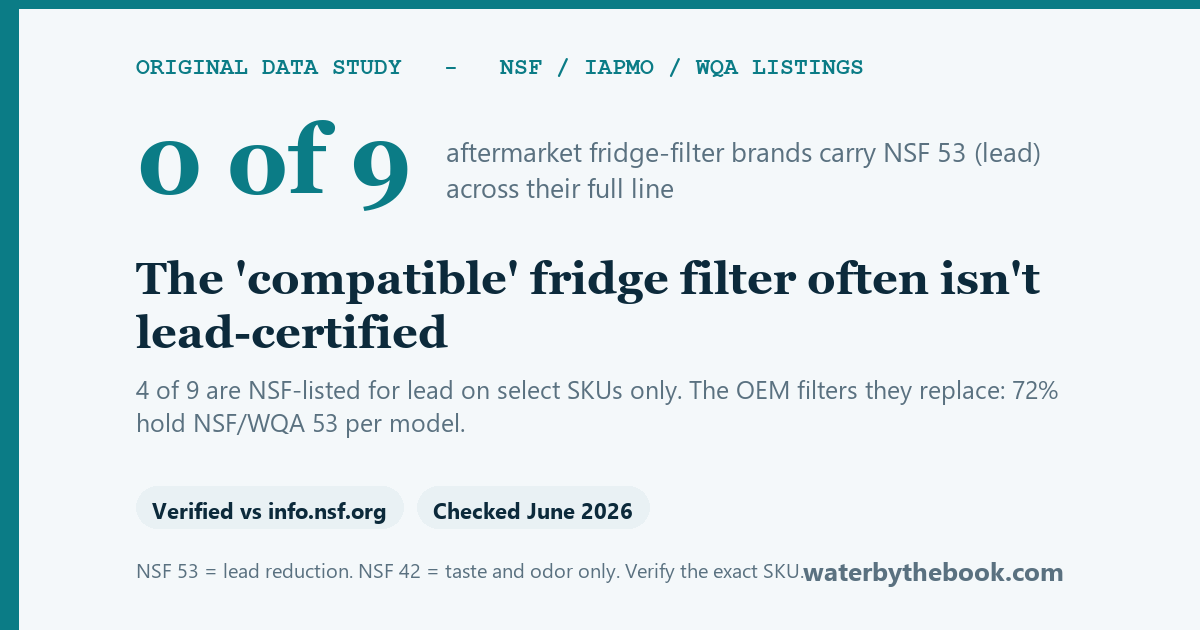
If you replace your refrigerator’s filter with a cheaper aftermarket refrigerator water filter, here is the honest answer to the question you should be asking: in most cases that “compatible” replacement is not certified to reduce lead, even though the OEM filter it replaces is. The replacement still fits. It still pours clean-tasting water. But the health certification you assumed carried over usually did not.
We checked. This is an original WaterByTheBook data study of the aftermarket refrigerator water filter market, built from our own filter cross-reference and verified against the official NSF listings. The finding is not that aftermarket filters are bad value or that any brand is lying. The finding is narrower and more useful: a real lead certification is the exception, not the rule, on the aftermarket, and you cannot tell which is which from the product listing. So you have to check the exact SKU. This study shows you why, and how.
The headline: Of the 9 aftermarket refrigerator-filter brands that recur across our cross-reference, 0 carry NSF/ANSI 53 (lead reduction) certification across their full product line – and only 4 are NSF-listed for it on any SKU at all (two more hold a 53 certification through IAPMO). The OEM filters they replace are reliably lead-certified: 72% hold NSF/WQA 53 per model. On the aftermarket, lead certification is the exception you have to hunt for, SKU by SKU.
What NSF 42 and NSF 53 actually mean
Two NSF/ANSI standards do most of the work on a refrigerator filter box, and the gap between them is the whole story.
- NSF/ANSI 42 is an aesthetic standard. It covers chlorine taste and odor, and particulates. It says nothing about health contaminants. Most aftermarket filters stop here.
- NSF/ANSI 53 is the health standard. It covers lead, cysts (like Cryptosporidium), and some VOCs. This is the certification that matters if you are filtering for lead, and it is the one most aftermarket filters do not hold.
A third number muddies the water on purpose: NSF/ANSI 372 is a lead-free materials standard. It certifies that the filter housing does not add lead to your water. It does not mean the filter removes lead. A listing that says “372 certified” is telling you the plastic is safe, not that you are protected from lead in your supply. Lead reduction is the separate 53 claim, and the EPA is blunt about why that matters: there is no safe level of lead in drinking water.
How we checked: the data and the method
We started from the WaterByTheBook filter cross-reference, the maintained database behind our filter finder. For this study we scoped it to refrigerator filters specifically – 39 OEM filter families (EveryDrop, LG, Samsung, GE, Frigidaire, Bosch, Miele, and their Kenmore equivalents) and the 121 aftermarket brand-listings that appear as “compatible” replacements for them.
For every OEM filter we recorded its certification level. For every aftermarket brand we recorded whether it is independently NSF-listed for NSF/ANSI 53 (lead) – not whether it claims lead reduction, but whether a real certification listing exists. We verified each brand in June 2026 against the official NSF product database at info.nsf.org, cross-checked against IAPMO R&T and WQA Gold Seal listings (two other legitimate certifiers that test to the same NSF/ANSI standards). Where a brand holds 53 only on a specific premium SKU, we say so; certification on the aftermarket is SKU-specific, not brand-wide.
This is a structural certification audit, not a laboratory test of filtration performance. We are not measuring how much lead a filter removes; we are measuring whether the certification a buyer reasonably expects is actually on file. We under-state rather than over-state throughout: a brand is credited with lead certification wherever any real listing exists.
What we found
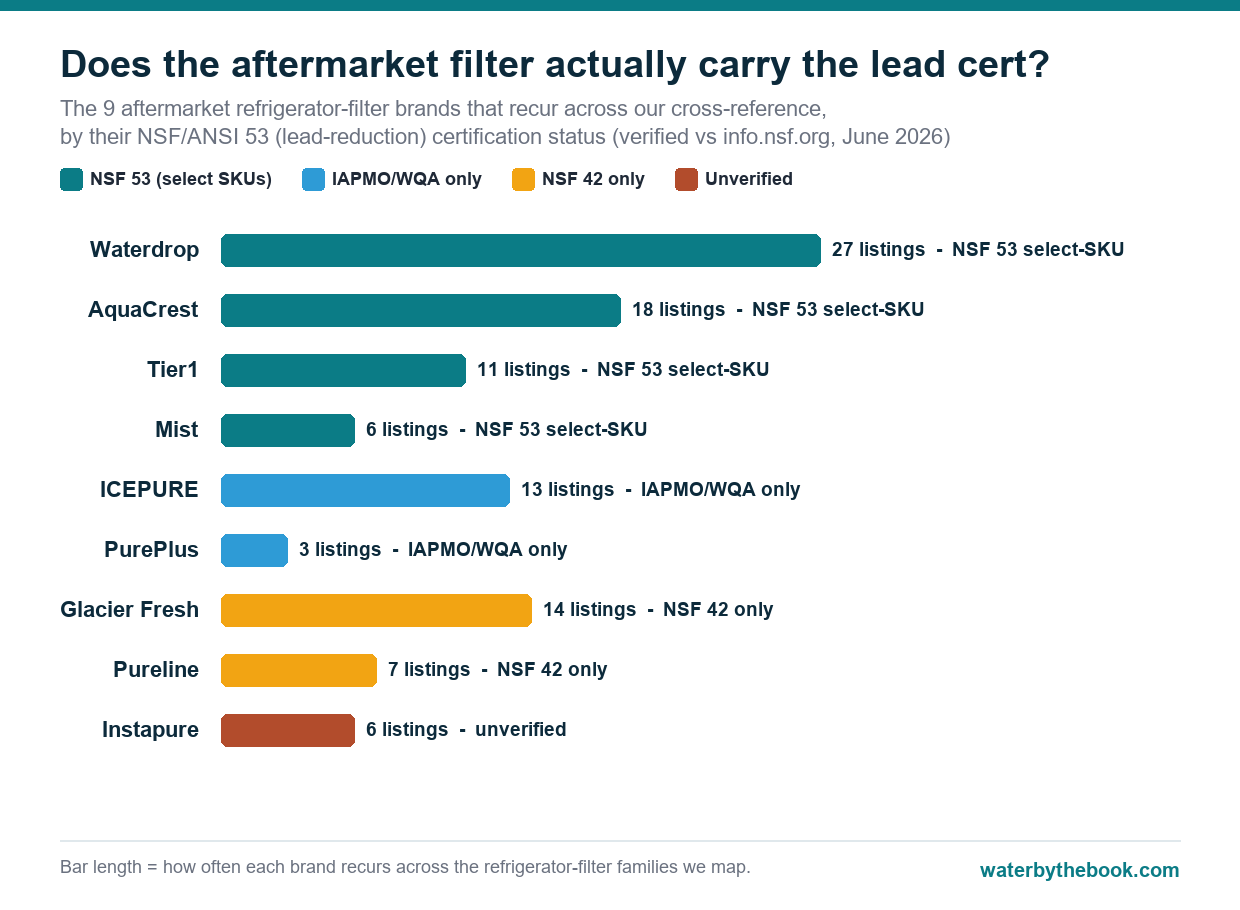
Of the 9 aftermarket brands that recur across the refrigerator-filter families we map:
- 4 are NSF-listed for lead (53) on select SKUs only – Waterdrop, AquaCrest, Tier1, and Mist. Their baseline product is NSF 42; the lead certification rides on specific premium models you have to seek out by part number.
- 2 claim lead reduction through IAPMO or WQA, not an NSF listing – ICEPURE (53 only on its PLUS/PRO line, via IAPMO) and PurePlus (IAPMO-certified to 53, not NSF-listed). IAPMO and WQA are legitimate certifiers, but a shopper looking for the brand on info.nsf.org will not find the 53 claim there.
- 2 are NSF 42 (taste and odor) only – Glacier Fresh and Pureline carry no verified lead reduction at all. Pureline’s listing is IAPMO 42/372: safe materials, no lead removal.
- 1 cannot be verified – Instapure does not appear in the NSF database; its certification is claimed but not independently confirmable.
Beyond those nine, about a dozen additional long-tail “compatible” brands appear in the cross-reference. Every one of them carries an NSF 42 baseline at best, with any lead claim unverified.
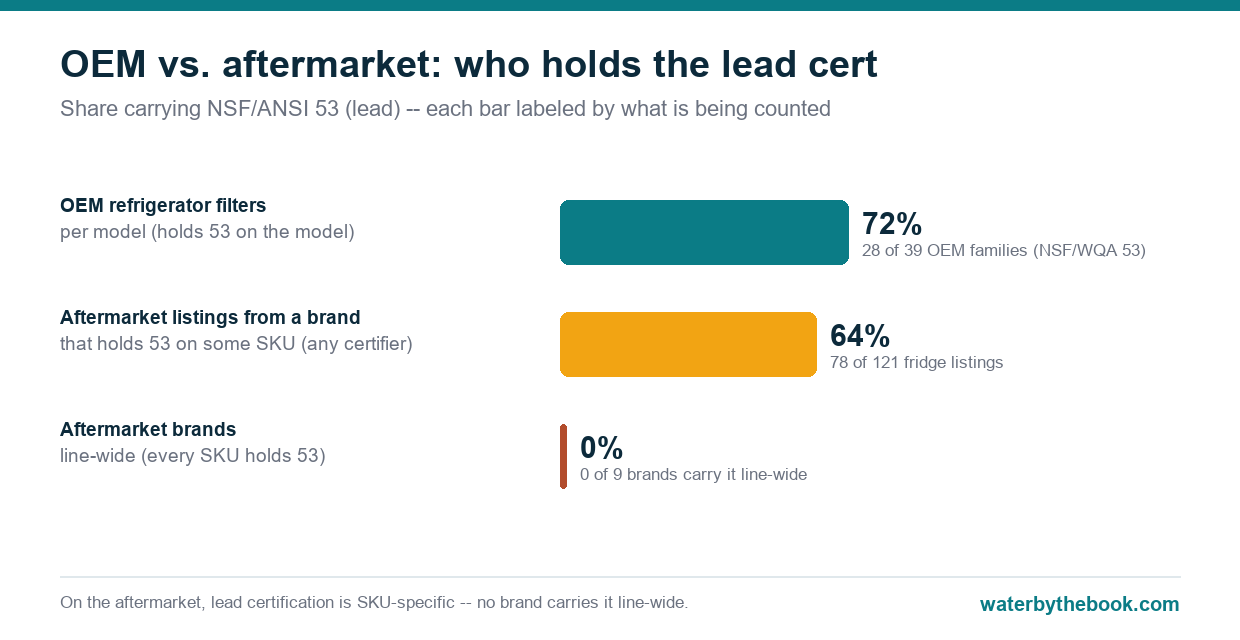
And the single most important number: 0 of the 9 carry NSF 53 across their full line. That does not mean lead certification is absent from the aftermarket – it means it is SKU-specific. About two-thirds of the aftermarket fridge listings in our cross-reference (78 of 121) come from a brand that holds a real NSF/ANSI 53 certification on some SKU (whether NSF-listed or via IAPMO/WQA) – but you have to find that exact SKU, because no brand carries the certification line-wide. (As an illustration of how SKU-specific it is: in our June 2026 review of the official NSF DWTU database, Waterdrop – the best-certified aftermarket brand – held NSF 53 on only a minority of its listings, roughly 1 in 5, across its full multi-category catalog. That figure comes from the NSF database directly, not computed from our cross-reference, and spans all of Waterdrop’s products, not just fridge filters.)
The honest comparison, by what is being counted: 72% of OEM refrigerator-filter families (28 of 39) hold NSF/WQA 53 per model. On the aftermarket, about two-thirds of listings (64%) come from a brand that holds 53 on some SKU, but 0 brands carry 53 line-wide – the gap is not that lead certification is missing, it is that you cannot assume the specific filter you grab has it.
One more thing we looked for and did not find: NSF/ANSI P473, the standard for PFOA and PFOS (the most common “forever chemicals”). No aftermarket brand we checked holds it. Where an aftermarket filter reduces PFAS at all, it does so under a model’s 53/401 claim, not a dedicated P473 certification.
What this means if you buy an aftermarket refrigerator water filter
None of this means you should never buy a compatible filter. A certified aftermarket filter can be a genuine bargain, and plenty of households do not need lead reduction in the first place. It means you should buy on the certification, not the price or the brand name – and you should confirm it yourself, because the listing will not make it easy.
- Decide what you actually need. If your home was built after 1986 and on a municipal supply that tests clean for lead, NSF 42 may be all you want. If you have older plumbing, a lead service line, or a well, you want a verified NSF 53 filter – and you should read what NSF 53 does and does not cover for lead before you assume any filter solves it.
- Find the exact SKU, not the brand. “Waterdrop is NSF 53 certified” is the kind of true-but-misleading claim that sells the wrong filter. The brand holds 53 on some models. Your model may not. Match the specific part number.
- Verify it on the source. Look the SKU up at info.nsf.org yourself, or use our filter finder, which records the verified certifier and claim level for each cross-referenced option. If you cannot find the SKU listed for 53, treat it as NSF 42.
The OEM filter is the safe default precisely because its certification is predictable. The savings on the aftermarket are real – but so is the certification gap, and only one of those two is printed in large type on the box.
How to verify your own filter in two minutes
Confirm the model printed on your current filter or in your owner’s manual first – one fridge line uses different filters across model years, and that printed number is the only reliable source of truth. Then:
- Search that exact part number at info.nsf.org (the official database) and read the “Reduction Claims” column. If it lists NSF/ANSI 53, the filter is certified for the contaminants shown there, lead included where stated.
- If the brand is not on info.nsf.org, check IAPMO R&T and WQA – a 53 listing there is still a real, independent certification.
- If you cannot find the SKU on any of the three, the filter is, for your purposes, NSF 42 (taste and odor) at most. That may be fine. Just buy it knowing that, not assuming more.
Methodology and honesty notes
What this is: a structural certification audit. We took the 39 refrigerator-filter OEM families and the 121 aftermarket brand-listings in the WaterByTheBook filter cross-reference, recorded each OEM filter’s certification level, and classified each recurring aftermarket brand by whether it holds an NSF/ANSI 53 (lead) listing. The counts are reproducible from the cross-reference file (the 39 OEM families, the 28 that hold NSF 53, the 121 listings, the 9-recurring-vs-long-tail split – same data in, same numbers out). The per-brand NSF 53 verdicts were verified by manual lookup of the official NSF DWTU database (info.nsf.org) plus IAPMO R&T and WQA Gold Seal listings in June 2026; those verdicts (and the illustrative Waterdrop SKU ratio) come from the certifiers’ databases directly, not from the cross-reference. NSF listing counts drift over time, so treat the verdicts as an as-of-June-2026 snapshot.
What this is not: a laboratory test, and not a claim that any brand misrepresents its products. NSF 53 certification is SKU-specific; a brand can hold it on a premium model while most of its line holds only NSF 42, and our brand-level verdicts reflect that (“on select SKUs”). “Recurring brands” means the 9 aftermarket brands that appear across multiple OEM families in our cross-reference; about a dozen additional long-tail brands appear less often and are reported separately. Certifier matters: some OEMs (GE, Frigidaire) certify through WQA rather than NSF, which is equally valid – we counted a verified 53 listing regardless of which of the three bodies issued it. The two grains we compare are different on purpose and labeled as such: the OEM figure is per-model (does this filter hold 53), the aftermarket “line-wide” figure is the strict every-SKU test, and we also report the matched per-listing figure (about two-thirds of aftermarket listings come from a brand that holds 53 on some SKU, counting any certifier). Your real-world protection depends on your specific filter, your water, and replacing the cartridge on schedule.
License: this study is free to cite and reuse with attribution to WaterByTheBook (CC BY 4.0). Suggested citation: Kwayne, Thomas. “Most ‘Compatible’ Refrigerator Filters Don’t Carry the Lead Certification They Replace.” WaterByTheBook, 2026. waterbythebook.com
Are aftermarket refrigerator water filters safe to use?
A certified aftermarket filter is generally safe and can be good value. The catch is that “certified” usually means NSF/ANSI 42 (taste and odor) only. Of the 9 recurring aftermarket brands we checked, none carry NSF 53 (lead) across their full line, and only 4 are NSF-listed for it on any SKU (two more hold a 53 certification through IAPMO). Safe to drink is not the same as certified to reduce lead. Confirm the specific SKU before you rely on it for health contaminants.
Does a cheaper aftermarket filter remove lead like the OEM filter?
Usually not, unless you specifically chose a 53-certified SKU. 72% of the OEM refrigerator filters in our study are NSF- or WQA-certified for lead (per model), but the aftermarket replacement that fits the same fridge is, by default, NSF 42 only – and no aftermarket brand carries 53 across its whole line. Even Waterdrop, the best-certified aftermarket brand, held NSF 53 on only a minority of its NSF-listed SKUs in our June 2026 database review (about 1 in 5). Match the part number and verify the 53 listing.
How do I check if my refrigerator filter is NSF 53 certified?
Find the exact part number printed on your current filter or in your manual, then look it up at info.nsf.org and read the reduction claims. If NSF/ANSI 53 is listed, it is certified for the contaminants shown, lead where stated. If the brand is not on NSF, check IAPMO R&T and WQA, which are equally valid. If it is on none of the three, treat it as NSF 42 (taste and odor) at most.
What is the difference between NSF 42, NSF 53, and NSF 372?
NSF 42 covers aesthetics (chlorine taste, odor, particulates). NSF 53 covers health contaminants (lead, cysts, some VOCs) – this is the lead-reduction certification. NSF 372 is a lead-free materials standard: it certifies the filter housing does not add lead, not that the filter removes lead. A “372 certified” filter is not a lead-reduction filter.
Which aftermarket filter brands are actually NSF 53 certified?
Of the recurring brands in our cross-reference, Waterdrop, AquaCrest, Tier1, and Mist are NSF-listed for lead on select SKUs (not their whole line). ICEPURE and PurePlus claim lead reduction through IAPMO, not an NSF listing. Glacier Fresh and Pureline are NSF 42 only. Instapure could not be verified. In every case, certification is SKU-specific – verify the exact model with our filter finder or at info.nsf.org.
{“@context”:”https://schema.org”,”@graph”:[{“@type”:”Dataset”,”name”:”Aftermarket Refrigerator Water Filter Lead-Certification Audit, 2026″,”description”:”A certification audit of 39 OEM refrigerator-filter families and 121 aftermarket brand-listings: which carry NSF/ANSI 53 (lead reduction) certification, verified against the official NSF DWTU database plus IAPMO R&T and WQA listings (June 2026). 0 of 9 recurring aftermarket brands carry NSF 53 across their full line; about two-thirds of aftermarket listings (78 of 121) come from a brand that holds 53 on some SKU via any certifier (NSF/IAPMO/WQA); 72% of OEM families (28 of 39) hold 53 per model. On the aftermarket, lead certification is SKU-specific.”,”url”:”https://waterbythebook.com/which-filter-fits-data-study/”,”creator”:{“@type”:”Organization”,”name”:”WaterByTheBook”,”url”:”https://waterbythebook.com/”},”license”:”https://creativecommons.org/licenses/by/4.0/”,”temporalCoverage”:”2026″,”isAccessibleForFree”:true,”variableMeasured”:[“OEM filter NSF/ANSI certification level”,”Aftermarket brand NSF/ANSI 53 (lead) listing status”,”Certifier (NSF / IAPMO / WQA)”],”measurementTechnique”:”Structural certification audit of a maintained filter cross-reference; per-brand verdicts verified by manual lookup of official NSF, IAPMO, and WQA product listings (June 2026)”,”keywords”:[“aftermarket refrigerator water filter”,”NSF 53 certification”,”lead reduction”,”refrigerator filter”]},{“@type”:”Article”,”headline”:”Most ‘Compatible’ Refrigerator Filters Don’t Carry the Lead Certification They Replace”,”author”:{“@type”:”Person”,”name”:”Thomas Kwayne”},”publisher”:{“@type”:”Organization”,”name”:”WaterByTheBook”,”logo”:{“@type”:”ImageObject”,”url”:”https://waterbythebook.com/wp-content/uploads/2026/07/filter-cert-og-card.png”}},”datePublished”:”2026-06-24″,”dateModified”:”2026-06-24″,”image”:”https://waterbythebook.com/wp-content/uploads/2026/07/filter-cert-og-card.png”,”mainEntityOfPage”:”https://waterbythebook.com/which-filter-fits-data-study/”,”description”:”An original WaterByTheBook data study: no recurring aftermarket refrigerator water filter brand carries NSF 53 (lead) across its line — it is SKU-specific. 72% of the OEM filters they replace hold 53 per model.”}]}
Related guides
Midea Refrigerator Water Filter: MIWF6200 vs MIWF8200 vs MIWF8900
Midea currently sells three refrigerator water filters – MIWF6200, MIWF8200, and MIWF8900 – and mixing them up is…
Kenmore Refrigerator Water Filter: Cross-Reference by Model
Kenmore doesn’t build refrigerators. It’s a private-label brand, so your Kenmore refrigerator water filter is actually determined by…
Does a Refrigerator Filter Remove PFAS? What NSF P473 Actually Certifies
Does a refrigerator filter remove PFAS? Not in any certified sense we can find. We checked every refrigerator…