Water softener vs whole-house filter is the wrong first question if you skip the step before it: what is actually wrong with your water? A softener and a whole-house filter solve different problems, use different mechanisms, and are not interchangeable – yet plenty of homeowners buy one, expect it to fix everything, and end up disappointed six months later. The honest starting point comes straight from the CDC’s own guidance on treating water: test first, then match the system to the measured problem, because no single home water treatment type protects against every water-quality issue.
This guide walks through how to tell a hardness problem from a filtration problem, what each system actually does (and doesn’t), when a home genuinely needs both, how to size a softener correctly, the one honest rule on iron, and real cost ranges – so you buy the system that matches your water, not the one that was easiest to find online.
Water Softener vs Whole-House Filter: Start With Your Symptoms
The fastest way through the water softener vs whole-house filter decision is to match what you’re actually seeing to one of two categories: hardness or filtration.
| What you’re noticing | Most likely category | Why |
|---|---|---|
| White crust on faucets, showerheads, glass, or the kettle | Hardness | Calcium and magnesium form mineral deposits and scale as water evaporates or heats. USGS |
| Cloudy glassware, spotting, or a white film after washing | Hardness | USGS lists cloudy dishes and glassware as a common hard-water effect. USGS |
| Soap won’t lather, skin feels filmy, soap scum in the tub | Hardness | Hard water reacts with soap to form scum and demands more soap or detergent to clean. USGS |
| Stiff, dingy laundry or unusually high detergent use | Hardness | WQA lists stiff laundry, soap curd, and scale buildup among hard-water symptoms. WQA |
| Chlorine taste or a swimming-pool smell (municipal water) | Filtration | NSF/ANSI 42 covers filters certified for chlorine taste-and-odor reduction. NSF |
| Sand, grit, or cloudy particles; clogged aerators | Filtration | Sediment filters remove suspended sand, silt, clay, and oxidized iron or manganese. Virginia Tech Extension |
| Rotten-egg odor, especially on well water or hot water | Filtration (or a water-heater issue) | Hydrogen sulfide gas can come from groundwater, plumbing, the water heater, or sulfur bacteria. Minnesota Dept. of Health |
| Reddish-orange staining or a metallic taste | Iron problem | EPA’s secondary standard flags iron above 0.3 mg/L for rusty color and staining. EPA |
| Black-to-brown staining or a bitter metallic taste | Manganese problem | EPA’s secondary standard flags manganese above 0.05 mg/L for black staining. EPA |
If your symptoms sit entirely in the top rows, you likely have a hardness problem and need a softener. If they sit in the bottom rows, you likely have a filtration problem and need a filter matched to the specific contaminant. Plenty of homes land in both categories at once – more on that below.
What a Water Softener Actually Does (and Doesn’t)
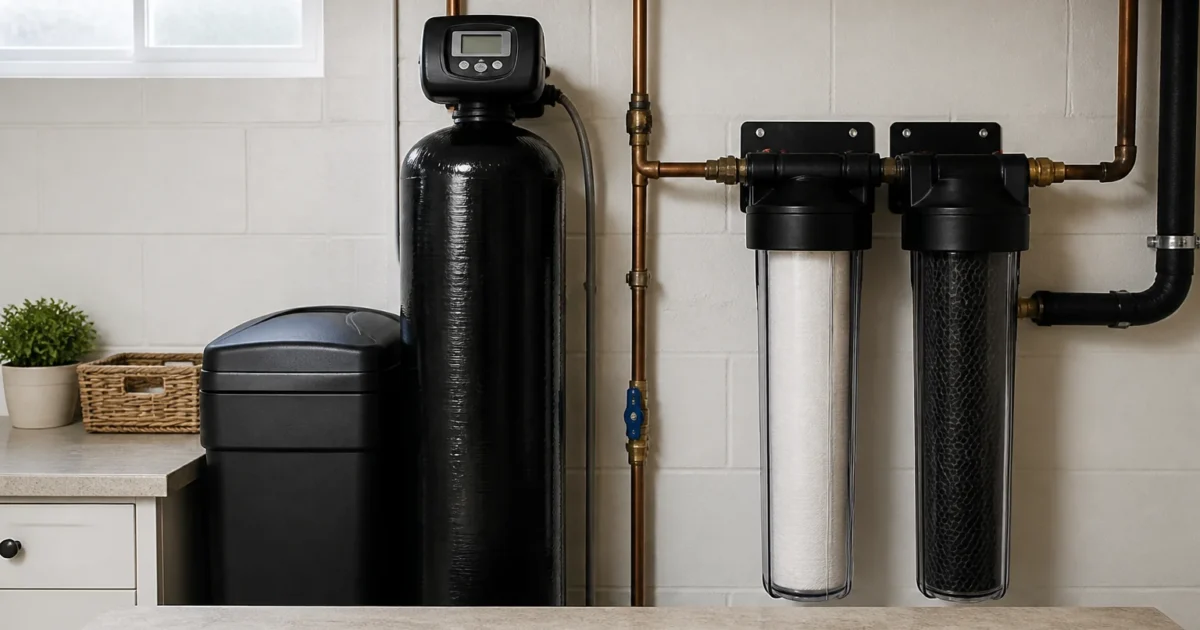
A water softener uses cation-exchange resin to swap calcium and magnesium ions – the minerals that cause hardness – for sodium or potassium ions, per EPA. NSF/ANSI 44 is the standard that governs softeners built around this process, regenerated with sodium or potassium chloride. Periodically the resin bed needs recharging: EPA notes that regeneration flushes the system and reloads it with sodium ions, which is why softeners use salt and water on a cycle rather than running maintenance-free. Our water softener salt types guide covers the rock, solar, and evaporated options and what actually changes between them.
The part worth saying plainly: a softener is not a general contaminant filter. Exchanging hardness ions is a different job than removing dirt, chemicals, or organics, and Pentair’s own commercial softening guidance is explicit that softening does not substitute for filtration. Pentair If your water tastes like chlorine or runs cloudy with sediment, a softener alone will not fix either problem – it will just make the same water softer.
What a Whole-House Filter Actually Does (and Doesn’t)
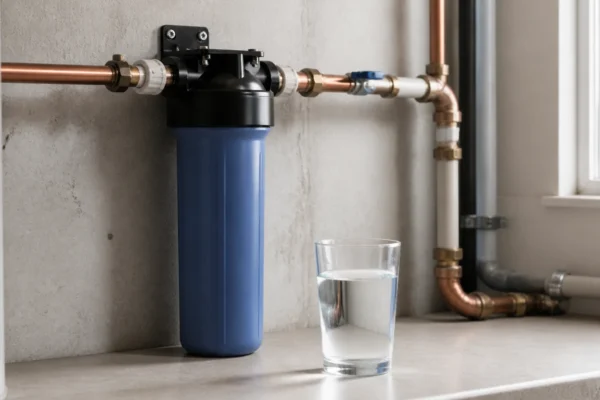
A whole-house sediment filter removes suspended particles – sand, silt, clay, oxidized iron, manganese, and sulfur particles – before they reach your fixtures, per Virginia Tech Extension. Add activated carbon and the system can also address chlorine, taste, odor, and some organic compounds; higher-capacity point-of-entry carbon stages exist specifically for contaminants you want removed before water enters the house. EPA notes that granular activated carbon in particular handles taste-and-odor compounds, natural organic matter, VOCs, and disinfection byproduct precursors well. NSF/ANSI 42 is the certification to look for on the box for a chlorine taste-and-odor claim.
What it doesn’t do: soften water. NSF draws a hard line between chlorine/taste/odor filtration under NSF/ANSI 42 and cation-exchange hardness reduction under NSF/ANSI 44 – they are separate standards for separate jobs. WQA adds that antiscaling devices sometimes marketed as softener alternatives may reduce scale behavior but do not lower total calcium or magnesium content, and are not proven to get water below 1 grain per gallon of hardness, per WQA. If you’re also weighing a whole-house system against an under-sink reverse osmosis unit for drinking water specifically, our whole-house filter vs under-sink RO guide covers that separate decision.
How Hard Is “Hard”? The Grains-Per-Gallon Thresholds
Hardness gets measured two ways – milligrams per liter as calcium carbonate, or grains per gallon (gpg) – and WQA’s conversion is that 1 gpg equals 17.1 mg/L. USGS classifies water as soft at 0-60 mg/L, moderately hard at 61-120 mg/L, hard at 121-180 mg/L, and very hard above 180 mg/L, per USGS.
Translated to the grain scale WQA uses, under 1 gpg is soft, 1.0-3.5 gpg is slightly hard, 3.5-7.0 gpg is moderately hard, 7.0-10.5 gpg is hard, and above 10.5 gpg is very hard, per WQA. Pentair’s commercial softening guide uses the same bands and states that water at 7 gpg or above is generally considered hard. A regional hardness map can point you toward the general odds, but USGS itself warns that its national map is 1975 regional data, not designed for an individual homeowner’s decision. A test kit or a lab test on your own water is the only number that actually settles the water softener vs whole-house filter question for your address.
Sizing a Softener – and the Iron Exception
Once you know you need a softener, sizing it correctly matters as much as buying one at all. The starting math is daily hardness load: people in the home multiplied by gallons used per person per day multiplied by hardness in gpg. USGS puts average indoor use at roughly 80-100 gallons per person per day, and EPA WaterSense cites an average of 82 gallons per person per day at home, per EPA WaterSense.
Worked example: a 4-person household at 82 gallons per person per day and 12 gpg hardness has a daily load of 3,936 grains (4 x 82 x 12). A 32,000-grain unit would theoretically cover about 8.1 days at that load (32,000 / 3,936) before it needs to regenerate – though real-world programming, reserve capacity, salt dose, and iron content typically shrink that number. WQA defines rated softening capacity as the manufacturer’s stated grains removed between regenerations at a specified flow rate and salt dose – the number on the spec sheet, not a guess.
Rheem’s own 2026 comparison chart shows why rounding up matters: a calculated need of 36,800 grains points to a 42,000-grain model, not the smaller 32,000-grain unit, per Rheem. Our sizing guide walks through this math for your own household, and the softener sizing calculator runs the numbers automatically once you know your hardness and household size.
Iron changes the math, and the honest rule is narrower than most marketing suggests: a softener handles clear-water ferrous iron only, within the model’s specific rating, and only after you add iron compensation to the hardness setting – it is not “any softener handles iron,” per Whirlpool’s owner’s manual. That manual instructs adding 5 grains to the hardness setting for every 1 ppm of ferrous clear-water iron, and states that ferric red-water iron, bacterial iron, and organically bound iron are not removed by a softener at all.
Ratings vary by model: Rheem’s RHS18 is rated for 3 ppm ferrous iron, the RHS32 for 8 ppm, and the RHS42/RHW42 for 11 ppm, while Whirlpool’s WHEC46 lists a 12 ppm maximum. If your iron is red, cloudy, or bacterial rather than clear-water ferrous, a softener is the wrong tool regardless of its rating – our iron-in-well-water guide walks through testing your iron type first and matching it to the right filtration approach.
When You Genuinely Need Both
A home can need a softener and a whole-house filter at the same time, and it’s more common than the either-or framing suggests. WQA and Virginia Tech Extension both describe the same real-world pattern, per Virginia Tech Extension: 10 gpg hardness plus chlorine taste on municipal water, or hard well water plus sediment, iron, manganese, or sulfur odor.
The typical order matters for equipment life: sediment filtration goes first when particles are present, so grit doesn’t foul downstream media; carbon filtration handles chlorine, taste, odor, or organics; softening comes after, since a softener’s resin performs better on water that’s already had particulate load removed. On well water specifically, CDC’s recommendation is to test first and match treatment to the specific germ or chemical of concern, because no single treatment type protects against every problem a private well can have, per CDC.
What Whole-House Water Treatment Actually Costs
Equipment prices and installed prices tell two different stories, and both matter to the water softener vs whole-house filter decision.
| Item | Typical cost | Source |
|---|---|---|
| Salt-based softener, 32,000-42,000 grain (equipment only) | $489-$849 | Home Depot; Lowes; Aquasure |
| Whole-house sediment/carbon filter (equipment only) | $156-$850 | Lowes; Home Depot |
| Softener salt, 40-lb bag | $8.58-$10.58 | Home Depot |
| Whole-house cartridge replacement | $17-$126 (basic sets); up to $357 (carbon media tank) | Home Depot |
| Professional installation, softener (average, full range) | ~$1,500 average; $200-$6,000 range | HomeAdvisor |
| Labor-only installation | $150-$1,000 | HomeAdvisor |
A few specifics behind those ranges: Home Depot lists the Rheem 32,000-grain RHS32 at $489 and the 42,000-grain RHS42 at $589, with the Wi-Fi-enabled RHW42 at $689. Lowes lists the Whirlpool 33,000-grain WHES33 at $519, and Aquasure’s Harmony line runs $539.99 for a 32,000-grain unit up to $849.99 for larger fine-mesh-resin models. On the filter side, Lowes lists whole-house systems from $155.99 for a basic 2-stage iSpring up to $849.99 for multi-contaminant systems, and Home Depot lists the iSpring WGB32B-DS at $464.26.
The installed number is the one that surprises people most: HomeAdvisor’s 2026 data puts full installed softener cost at a $200-$6,000 range depending on system type, home size, hardness, and any plumbing or electrical work required, per HomeAdvisor.
Water Softener vs Whole-House Filter: The Bottom Line
Buy a softener if your symptoms are scale, spotting, soap scum, stiff laundry, and a lab or strip test puts your hardness at 7 gpg or above. Buy a whole-house filter if your symptoms are chlorine taste, sediment, iron or manganese staining, or sulfur odor, and match the filter media (sediment, carbon, or a targeted iron/manganese stage) to what the test actually found. Buy both if your test results land in both columns – which, on hard well water especially, is a genuinely common result, not an upsell.
What doesn’t work is buying either system on a guess and hoping it covers everything. A softener will not touch chlorine taste. A carbon filter will not touch hardness. The $10-$30 test that tells you which one you have is the cheapest step in this entire decision.
What to Do Next
If your test says hardness, start with our sizing guide and run your numbers through the softener sizing calculator before you buy. If iron showed up on the test, read our iron-in-well-water guide first – iron type changes the answer more than any other single factor. If you’re deciding between a whole-house system and a smaller under-sink reverse osmosis unit for drinking water specifically, our whole-house filter vs under-sink RO guide covers that trade-off, and our NSF filter certifications guide explains how to verify any system’s actual certified claims before you buy it.
Can a water softener replace a whole-house filter, or the other way around?
No. A softener exchanges calcium and magnesium for sodium or potassium ions and does not filter sediment, chlorine, or organics; a whole-house sediment or carbon filter does not reduce hardness. NSF certifies them under separate standards – NSF/ANSI 44 for softening, NSF/ANSI 42 for chlorine taste and odor – because they are built to do different jobs.
How do I know if my water is actually hard enough to need a softener?
Test it. USGS and WQA both put “hard” at roughly 7 gpg (121 mg/L) and above, with anything past 10.5 gpg considered very hard. A regional hardness map can suggest the odds, but USGS itself says that map isn’t designed for an individual home’s decision – a test strip or lab test on your own tap water is what actually settles it.
Will a water softener remove the iron staining in my sinks?
Only sometimes. A softener can handle clear-water ferrous iron within its rated limit, and only after you add iron compensation to the hardness setting – Whirlpool’s manual specifies 5 grains added per 1 ppm of ferrous iron. Ferric (red-water), bacterial, or organically bound iron is not removed by a softener and needs filtration or a different treatment approach instead.
How much does it cost to install a water softener versus a whole-house filter?
Equipment alone runs $489-$849 for a mainstream 32,000-42,000 grain softener and $156-$850 for a whole-house sediment/carbon filter system. Add professional installation and HomeAdvisor’s data shows a softener averaging about $1,500 installed, with a full range of $200-$6,000 depending on home size, hardness, and any plumbing or electrical work needed.
Do I need both a softener and a whole-house filter?
Sometimes, yes – it’s a genuinely common result on hard well water, where hardness, sediment, iron, manganese, or sulfur odor can all show up on the same test. When both problems are real, the typical setup runs sediment filtration first, then carbon, then softening, so the softener resin isn’t fouled by particulate load it was never built to handle.
Sources
- USGS: Hardness of water
- WQA: Scale deposits and perceptible hard-water issues
- WQA: Glossary of terms
- NSF: Standards for water treatment systems
- Virginia Tech Extension: Household water treatment
- Minnesota Department of Health: Hydrogen sulfide in well water
- EPA: Secondary drinking water standards
- EPA: Cation-exchange water softeners
- EPA: Overview of drinking water treatment technologies
- Pentair: Softening and ion exchange, issues and solutions
- CDC: Guidelines for treating well water
- USGS: How much water do I use at home each day
- EPA WaterSense: Statistics and facts
- Rheem: Water softener comparison chart
- Whirlpool: Water softener owner’s manual
- Whirlpool: WHEC46 Wi-Fi water softener
- Home Depot: Rheem RHS32 32,000-grain softener
- Home Depot: Water softeners
- Lowes: Whirlpool WHES33 33,000-grain softener
- Aquasure: Harmony softener collection
- Lowes: Whole-house filtration systems
- Home Depot: iSpring WGB32B-DS whole-house system
- iSpring: WGB32B whole-house system
- Home Depot: Whole-house filter replacements
- Home Depot: Water softener salt
- HomeAdvisor: Water softener installation cost
- HomeAdvisor: Who to hire for water softener installation