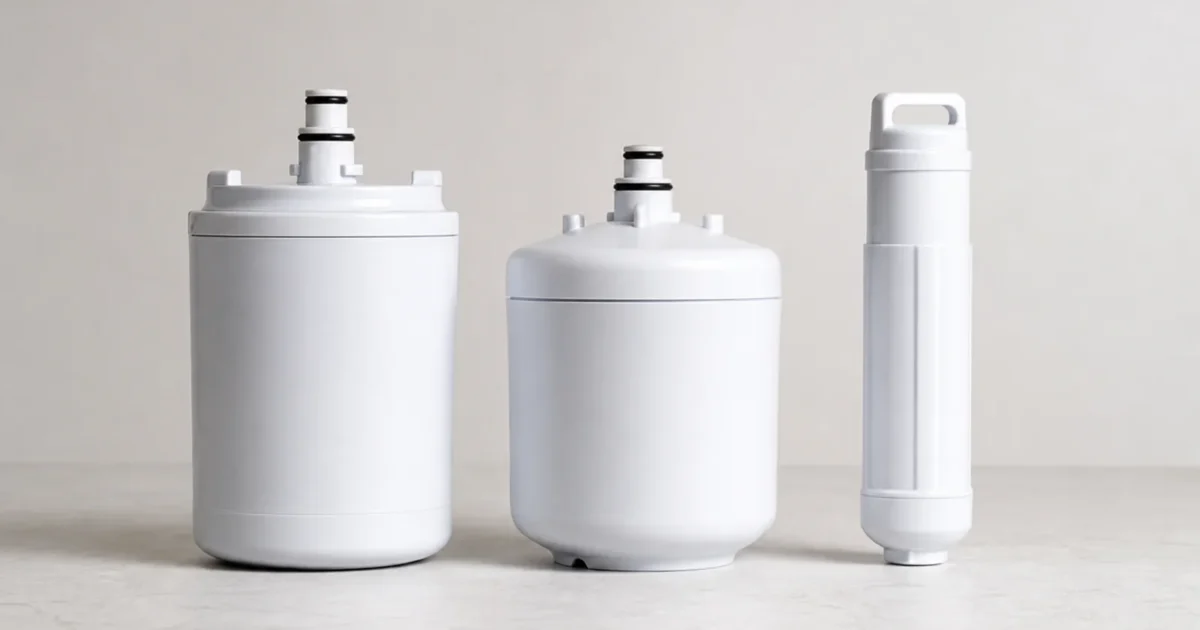
Are water filters interchangeable? Sometimes physically, rarely equivalently. A third-party cartridge can seat and seal in your housing perfectly and still not carry the certifications the filter it replaces does – and on some fridges it will not even be accepted by the machine.
The question people type is one question. The honest answer is three separate questions stacked on top of each other: does it fit, does it filter the same, and is it the filter your production year actually takes. A “compatible” filter can pass the first test and quietly fail the other two. This article walks all three layers, with the real model numbers where each one bites, and ends with the one rule that prevents the wrong-filter purchase entirely.
Are Water Filters Interchangeable? The Three-Layer Answer
Interchange has three layers, and a filter is only a true substitute when it clears all three:
| Layer | The question | Where it bites |
|---|---|---|
| Physical fit | Does it seat, seal, and lock in the housing? | Look-alike cartridges with different keying; RFID-chip fridges that reject non-genuine filters |
| Certification | Does the exact SKU carry the same verifiable listings? | “Fits like the original” filters that are NSF 42 only, replacing an NSF 53 original |
| Model year | Is this the filter your specific production year takes? | Same fridge series, different filter – round vs square Samsung cartridges, push-in vs twist-in Frigidaire |
Layer 1 is where interchangeability is real and common. Layers 2 and 3 are where the wrong-filter trap lives. Take them in order.
Layer 1: Physical Fit – One Housing, Many Badges
Physical interchange is genuinely widespread, because most “different brands” of refrigerator are the same manufacturer wearing different badges. Our cross-reference currently tracks 58 filter form-factor families across fridge, reverse osmosis, pitcher, and whole-house categories – 39 of them refrigerator families – and many of those families serve four or more brand names with one cartridge.
The cleanest example: EveryDrop Filter 1 (EDR1RXD1, also sold as W10295370A). That single cartridge serves Whirlpool, Maytag, Amana, KitchenAid, and JennAir – all Whirlpool-built fridges – and the Kenmore filter numbers 9081 / 46-9081 and 9930 / 46-9930 are the same cartridge rebadged for Sears-sold, Whirlpool-made models. Five badges, one filter. That is real interchangeability, born of shared manufacturing, not aftermarket cleverness.
At the far end of the spectrum sit true standard form factors. A 10” x 4.5” “Big Blue” whole-house sediment cartridge like the GE FXHSC drops into housings from Pentair/Pentek, Culligan, and essentially any brand built to that standard size. Where a dimensional standard exists, filters really are interchangeable in the plain sense of the word.
Then there is the counter-example that proves fit is never guaranteed: GE’s chipped cartridges. The GE RPWFE carries an RFID chip the refrigerator reads; per GE Appliances’ own support documentation, a wrong or non-genuine filter makes the dispenser refuse to run and the display read “Leak Detected.” The similar-looking XWFE also carries a chip, and a GE firmware update has made some fridges reject the older non-chipped XWF and aftermarket copies outright. GE supplies a bypass plug (WR17X23645) to run without a filter, at which point the screen reads “Unfiltered Water.” We cover that whole family in our GE filter guide (RPWFE vs RPWF vs XWFE). If your fridge reads a chip, physical fit alone settles nothing – confirm your exact model before buying anything.
Layer 2: Certification – A Filter That Fits Is Not a Filter That Matches
This is the layer most “compatible filter” listings skip past, and it is where the numbers get uncomfortable.
Quick vocabulary: NSF/ANSI 42 is the aesthetic standard – chlorine taste and odor. NSF/ANSI 53 is the health standard – lead, cysts, and other contaminants with health effects. A cartridge certified only to 42 makes water taste better and makes no health claim. Most OEM refrigerator filters carry 53: in our cross-reference, 28 of the 39 OEM fridge-filter families – about 72% – hold an NSF 53 listing.
Now the aftermarket. In June 2026 we checked the nine recurring aftermarket refrigerator-filter brands in our data – 121 listings’ worth – against the official certification databases. The result, as of that verification pass:
- Zero of the nine carry NSF 53 across their full line.
- Four (Waterdrop, AquaCrest, Tier1, Mist) are NSF-listed for lead – but on select SKUs only. Waterdrop, the strongest of the nine, holds NSF 53/401 on roughly
107of about555listed SKUs – around one in five. - Two (ICEPURE, PurePlus) back their lead claims through IAPMO listings, not NSF – a legitimate accredited certifier, but you will not find them at info.nsf.org.
- Two (Glacier Fresh, Pureline) are verifiable to 42 only. Pureline’s “372” listing is a lead-free materials standard, not lead reduction – an easy label to misread.
- One (Instapure) we could not verify in the NSF database at all.
- None of the nine carry P473, the PFOA/PFOS standard, on any SKU we found.
So the honest picture is not “aftermarket filters are junk” – four of nine brands have genuinely NSF-listed lead SKUs. The trap is that certification is SKU-specific while marketing is brand-wide. “Fits and filters like the original” on the box tells you nothing about the cartridge in your hand. The distinction that matters is NSF-LISTED – verifiable in the official NSF certification database – versus manufacturer-claimed. A claim you cannot look up is not a certification. We keep a plain-English version of these lookups in our filter certification registry, brand by brand and SKU by SKU.
One nuance for fairness: certifier and quality are not the same axis. Some OEMs (GE and Frigidaire among them) certify their own filters through WQA rather than NSF’s database. IAPMO and WQA are accredited certifiers testing against the same NSF/ANSI standards. The test is verifiability, not the logo – if the exact SKU appears in an accredited listing covering the contaminant you care about, the claim is real.
Layer 3: Model-Year Drift – Same Fridge Line, Different Filter
The third layer catches people who did everything else right: filters change within a fridge line across production years.
Samsung is the textbook case. The round-cylinder HAF-CIN (part DA29-00020B) serves many Samsung side-by-side and French-door models, per Samsung’s HAF-CIN product page. Newer Samsung French-door and Bespoke models take the square, blocky HAF-QIN (part DA97-17376B), per Samsung’s HAF-QIN page. Both are “Samsung interior filters.” They do not fit each other’s housings at all. Buy by the series name – “it’s a Samsung French door” – and you have coin-flip odds of the wrong shape arriving.
Part numbers drift even when the cartridge does not. Samsung’s DA29-00020A is the discontinued predecessor of the current -00020B; the older DA97-08006C is the predecessor of DA97-17376B. Frigidaire runs the same gauntlet: the ULTRAWF is a push-in cartridge and the EPTWFU01 is a twist-in – adjacent-sounding names, different mechanisms – and the current PurePour PWF-1 (FPPWFU01, rated about 200 gallons) has a chip-equipped successor, the PWF-2 (FPPWFU02, rated about 125 gallons), that is not freely interchangeable with it on Connect-enabled models.
The defense is boring and absolute: match the part number printed on the filter currently in your fridge, or listed in your fridge’s manual for your full model number – never the brand, never the series.
When an Aftermarket Filter Is an Honest Choice – and When It Is a Gamble
Aftermarket is not a dirty word. It is a fine, honest choice when three things are true: the fit family is confirmed for your exact model, the specific SKU carries a verifiable listing for the contaminant you care about, and your fridge does not enforce a chip. For a chlorine-taste concern on a chip-free Whirlpool, a 42-listed aftermarket cartridge at a third of the OEM price is a rational buy, and we name certified options in our EveryDrop-compatible alternatives guide.
It becomes a gamble in three situations. First, chip-enforced fridges – GE RPWFE/XWFE models and Frigidaire PWF-2 Connect models – where a non-genuine cartridge may simply be refused. Second, a lead or cyst concern paired with a 42-only SKU: the water will taste fine while the health claim you assumed is absent. Third, any brand whose listings you cannot find in an accredited database – there, you are trusting a label, not a test.
The trade-off, said out loud: OEM filters cost more and are certified nearly across the board; aftermarket filters cost less and are certified selectively. Neither fact is a scandal. You just have to check the one SKU you are about to buy.
How to Check in 60 Seconds
Three steps, in order:
- Read the filter, not the fridge. Pull the current cartridge and read the model printed on it (or find the filter part number in your manual under your full model number). This one step defeats the model-year trap.
- Run it through our filter finder. It maps your filter or fridge model to its form-factor family, the OEM part, and the aftermarket options with their certification status stated plainly. The finder exists because fit questions are what readers actually ask us most – our finder data study breaks down what those questions look like.
- Verify the exact SKU. Before buying an aftermarket cartridge for a health claim, confirm that specific SKU in the NSF listing database or our certification registry. Thirty seconds of lookup is the entire difference between a certified filter and a claimed one.
Are refrigerator water filters interchangeable between brands?
Often, yes – when the brands share a manufacturer. EveryDrop Filter 1 (EDR1RXD1 / W10295370A) serves Whirlpool, Maytag, Amana, KitchenAid, and JennAir, and Kenmore 9081 / 9930 are the same cartridge rebadged. But interchange follows the form-factor family, not the badge – confirm your model’s family first.
Will an aftermarket filter work in a GE fridge with the RFID chip?
Frequently not. On RPWFE fridges, GE documents that a non-genuine filter makes the dispenser refuse to run and the display read “Leak Detected,” and a firmware update has led some XWFE fridges to reject non-chipped filters. Verify that your specific model accepts a non-OEM cartridge before spending the money.
If an aftermarket filter fits, does it filter the same?
Not necessarily – this is the wrong-filter trap in one sentence. In our June 2026 check of nine recurring aftermarket brands, zero carried NSF 53 (lead) across their full line; four were NSF-listed for lead on select SKUs only. A cartridge can fit perfectly and carry a weaker certification than the filter it replaces.
How do I know if a specific filter SKU is actually certified?
Look it up rather than trusting the box: search the exact SKU at info.nsf.org (or the IAPMO/WQA listings, which are also accredited), or use our certification registry where we have done the lookup already. NSF-listed means verifiable; “tested to NSF standards” on a label, alone, is a claim.
What is the confirm-your-model rule?
It is the one habit that beats all three layers at once: before you buy any filter, confirm the model printed on your current filter or in your fridge’s manual for your full model number. One fridge line can use different filters across production years – so confirm your model first, every time.
Related guides
Midea Refrigerator Water Filter: MIWF6200 vs MIWF8200 vs MIWF8900
Midea currently sells three refrigerator water filters – MIWF6200, MIWF8200, and MIWF8900 – and mixing them up is…
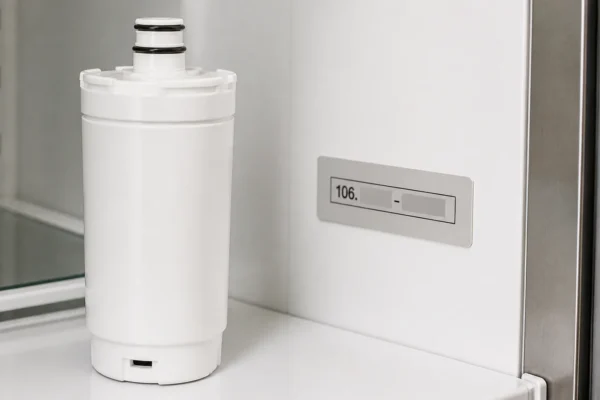
Kenmore Refrigerator Water Filter: Cross-Reference by Model
Kenmore doesn’t build refrigerators. It’s a private-label brand, so your Kenmore refrigerator water filter is actually determined by…
Does a Refrigerator Filter Remove PFAS? What NSF P473 Actually Certifies
Does a refrigerator filter remove PFAS? Not in any certified sense we can find. We checked every refrigerator…