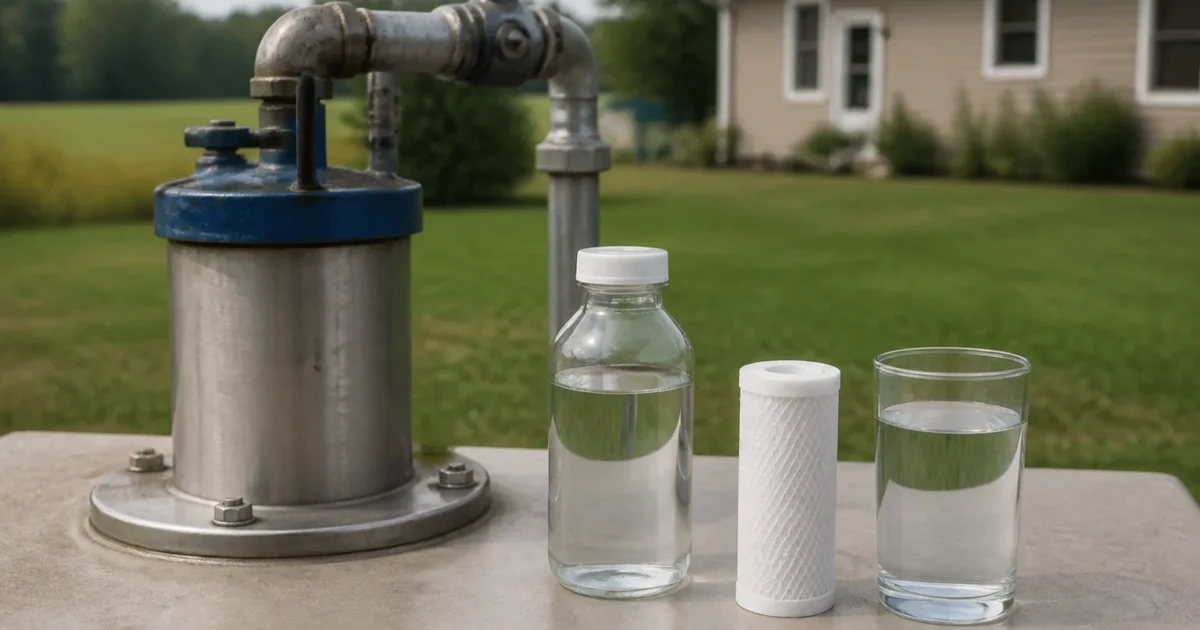
Arsenic in well water is dangerous precisely because nothing about your water will tell you it’s there. The EPA’s enforceable limit of 0.010 mg/L – 10 micrograms per liter, or 10 parts per billion – applies to public water systems. It is not a federal rule that anyone enforces at your private well. EPA says plainly that private domestic well water is not regulated under the Safe Drinking Water Act, and CDC says the same: the rules that protect public systems do not apply to a privately owned well. Testing, maintenance, and any treatment decision are the owner’s job. Arsenic also gives no warning on its own – it’s tasteless, colorless, and odorless, so a well that looks and tastes completely clean can still carry it well above the level that matters.
This guide covers what the EPA limit actually means for a private well owner, the health basis behind it (without the scare tactics), how common arsenic really is in well water nationally, the one technical detail – arsenic speciation – that decides whether a given filter will work, and the honest, certification-backed answer to what actually removes it.
Arsenic in Well Water: Is There a Limit That Applies to You?
Not one that anyone enforces for you. EPA’s National Primary Drinking Water Regulations set the arsenic maximum contaminant level (MCL) at 0.010 mg/L, with a maximum contaminant level goal (MCLG) of zero – but that MCL is a legal requirement for public water systems, not private wells. If you’re on a private well, EPA is direct about it: no federal agency is routinely testing or enforcing that limit for you. The canonical version of this to keep in mind is simple – EPA’s 10 ppb arsenic limit applies to public water systems, and a private well owner has to treat it as a practical benchmark, not a guarantee anyone is checking.
Some states go further than the federal number. New Jersey recommends whole-house arsenic treatment for private wells once arsenic exceeds 5 µg/L – half the federal benchmark – and NIEHS notes that some states have adopted standards stricter than 10 ppb. That’s state-specific guidance, not a national rule, so don’t assume it applies outside that state.
A few states also publish immediate-action thresholds for high results. Washington’s health department advises switching to bottled water for drinking and cooking while you sort out long-term options, and recommends stopping drinking or food-prep use immediately once arsenic tests above 50 ppb. Massachusetts sets its own immediate-action line at 200 ppb. Neither of those contradicts the federal MCL – they’re state public-health guidance for what to do right now if a result comes back high, not a different legal limit.
The Health Basis: Why Long-Term Arsenic Exposure Matters
Arsenic is a long-term exposure issue, and it deserves a measured explanation rather than a scary one. The risk depends on the arsenic form, the dose, how long you’re exposed, how you’re exposed, and your own susceptibility – ATSDR’s clinician guidance is the strongest source for that nuance. EPA links long-term ingestion of inorganic arsenic to skin, bladder, lung, kidney, nasal-passage, liver, and prostate cancers, plus cardiovascular, pulmonary, immunological, neurological, and endocrine effects. None of that is a verdict on any individual glass of water – it’s the reason testing matters, not a reason to panic.
The part worth repeating is that you cannot detect arsenic yourself. NIEHS confirms it’s tasteless, colorless, and odorless. Clear, good-tasting well water can still carry arsenic well above the level that matters – testing is the only reliable way to know.
Not every household use carries equal risk. Washington and Minnesota health departments both note that bathing and dishwashing are generally unlikely to cause problems, because arsenic isn’t well absorbed through skin and doesn’t evaporate easily – ingestion through drinking and food preparation is the priority. ATSDR recommends a certified filter or an alternate water source for drinking, cooking, food prep, and tooth brushing when arsenic removal is needed. Both states flag very high levels, around 500 µg/L, as a point for additional advice on broader household use – but at most residential levels, treating drinking and cooking water is the practical starting point, not necessarily the whole house.
How Common Is Well-Water Arsenic Nationally?
More common than most well owners assume, and geography alone won’t tell you whether your well is one of the ones affected. USGS modeled arsenic probability above 10 µg/L using results from 20,450 domestic wells, and estimated that about 2.1 million people in the conterminous United States use domestic wells with predicted arsenic concentrations above that threshold – a range of roughly 1.5 to 2.9 million people accounting for model uncertainty. High-arsenic wells can turn up across the country, with some regions more affected than others.
Treat that map as a screening tool, not a substitute for your own results. USGS itself says the only way for a well owner to be certain what’s in their water is to test that well. Later USGS modeling also suggests drought conditions could raise the modeled population above 10 µg/L from roughly 2.7 million to 4.1 million people nationally – useful context for why regional risk shifts, but not a prediction for any specific address.
If your well is new, timing matters too. Minnesota’s health department suggests retesting a new well about six months after construction if arsenic shows up, because levels can move in the first few months. USGS found measured arsenic in new wells was more consistent when samples were filtered, drawn from household plumbing rather than the drill rig, and collected several months after construction rather than immediately.
The Detail That Decides Your Filter: Arsenic Speciation
This is the single most important technical fact in this entire guide, and it’s the reason two households with “arsenic in the water” can need two completely different filters. Arsenic in groundwater shows up mainly in two forms: arsenite, or As(III), and arsenate, or As(V). The EPA arsenic treatment handbook explains why the distinction matters – at the pH of most natural water, roughly 6 to 9, As(III) is electrically neutral, which makes it harder to remove by adsorption, anion exchange, or coprecipitation. As(V) is negatively charged at that same pH range, which makes it noticeably easier to remove with those same processes.
That’s the core reason a filter that performs well on pentavalent arsenic can underperform on trivalent arsenic in the same house. EPA describes converting As(III) to As(V) with an oxidant as critical to getting good performance out of many arsenic treatment processes – but oxidation and removal are two separate steps. Oxidizing arsenic changes its form into something more removable; the water still needs a treatment process that actually removes the oxidized arsenic afterward.
Don’t assume you know your well’s arsenic form from geography, depth, or how the water looks. A U.S. EPA research-program study of 65 wells found some were predominantly As(V), some predominantly As(III), and some a mix of both. Speciation also requires the lab to handle the sample correctly – filtration, preservation chemistry, refrigeration, and light protection can all affect whether the As(III)/As(V) ratio in your sample still reflects your actual well water by the time it’s tested. Don’t collect a routine total-arsenic sample and expect to request speciation on it later; ask the lab for speciation-specific bottles and instructions before you collect.
What Actually Removes Arsenic From Well Water
Treating arsenic in well water comes down to matching a certified technology to your speciation result – not buying whatever the label implies. Reverse osmosis can reduce arsenic, but it is not a universal fix and shouldn’t be marketed or bought as one. NSF/ANSI 58 covers point-of-use RO systems and includes an optional arsenic (and pentavalent-arsenic) reduction claim – optional, meaning plenty of NSF/ANSI 58-certified units carry no arsenic claim at all. A valid claim has to name arsenic specifically and apply to your exact product model. On NSF’s own listing search the claim appears verbatim as “Arsenic (Pentavalent)” under standards 53 and 58 – and this is the part well owners miss: these listings are certified for treating incoming arsenic only up to a stated level. Read that incoming-level figure off your model’s listing and compare it against your own lab result. If your raw water tests above it, a product carrying the claim has not been certified for water like yours.
RO is most reliable against pentavalent arsenic, As(V), or water where As(III) has already been oxidized. A USGS study of household RO systems in a high-arsenic region of Nevada found average removal of 80.2 percent – solid, but wells dominated by As(III) saw significantly lower efficiency, and some treated water still came out above 10 ppb.
Anion exchange removes negatively charged arsenic species – mainly As(V) – by exchanging them with chloride on a resin bed, per EPA. Neutral As(III) is a problem for this technology unless it’s been oxidized first; full-scale ion-exchange systems in an EPA arsenic demonstration program removed arsenic, nitrate, and uranium below their MCLs when properly designed and maintained, though fouling and delayed regeneration cut into real-world performance.
Iron-based adsorptive media – granular ferric oxide or ferric hydroxide – can also remove arsenic, but capacity depends heavily on your water’s pH and competing ions like silica, phosphate, fluoride, and sulfate. All three – anion exchange, adsorptive media, and RO – are EPA-demonstrated approaches, but none is a drop-in fix without matching the design to your actual water chemistry.
A standard carbon filter, refrigerator filter, or generic pitcher is not arsenic protection unless the specific product carries an explicit arsenic reduction certification. CDC notes that pitcher and refrigerator filters mostly use activated carbon for taste and odor, and NSF is blunt that consumers have to check what a specific product is certified to remove – “carbon filter” and “NSF certified” are not the same thing as “certified for arsenic.”
That said, don’t go to the other extreme either: some certified pitcher products do carry pentavalent-arsenic reduction claims under specified influent limits. The accurate statement is that most ordinary carbon pitchers are not arsenic treatment, and a pitcher only counts if its exact model has an explicit arsenic reduction claim on the certifier’s listing – check which NSF standard actually covers your contaminant before assuming.
Certification also isn’t limited to NSF – WQA and IAPMO are both accredited certifiers, so “NSF listing” shouldn’t be shorthand for all valid certification. And NSF/ANSI 58 certification by itself doesn’t guarantee an arsenic claim: NSF’s own listing for iSpring RCC7AK variants shows certification for TDS reduction and other claims, but the viewed record didn’t list pentavalent arsenic for those variants. That doesn’t prove the system can’t reduce arsenic – it proves you need to check the exact model’s certified listing, not the product category.
Two things worth ruling out plainly. A conventional cation-exchange softener built for hardness is not an arsenic treatment system – Minnesota’s health department and NIEHS both say so, though CDC notes engineered ion-exchange systems may remove specific charged contaminants if designed and labeled for that purpose. And boiling does not remove arsenic – NIEHS confirms boiling will not remove it, and Minnesota’s health department goes further, warning that boiling only concentrates arsenic as some of the water evaporates – the wrong instinct for a contaminant people are used to boiling away for germs.
The Test-First Workflow for Arsenic in Well Water
CDC recommends a state-certified laboratory for any well-water test. The workflow below follows the sequence EPA, CDC, and USGS guidance converge on:
- Test raw well water through a certified drinking-water lab – not a TDS meter. USGS’s Nevada RO study is a good reminder that “low TDS” and “safe arsenic level” aren’t the same measurement.
- Start with total arsenic, since EPA’s public-water MCL is based on total arsenic at 0.010 mg/L.
- If the result comes back elevated, reduce ingestion exposure first. EPA advises contacting your local health department and retesting to confirm, and Washington recommends bottled water for drinking and cooking while you sort out treatment.
- Near or above the relevant benchmark, order speciation for As(III) and As(V) – ask the lab for speciation-specific sampling instructions before you collect the sample.
- Test supporting water chemistry – pH, iron, manganese, sulfate, nitrate, TDS, and hardness all affect which technology will actually work.
- Match treatment to your lab results and real certification or engineering evidence, adding oxidation ahead of RO, anion exchange, or adsorption if As(III) is significant.
- Retest treated water after installation, and keep the system maintained on schedule. A certification claim or an installer’s promise isn’t the finish line – confirmed post-treatment results are.
Installation quality matters more than people expect. A Maine/New Jersey study of private-well arsenic treatment found failures more common among homeowner-installed or -maintained systems than vendor-installed or -maintained ones. For whole-house systems, high arsenic, significant As(III), or complex water chemistry, professional design and maintenance is the safer default, not an upsell.
One more honesty check: an arsenic system solves arsenic. It doesn’t automatically address nitrate, uranium, manganese, PFAS, or bacteria that might also be in your well, and competing ions in your water can reduce how well an arsenic system performs. Test broadly, not just for the one contaminant you’re worried about.
What Treating Arsenic in Well Water Actually Costs
Treat these as examples, not current quotes – installed cost depends on your raw arsenic level, whether As(III) needs oxidation, your water chemistry, and the technology chosen. A New Hampshire DES survey cited by Massachusetts puts median installed point-of-use treatment at $1,200 with $343 in median annual maintenance, and median whole-house installation at $3,000 with $550 annual. UMass Extension cites roughly $950-$1,300 for a point-of-use RO device with built-in pre-oxidation for As(III).
Testing itself is comparatively cheap: Washington estimates arsenic lab tests at $20-$35, and Massachusetts estimates $15-$30. Speciation, supporting chemistry, and post-installation verification add to that total, but the entry cost to know what’s actually in your water is small next to any treatment decision.
What to Do Next
Dealing with arsenic in well water rarely happens in isolation. If you’re on a well with other known issues – iron staining, sulfur odor, hardness – read our iron-in-well-water guide alongside this one, since co-contaminants change which system makes sense. Before buying any RO, anion-exchange, or adsorptive-media system for arsenic, confirm the exact model’s arsenic claim in our filter certification registry and see which NSF standard actually covers what so you’re not relying on a category name. If reverse osmosis is on your shortlist, our reverse osmosis guide covers the tradeoffs – water waste, pretreatment needs, and where it fits – in more depth.
Does the EPA’s arsenic limit apply to my private well?
No. The EPA’s 0.010 mg/L (10 ppb) arsenic limit is an enforceable standard for public water systems. Private wells are unregulated under the Safe Drinking Water Act, and EPA and CDC both say testing and treatment decisions are the well owner’s responsibility – no agency is routinely checking your well for you.
Can I tell if my well has arsenic by taste, smell, or clarity?
No. Arsenic in water is tasteless, colorless, and odorless. Clean-looking, good-tasting well water can still carry arsenic above the level that matters – a certified lab test is the only reliable way to know.
Does boiling remove arsenic from well water?
No, and it can make things worse. Boiling doesn’t remove arsenic, and as water evaporates during boiling, the remaining arsenic concentration can actually increase.
Does reverse osmosis remove arsenic from well water?
It can, but not automatically. A USGS study of household RO systems averaged 80.2 percent arsenic removal, but performance dropped significantly on wells dominated by trivalent arsenic (As(III)), and some treated water still exceeded 10 ppb. Look for an NSF/ANSI 58 listing that specifically names arsenic or pentavalent arsenic for your exact model.
Will a water softener remove arsenic from my well water?
Generally no. A conventional cation-exchange softener built for hardness is not an arsenic treatment system. Only an engineered ion-exchange system specifically designed and certified or validated for arsenic removal should be relied on for that purpose.
How much does it cost to test well water for arsenic?
Modestly. State health departments cite roughly $15-$35 for a basic arsenic lab test, though speciation testing, supporting water-chemistry tests, and post-treatment verification add to the total.
Sources
- EPA: National Primary Drinking Water Regulations
- EPA: Private Wells
- EPA: Protect Your Home’s Water
- CDC: Guidelines for Testing Well Water
- ATSDR: Arsenic Clinician Brief
- NIEHS: Arsenic
- NJDEP: Arsenic and Private Wells
- Washington DOH: Arsenic and Your Private Well
- Massachusetts: Arsenic in Private Well Water FAQs
- Minnesota Department of Health: Arsenic in Well Water
- USGS: Estimating High-Arsenic Domestic-Well Population
- USGS: Mapping and Characterizing the Arsenic Hazard in Private Wells
- EPA: Arsenic Treatment Handbook
- EPA: Arsenic Treatment Technology Demonstrations
- USGS: Effectiveness of Household Reverse Osmosis Systems in a High-Arsenic Region
- NSF: NSF/ANSI 58 Reverse Osmosis Overview
- NSF: Contaminant Reduction Claims Guide
- NSF: iSpring RCC7AK Listing
- CDC: Choosing Home Water Filters
- NJDEP: Private Well Treatment
- UMass Extension: Arsenic in Private Drinking Water Wells
Educational content only. Not a substitute for water testing or evaluation by a certified water-treatment professional or your local health department. Regulatory limits, state guidance, and product certifications can change – always verify current status with the EPA, your state health department, and the official NSF/WQA/IAPMO listing before making a decision. Use of any guidance from this guide is at your own risk.
As an affiliate, WaterByTheBook may earn from qualifying purchases – it costs you nothing and never changes which filter we say fits.
Related guides
What’s In My Tap Water? How to Check Your EPA Data and Pick a Filter
What’s in my tap water? is a question with a real, checkable answer for most U.S. households –…
Nitrate in Drinking Water: The Infant Risk, the EPA Limit, and What Actually Removes It
Nitrate in drinking water is one of the few contaminant stories with a genuine emergency dimension. For most…
Chloramine vs Chlorine: How to Tell What Your Utility Uses (and Why It Changes Your Filter)
Chloramine vs chlorine is not a question most homeowners think to ask – until a filter that used…