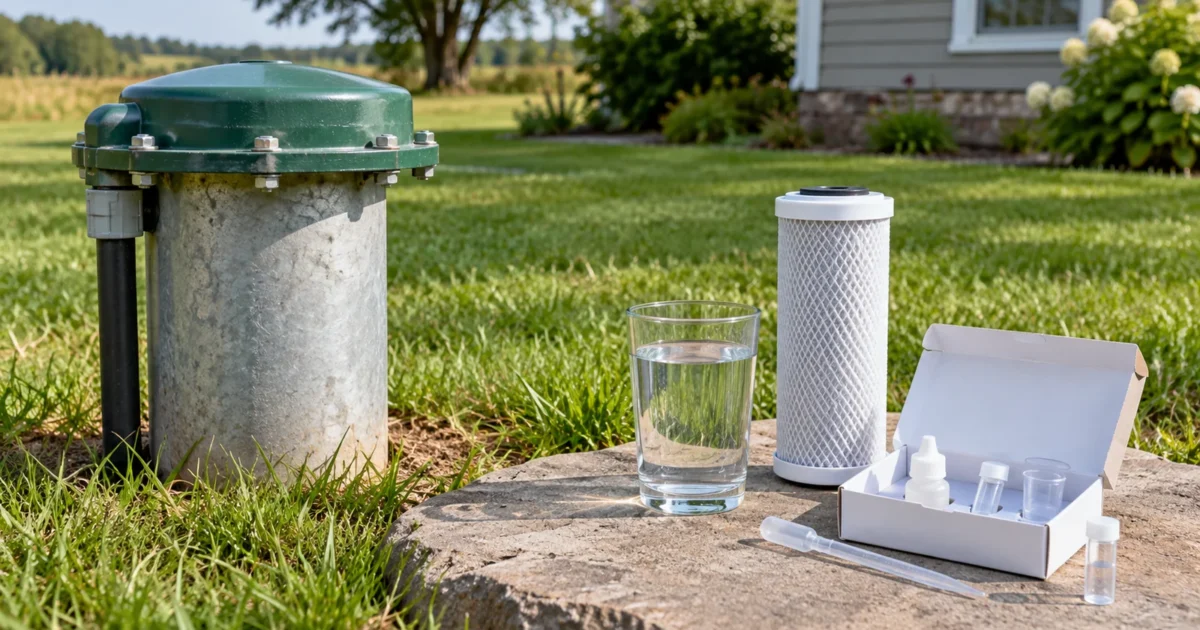
Arsenic in drinking water is the contaminant you cannot see, taste, or smell, and the one most people never think to test for. It is mostly natural – it dissolves into groundwater from arsenic-bearing rock – so it is a private-well and groundwater story. The EPA limit is 10 parts per billion, the health basis is cancer over the long term, and the fix is reverse osmosis or specialized media, not a carbon filter. This guide covers what arsenic is, what the agencies actually say about the risk, and what removes it.
The one thing to get right: a standard carbon pitcher or fridge filter does not reliably remove arsenic. The methods that work are reverse osmosis, anion exchange, and adsorptive media like activated alumina – and the form of arsenic matters, so the unit needs a specific certified arsenic-reduction claim. If you are on a private well, test first; the EPA’s limit does not cover you.
What arsenic is
Arsenic is a naturally occurring semi-metal in the earth’s crust. In water it is found mainly in two inorganic forms – arsenite (As III) and arsenate (As V) – which are the forms of concern; the organic arsenic in some seafood is generally far less toxic. It is tasteless, odorless, and colorless in water, so a laboratory test is the only way to know it is there.
The health basis (what the agencies actually say)
We will attribute every claim, because this is a long-latency risk, not an acute one. The National Toxicology Program lists arsenic as “known to be a human carcinogen.” ATSDR states that arsenic exposure “is associated with lung cancer, nonmelanoma skin cancers, and bladder cancer,” with limited evidence for kidney, liver, and prostate cancers, and that long-term ingestion is also associated with cardiovascular disease and type 2 diabetes. (ATSDR: arsenic) A crucial caveat ATSDR stresses: arsenic-related disease has a long latency – often years for skin changes and decades for cancers – so feeling fine does not mean the water is safe. The EPA set the health goal (MCLG) at zero, treating arsenic as a carcinogen with no risk-free threshold; the enforceable 10 ppb limit is a feasibility-balanced number, not a declaration that 10 ppb is risk-free. These are population-level associations from chronic exposure; no agency claims a given person at the limit will develop disease.
How arsenic in drinking water gets there
The dominant source is natural geology: arsenic dissolves into groundwater from naturally arsenic-bearing rock and soil as water moves through an aquifer, which is why certain regions and private wells are most affected. Secondary, mostly legacy human sources (per ATSDR) include metal smelting, wood preservation, and arsenical pesticides – though most U.S. arsenical pesticide uses were discontinued in the 1980s-90s, leaving some legacy soil contamination.
What the EPA limit is
The EPA’s enforceable maximum contaminant level (MCL) for arsenic is 10 ug/L (10 ppb), set by the 2001 Arsenic Rule that lowered the old 50 ppb standard, with compliance required by 2006. Two things to keep straight:
- Compliance is a running annual average. A system is judged by averaging quarterly results over a year at each sampling point, so a single quarterly sample over 10 ppb is not automatically a violation (unless one result is high enough to push the annual average over by itself).
- The health goal is zero. Because arsenic is a carcinogen, the non-enforceable MCLG is zero; the 10 ppb MCL reflects what is feasible to achieve. (EPA: arsenic rule history)
How to know if YOU have arsenic
- On a public system? Enter your ZIP in the water watchdog and read your annual Consumer Confidence Report – public systems test for arsenic and must report it.
- On a private well? Test it – this is the important one. The EPA’s limit does not cover private wells, and arsenic is odorless and tasteless, so it gives no warning. A certified lab test is the only way to know.
- In a known arsenic region or an older agricultural area? Treat that as a reason to test sooner.
How filtration helps (and what does not)
Arsenic is, like nitrate, a contaminant where the common filters fall short:
- Reverse osmosis (NSF/ANSI 58) – the most common effective point-of-use fix; look for a specific arsenic-reduction claim (these certify for arsenate, As V – oxidize As III first).
- Anion exchange and adsorptive media (activated alumina, iron-based media) – EPA-recognized arsenic treatments. Anion exchange and activated alumina work best on As V, so pre-oxidize As III. Granular ferric hydroxide (GFH), an iron-based medium, is the exception: EPA’s treatment review notes that “unlike AA, GFH does not require pre-oxidation.” (EPA: Technologies and Costs for Removal of Arsenic From Drinking Water)
- Oxidation/filtration matters: the trivalent form (As III) is poorly removed until oxidized to As V, so pretreatment is often needed – a step homeowners and even some installers miss.
- Does NOT work: standard activated carbon (a plain carbon pitcher or fridge filter) does not reliably remove arsenic.
Because the wrong unit here is falsely reassuring, verify the certification. Use the Which Filter Fits finder to find a system for your setup, and the Filter Certification Registry to confirm it carries a specific arsenic reduction listing – not just “filters water.”
Related guides
- Nitrate in drinking water – the other well-water contaminant that needs RO or ion exchange, not carbon.
- Radium & uranium in drinking water – the natural radiological contaminants, also removed by RO / ion exchange.
- Reverse Osmosis & Drinking Water – the system that handles arsenic, nitrate, and more at once.
What is the EPA limit for arsenic in drinking water?
10 ug/L (10 ppb), from the 2001 Arsenic Rule that lowered the old 50 ppb standard. Compliance is a running annual average, and the health goal (MCLG) is zero.
Does a carbon filter remove arsenic?
No – standard activated carbon does not reliably remove arsenic. Use reverse osmosis (NSF/ANSI 58), anion exchange, or adsorptive media like activated alumina, with a specific arsenic-reduction claim (and oxidation pretreatment for As III).
Who is most at risk from arsenic in water?
Private-well owners in arsenic-bearing geology – arsenic is odorless and tasteless, and the EPA limit covers public systems, not wells, so test your own.
Sources
Related guides
Radium and Uranium in Drinking Water: Gross Alpha, Limits and Filters
Radium and uranium in drinking water, along with gross alpha activity, are the naturally radioactive side of your…
Fluoride in Drinking Water: The Limits, the Benefit, and the Debate
Fluoride is the one contaminant on this site that is genuinely contested, so we are going to do…
Disinfection Byproducts in Drinking Water (TTHM & HAA5): The Limits and the Tradeoff
Disinfection byproducts in drinking water are the trade you make for safe water. Utilities add chlorine or chloramine…