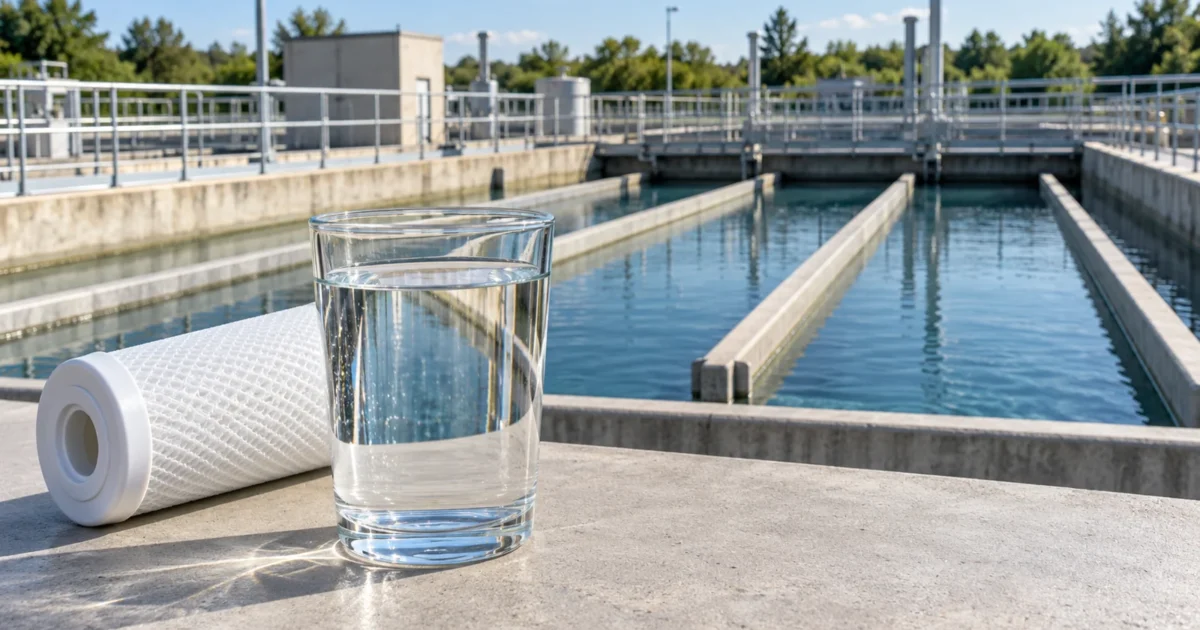
Disinfection byproducts in drinking water are the trade you make for safe water. Utilities add chlorine or chloramine to kill the germs that once caused cholera and typhoid – and that disinfectant reacts with natural organic matter in the water to form trihalomethanes (TTHM) and haloacetic acids (HAA5). The EPA limits them (TTHM 80 ppb, HAA5 60 ppb), and this is the one contaminant family where a plain carbon filter actually works. This guide covers what they are, the honest tradeoff, and how to reduce them.
The framing that matters: do not stop drinking disinfected water to avoid byproducts. Disinfection prevents acute, immediate illness – a far bigger and more certain risk than DBPs. The EPA’s own rules are written to balance the two. If you want to lower DBPs, do it at the tap with a certified carbon filter – never by drinking untreated water.
What disinfection byproducts in drinking water are
DBPs are not added to water – they form in it. When the chlorine or chloramine a utility uses to disinfect reacts with naturally present organic matter (decaying leaves, etc.), the reaction produces a family of byproducts. The two regulated groups are TTHM (four trihalomethanes) and HAA5 (five haloacetic acids). Systems that draw from surface water, with more organic matter, tend to form more of them.
The health basis (what the agencies actually say)
Attributing carefully: the EPA lists the potential effects of long-term exposure above the MCL as, for TTHM, “liver, kidney or central nervous system problems; increased risk of cancer,” and for HAA5, “increased risk of cancer.” Those are EPA’s stated above-the-limit effects, not a claim that compliant tap water causes them. The CDC puts it more plainly: “At high enough levels, disinfection byproducts can cause health problems over time,” but “the low levels of disinfectants allowed in tap water do not make people sick.” (CDC: water disinfection) So the concern is chronic and dose-dependent, and it sits on the other side of a deliberate public-health tradeoff.
How they get into water
DBPs are a byproduct of treatment itself – the unavoidable cost of disinfection. Their level depends on how much organic matter is in the source water, the disinfectant used, water temperature, and time in the distribution system (they can rise the longer treated water sits in the pipes). This is why the EPA’s Stage 2 rule measures them at locations across the system, not just at the plant.
What the EPA limits are
Under the Stage 2 Disinfectants and Disinfection Byproducts Rule: TTHM = 80 ug/L (80 ppb) and HAA5 = 60 ug/L (60 ppb). These are not single-sample limits – compliance is a locational running annual average (LRAA): the average of quarterly results at each monitoring location over a year. A system violates the MCL if the LRAA at any location exceeds the limit, so one high quarterly reading is a flag, not an automatic violation. (EPA: Stage 1 and Stage 2 DBP rules)
How to know if YOU have elevated DBPs
- Check your utility’s report. Enter your ZIP in the water watchdog and read your annual Consumer Confidence Report – public systems test for TTHM and HAA5 and must report them.
- At the end of the line? Homes farther from the treatment plant, where treated water has sat longest, can see higher DBPs – worth noting if your CCR is borderline.
- On a private well with no disinfection? DBPs are generally not your issue (you have the opposite concern – pathogens); test for bacteria instead.
How filtration helps (this is the one where carbon works)
Unlike arsenic, nitrate, or the radiologicals, DBPs are well-suited to carbon:
- Activated carbon – at treatment-plant scale, EPA’s Stage 2 technologies document treats granular activated carbon as a precursor-removal strategy: it removes natural organic matter before disinfection, so fewer byproducts form (EPA: Stage 2 technologies and costs). That document covers utility treatment, not home filters. Our own advice at the tap: look for a filter certified to NSF/ANSI 53 with a specific trihalomethane (TTHM) reduction claim – not a generic “carbon filter,” and not NSF/ANSI 42, which is taste-and-odor only.
- Reverse osmosis systems also reduce DBPs – largely via their built-in carbon stages, along with much else.
- The practical point: a good certified under-sink or pitcher carbon filter is an effective, affordable DBP fix – one of the few places the cheap option is the right one.
Use the Which Filter Fits finder to find a certified option for your setup, and the Filter Certification Registry to confirm the exact model carries the TTHM reduction listing.
Related guides
- PFAS in drinking water – another contaminant a certified NSF/ANSI 53 carbon or RO unit can address.
- Lead in drinking water – where NSF/ANSI 53 certification also does the work.
- Reverse Osmosis & Drinking Water – the broader option if you want one system for many contaminants.
What are the EPA limits for TTHM and HAA5?
TTHM 80 ug/L and HAA5 60 ug/L under the Stage 2 D/DBP Rule, judged as a locational running annual average (a single high sample is not automatically a violation).
Does a carbon filter remove disinfection byproducts?
Yes – this is the family where carbon works. Look for NSF/ANSI 53 with a specific TTHM reduction claim (not NSF/ANSI 42, which is aesthetic only). RO also reduces them.
Should I stop drinking chlorinated water to avoid DBPs?
No – disinfection prevents acute illness that is a far greater risk. Manage DBPs at the tap with a certified carbon filter; never drink untreated water to avoid them.
Sources
Related guides
Radium and Uranium in Drinking Water: Gross Alpha, Limits and Filters
Radium and uranium in drinking water, along with gross alpha activity, are the naturally radioactive side of your…
Fluoride in Drinking Water: The Limits, the Benefit, and the Debate
Fluoride is the one contaminant on this site that is genuinely contested, so we are going to do…
Arsenic in Drinking Water: The Limit, the Risk, and the Right Filter
Arsenic in drinking water is the contaminant you cannot see, taste, or smell, and the one most people…