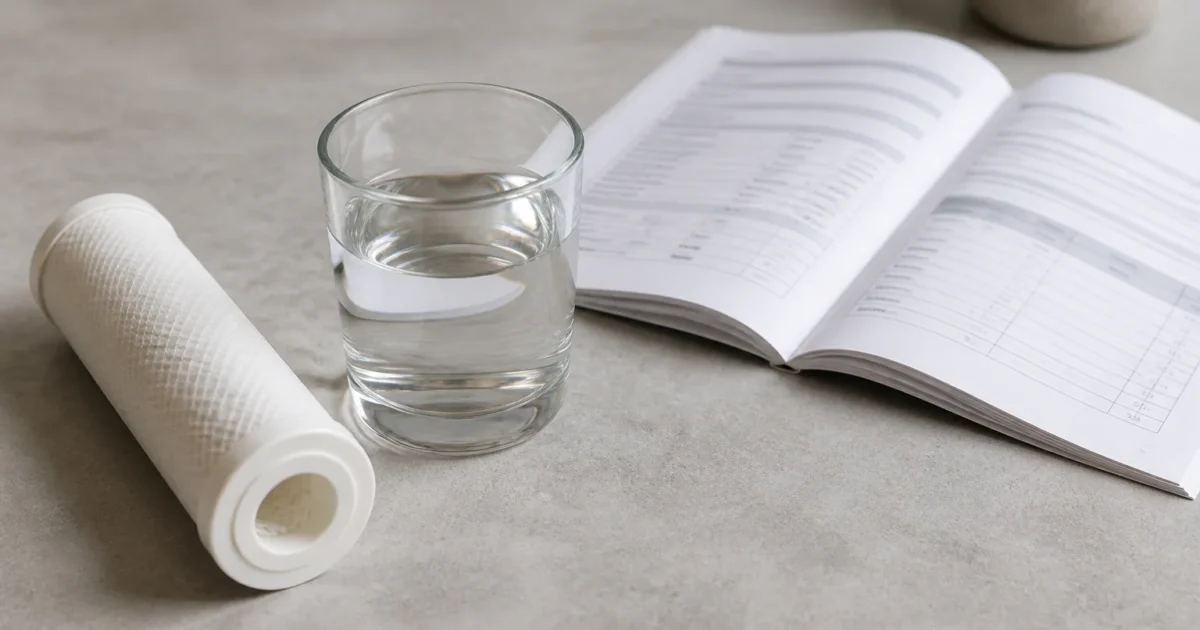
Chloramine vs chlorine is not a question most homeowners think to ask – until a filter that used to fix the “pool smell” from the tap stops working, or a new water filter’s box promises “removes chlorine” and the water still tastes off. Both are disinfectants added by public water systems to kill germs, and both are routine, regulated, and safe at the levels utilities are allowed to use. The part that actually matters for a homeowner is narrower: which one does your utility use, and does your filter’s certified claim match it. Free chlorine is generally easy to reduce with ordinary carbon filtration. Chloramine is more persistent and needs a filter with an explicit chloramine reduction claim – “carbon filter” alone is not proof it works.
This guide covers what chlorine and chloramine actually are, why so many utilities have switched to chloramine, exactly how to find out which one reaches your address, and – the part that decides what you should buy – how to verify a filter is actually rated for the disinfectant you have.
Chloramine vs Chlorine: What They Actually Are
Chlorine and chloramine are both municipal disinfectants used to control microbes in drinking water, not unusual contaminants that snuck in. The CDC describes chlorine as a disinfectant used to kill germs in drinking water, and describes chloramines as compounds formed from chlorine and ammonia – the form used in drinking water is monochloramine. EPA’s chloramines page says chloramines are usually formed when ammonia is added to chlorine, specifically to help maintain disinfection as water travels through the distribution system to your tap.
Both are regulated the same way: EPA’s National Primary Drinking Water Regulations list chlorine and chloramines together, each with a maximum residual disinfectant level of 4.0 mg/L as Cl2. So the honest framing for chloramine vs chlorine isn’t “is my utility doing something unsafe” – it’s “which one does my utility use, and what does that mean for the filter I buy.” EPA is direct on the practical difference that drives the rest of this guide: monochloramine is more difficult to remove from drinking water than chlorine.
Why Utilities Use Chloramine, and the Trade-Offs
CDC says utilities commonly use chlorine or chloramine to keep killing germs as water sits in pipes – chlorine gets used up relatively quickly, while chloramine keeps working longer in the distribution system. That persistence is also the main reason many systems switched to chloramine as a secondary disinfectant: EPA’s chloramines page notes that some systems changed disinfectants specifically to meet disinfection byproduct requirements, since chlorine reacting with natural organic material in water can form regulated byproducts such as total trihalomethanes and haloacetic acids under the Stage 1 and Stage 2 Disinfectants and Disinfection Byproducts Rules.
That trade comes with its own management questions, not a free lunch. EPA’s guidance for utilities flags nitrification, corrosion, and taste-and-odor issues as considerations when a system chloraminates, and chloramine can affect water chemistry in ways relevant to lead and copper plumbing. That does not mean chloramine “causes” lead – corrosion effects are water-chemistry-specific and utility-managed, and EPA provides utilities specific guidance on minimizing lead and copper when switching disinfectants.
One 2004 sampling review from an archived EPA page on the DC lead episode found lead levels were generally lower during periods of free-chlorine addition, and experts at the time suspected the absence of free chlorine – not chloramine addition on its own – may have contributed to the leaching. DC Water has since stabilized its water chemistry with corrosion control.
Some chloraminated utilities also run temporary free-chlorine conversions for maintenance or biofilm control, and the schedule genuinely varies by system – this is not something to assume is identical everywhere. DC Water switched from chloramine to free chlorine for about six weeks in spring 2026; Tampa says it typically converts to chlorine a few times a year, usually winter and summer, for around three weeks; Sarasota County skipped its planned 2026 conversion because of drought conditions. If your utility does this, expect a public notice with dates – check your own utility’s current notice rather than assuming an annual pattern.
How to Find Out Which One Your Utility Uses
If you’re a public-water customer, start with your Consumer Confidence Report – the annual water quality report utilities must deliver by July 1 under EPA’s CCR rule. CDC says the report should show whether a disinfectant is present, what kind the system uses, and disinfectant levels for the prior year. Look specifically for the words “free chlorine,” “chloramine,” or “monochloramine.”
Be careful with one specific phrase: “chlorine residual” alone is not proof your utility uses free chlorine. Total chlorine residual is defined as free chlorine plus combined chlorine, and combined chlorine includes chloramines – so a chloraminated system can legitimately report “total chlorine” or “chlorine residual” on its CCR. If your report says “free chlorine” specifically, you can treat that as the free-chlorine case. If it says total chlorine, chlorine residual, combined chlorine, chloramine, or monochloramine, don’t guess – call the utility named on your water bill and ask directly what residual disinfectant reaches your address, not just what the system generally uses. That address-specific question matters if you’re served by a wholesaler or a consecutive/purchased-water system, where the answer can vary by pressure zone or service area.
If you’re on a private well, this step doesn’t apply to you – there’s no CCR and no municipal disinfectant to identify. EPA says private wells aren’t regulated under the Safe Drinking Water Act, and CDC recommends private well owners test at least annually, through a state-certified lab, for total coliform bacteria, nitrates, total dissolved solids, and pH.
Why Chloramine vs Chlorine Changes Your Filter Choice
This is the part that actually changes what you buy. NSF separates “chlorine” and “chloramine” into distinct contaminant-reduction categories in its own certification listings – they are not the same claim, and a filter certified for one is not automatically certified for the other.
For free chlorine taste and odor, the entry-level claim to look for is NSF/ANSI 42 chlorine taste-and-odor certification. For chloramine, you need an explicit chloramine reduction claim – check it against NSF’s certified chloramine-reduction listings, which show the exact system, replacement element, service cycle in gallons, and flow rate. That means checking the exact model and the exact replacement cartridge, not just the brand or the word “carbon” on the box.
Carbon isn’t automatically the wrong media for chloramine – it just isn’t automatically the right one either. WQA notes that both activated carbon and catalytic activated carbon are legitimate residential methods for chloramine, but ordinary activated carbon can require long contact time to work, while catalytic carbon has higher catalytic activity built for exactly this job. The reliable rule is: look for an explicit chloramine reduction claim on the exact product, since many stronger chloramine filters use catalytic carbon or a design that provides enough contact time – not “any carbon filter will eventually get it.”
How to Verify a Filter Is Actually Rated for Chloramine
Marketing copy is not the proof. NSF’s own listings or an equivalent WQA or IAPMO certification directory are. A few checks worth running before you buy:
Don’t stop at the standard number. NSF/ANSI 42 is an aesthetic-effects standard, and different products carry different claims under it – some list chlorine taste and odor, some list chloramine reduction, some list both. Look inside the specific listing for the exact claim rather than treating “NSF/ANSI 42” as shorthand for chlorine only.
Confirm the replacement cartridge, not just the housing. NSF’s own FAQ guidance is clear that consumers should check the certified product details for the exact model – a similar-looking or same-brand replacement cartridge doesn’t automatically carry the same certified claim as the one you tested.
Watch shower filters specifically. NSF/ANSI 177 shower filter certification covers reduction of free available chlorine only. A shower filter marketed around “chlorine removal” shouldn’t be assumed to handle chloramine unless the listing separately documents chloramine performance.
Be careful with reverse osmosis. The RO membrane by itself is not a chloramine solution – EPA’s monochloramine guidance is explicit that RO membrane treatment alone does not remove it. But that doesn’t mean no RO system can; some complete under-sink RO systems include carbon pre- or post-filters and carry a chloramine reduction claim as a full system. Check whether the complete system is certified for chloramine, not the membrane stage alone, and confirm the exact model in our filter certification registry rather than guessing from the category name.
Two examples, so you know what to search for – and they illustrate the difference this section is about. Under-sink systems such as Aquasana’s Claryum 2-Stage are the shape to look for: a named model you can look up. By contrast, cartridges such as Pentair’s Pentek ChlorPlus are marketed for chloramine reduction, but the product page makes no third-party chloramine-certification claim – which is exactly the gap to watch for. Marketing copy that says “chloramine” is not a certification. Treat both as starting points, not endorsements, and verify the specific model and cartridge in the certifier’s own listing before buying.
As a rough price range, and only a starting point since retail prices shift – replacement chloramine-rated cartridges have run roughly $35-$240, point-of-use systems roughly $70-$250, and whole-house chloramine systems roughly $550-$1,200-plus before installation. Confirm current pricing before budgeting.
For the full breakdown of which NSF standard covers which contaminant, see our guide to what each NSF standard actually removes.
Taste, Odor, and Everyday Household Use
Both are safe for normal household use at the levels utilities are allowed to use – EPA is explicit that chloraminated water meeting regulatory standards is safe for drinking, cooking, bathing, and other everyday purposes. Taste and odor differences are the more common complaint, and here’s one place people reach for the wrong fix: letting a glass or pitcher of water sit out removes chlorine taste, but it does not remove chloramine. EPA and CDC both confirm that sitting water at room temperature does not remove monochloramine.
If a utility notice tells you to fill and refrigerate an open pitcher during a free-chlorine period – DC Water and Tampa both give this advice during their temporary chlorine conversions – that tactic only works while free chlorine is actually in the water, not as a general chloramine fix.
One consideration worth a mention if you’re thinking about removing disinfectant from all the water entering your home: CDC notes that a whole-house filter removing chlorine or other disinfectants can allow more microbial growth in household plumbing, since the disinfectant residual is doing some of that work throughout the pipe run. That’s not a reason to avoid whole-house dechlorination – it’s a reason to treat it as a system with maintenance and sizing considerations, not an automatic upgrade with no downside. Professional opinions genuinely vary here depending on your plumbing and water chemistry.
Sensitive Users: Dialysis, Aquariums, and Special Cases
Most people don’t need to do anything differently for chloramine vs chlorine beyond picking the right filter. Two groups do.
Dialysis is a genuine medical concern, not a general homeowner tip – consult your care team. CDC says dialysis centers must remove all chemical disinfectants, including chlorine and chloramine, from water before it’s used in dialysis, because that water contacts blood directly. Home dialysis users should follow their machine’s instructions or contact the manufacturer directly rather than relying on a general water-filter recommendation, and EPA advises anyone on dialysis with water-quality concerns to talk to their physician.
Aquariums need a conditioner that actually matches your disinfectant. CDC says fish, reptiles, and amphibians absorb water directly into the bloodstream and can get sick from even low disinfectant levels – and that letting water sit removes chlorine but not chloramine, the same limitation as for drinking use. Chloramine conditioners have to do more work than chlorine ones: breaking the chlorine-ammonia bond leaves ammonia behind, and that ammonia has to be neutralized too. Products such as Seachem’s Prime are formulated to address both steps – a plain sodium thiosulfate dechlorinator, by itself, isn’t necessarily enough for chloraminated tap water unless the ammonia is handled as well. Use a conditioner explicitly labeled for chloramine, and follow its dosing instructions.
If your utility runs a temporary free-chlorine conversion, dialysis and aquarium precautions don’t get to relax during that window. DC Water tells dialysis centers, medical facilities and aquatic pet owners to “continue to take the same precautions during the temporary switch to chlorine.” Tampa is narrower: it says kidney dialysis patients “should not be impacted” by its chlorine treatment and directs anyone with special health concerns to their health care provider, while telling aquarium owners they “should already have a water treatment system in place that will remove chloramine and chlorine.” Either way, a treatment step you rely on is not something to drop because the disinfectant changed for a few weeks.
What to Do Next
Start with your utility’s Consumer Confidence Report to find your actual disinfectant, then use our guide to which NSF standard removes what to understand the certification landscape beyond chlorine and chloramine. Before buying anything specifically for chloramine, confirm the exact model and cartridge in our filter certification registry rather than trusting box copy – the certified claim, not the brand name, is what tells you the filter actually does the job.
How can I tell if my water has chloramine instead of chlorine?
Check your utility’s Consumer Confidence Report for the words “chloramine” or “monochloramine.” If it just says “total chlorine” or “chlorine residual,” that doesn’t rule out chloramine – call your utility and ask directly what residual disinfectant reaches your address.
Does my current water filter remove chloramine?
Only if it carries an explicit chloramine reduction claim on the certified listing for that exact model and cartridge. A filter certified under NSF/ANSI 42 for chlorine taste and odor is not automatically certified for chloramine – check the specific claim, not just the standard number.
Can I just let tap water sit out to get rid of chloramine?
No. Letting water sit removes chlorine taste but does not remove chloramine, according to both EPA and CDC. That trick only works during periods when your utility is using free chlorine.
Does reverse osmosis remove chloramine?
The RO membrane alone does not. Some complete under-sink RO systems include additional carbon stages and carry a separate chloramine reduction certification as a full system – verify the complete system’s certified claim rather than assuming the membrane handles it.
Is chloraminated water safe for dialysis or fish tanks?
Not without specific treatment. Dialysis water must have all chemical disinfectants removed before use, and home dialysis users should follow their machine’s instructions or their care team’s guidance. Aquariums need a conditioner labeled specifically for chloramine, since it must neutralize both the chlorine-ammonia compound and leftover ammonia.
If my utility switches from chloramine to chlorine seasonally, do I need a different filter?
Not necessarily – a filter certified for chloramine reduction generally still handles free chlorine, since chloramine is the harder contaminant to remove. But confirm the dates of any temporary switch with your utility’s current notice, since schedules vary by system and year.
Sources
- CDC: About Water Disinfection With Chlorine and Chloramine
- EPA: Chloramines in Drinking Water
- EPA: National Primary Drinking Water Regulations
- EPA: Monochloramine Removal Q&A
- EPA: Stage 1 and Stage 2 Disinfectants and Disinfection Byproducts Rules
- EPA: Consecutive Systems Guidance
- EPA Archived: DC Lead and Chlorine Page
- DC Water: 2026 Chlorine Switch
- DC Water: 2005 Annual Switch Suspension
- City of Tampa: Chlorine Disinfection
- Sarasota County: Chlorine Conversion FAQ
- EPA: CCR Information for Consumers
- CDC: Guidelines for Testing Well Water
- EPA: Private Drinking Water Wells
- NSF: Contaminant Reduction Claims Guide
- NSF: Standards for Water Treatment Systems
- NSF: Chloramine Reduction Certified Listings
- NSF: Water Filter FAQs
- NSF: NSF/ANSI 177 Shower Filter Certification
- WQA: Chloramine Resource
- CDC: Choosing Home Water Filters
- EPA: Chloramines and Dialysis Q&A
- Seachem: Prime Product Page
- Aquasana: Claryum 2-Stage
- Pentair: Pentek ChlorPlus
Educational content only. Not a substitute for water testing or evaluation by a certified water-treatment professional or your local health department. Regulatory limits, utility disinfection schedules, and product certifications can change – always verify current status with your utility, the EPA, and the official NSF/WQA/IAPMO listing before making a decision. Use of any guidance from this guide is at your own risk. Nothing in this guide is medical advice; dialysis patients and anyone with a health-related water-quality concern should consult a physician or their treatment provider.
As an affiliate, WaterByTheBook may earn from qualifying purchases – it costs you nothing and never changes which filter we say fits.
Related guides
What’s In My Tap Water? How to Check Your EPA Data and Pick a Filter
What’s in my tap water? is a question with a real, checkable answer for most U.S. households –…
Arsenic in Well Water: The EPA Limit, Health Risk, and Which Filters Actually Remove It
Arsenic in well water is dangerous precisely because nothing about your water will tell you it’s there. The…
Nitrate in Drinking Water: The Infant Risk, the EPA Limit, and What Actually Removes It
Nitrate in drinking water is one of the few contaminant stories with a genuine emergency dimension. For most…