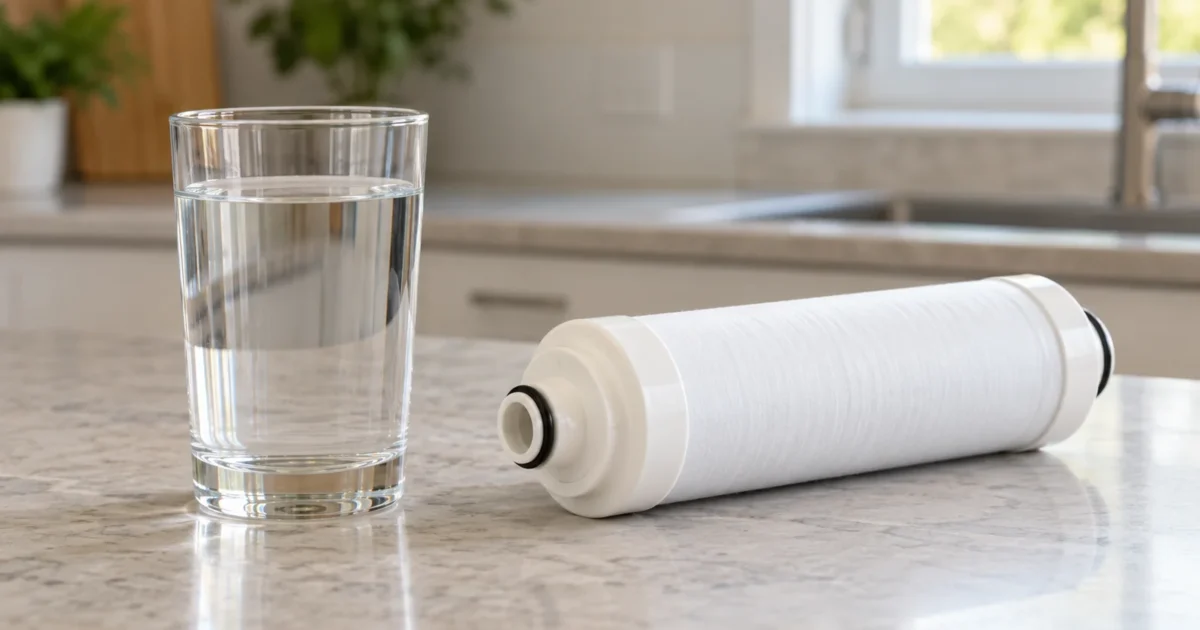
PFAS are a family of thousands of synthetic “forever chemicals,” and in April 2024 the EPA set the first national drinking-water limits for them: 4 parts per trillion each for the two most-studied ones, PFOA and PFOS. If your water is over that line, the fix at your tap is a filter specifically certified to reduce PFAS – either NSF/ANSI 53 or reverse osmosis. This guide is the plain-English version: what PFAS are, what the limit means, how to find out if you have them, and what actually filters them.
The honest headline: PFAS are common but the level is the point. In our national PFAS study, about 1 in 9 US public water systems averaged PFOA or PFOS above the 4 ppt limit – a real, large number, but it also means most systems were under it. Check yours before you buy anything.
What PFAS are
PFAS – per- and polyfluoroalkyl substances – are synthetic chemicals used since the 1940s in nonstick coatings, water-repellent fabrics, firefighting foam, and food packaging. They are called “forever chemicals” because the carbon-fluorine bond does not break down easily in the environment or the body. There are thousands of them; the EPA’s UCMR 5 monitoring covers 29 (EPA: UCMR 5), and its enforceable limits focus on the most-studied few. (EPA: PFAS in drinking water)
The health basis (what the agencies actually say)
We are not going to tell you PFAS in your water will make you sick – that depends on the level and the length of exposure, and the science is still developing. What we can tell you is what the federal agencies have concluded. The EPA and the federal toxicology agency ATSDR report that exposure to certain PFAS at sufficient levels is associated with effects including increased cholesterol, changes in liver enzymes, decreased vaccine response in children, increased risk of high blood pressure in pregnancy, and – for PFOA – kidney and testicular cancer. (ATSDR: PFAS health effects) That body of evidence is why the EPA set the limit as low as the science and testing allow.
How PFAS get into water
PFAS reach drinking water from manufacturing sites, airports and military bases (firefighting foam), landfills, and wastewater. Because they do not break down, they accumulate in groundwater and surface water that utilities draw from. This is why the contamination map is regional – near industrial and military sources – rather than uniform. It is also why a system can be over the limit through no fault of its own treatment.
What the EPA limit is
The EPA’s 2024 National Primary Drinking Water Regulation set enforceable limits (MCLs):
- PFOA: 4 ppt and PFOS: 4 ppt – the two current, retained limits.
- PFHxS, PFNA, and GenX (HFPO-DA): 10 ppt each – set in 2024 but proposed for rescission in the 2025-2026 reconsideration, so treat them as unsettled.
A part per trillion is about one drop in a thousand Olympic pools, and 4 ppt is also roughly the lowest level labs can reliably measure – so the limit is set right at the detection floor. One important nuance: compliance with the MCL is judged by a running annual average at each sampling point (EPA: PFAS in drinking water); in our reading, that makes a single sample above 4 ppt a flag to look closer, not an automatic violation.
How to know if YOU have PFAS
- Check your utility’s reported testing. Under the EPA’s UCMR5 program (2023-2025), community and non-transient non-community water systems serving 3,300 or more people, plus a representative sample of 800 smaller ones, tested for 29 PFAS. (EPA: UCMR 5) The fastest way to see your system’s results is to enter your ZIP in the water watchdog – it shows what your utility reported, graded against the 4 ppt limit, with the date.
- Read your Consumer Confidence Report (CCR). Every utility publishes one annually; it is the official record. The watchdog reads the federal data, but your CCR is the most current local word – confirm against it.
- If you are on a private well, test it. UCMR5 and CCRs do not cover wells. A certified lab test is the only way to know.
How filtration helps (and what does not)
Here is the part the filter aisle gets wrong. Not every filter removes PFAS – only specific certifications do:
- NSF/ANSI 53 activated-carbon filters that specifically list PFOA/PFOS reduction – many under-sink and some pitcher/fridge filters qualify, but it is SKU-specific, not brand-wide.
- Reverse osmosis (NSF/ANSI 58) – removes PFAS along with most dissolved contaminants; the most thorough option, at the cost of some water to drain and a slower flow.
- Not enough: a filter certified only to NSF 42 (taste and odor) is not certified to reduce PFAS, no matter what the box implies.
The way to avoid buying the wrong thing is to verify the exact model. Use the Which Filter Fits finder to get options that fit your system, and the Filter Certification Registry to confirm a specific filter’s real NSF listing for PFAS – not the marketing claim. Our NSF data study found how often the claim and the listing diverge.
Related guides
- Lead in drinking water – the other contaminant an NSF 53 filter handles.
- Nitrate in drinking water – which, like PFAS, needs RO or a specific certification (carbon will not do it).
- Reverse Osmosis & Drinking Water – the system that removes PFAS, lead, and nitrate at once.
What is the EPA limit for PFAS in drinking water?
The EPA set enforceable limits in April 2024: 4 parts per trillion (ppt) each for PFOA and PFOS. Those two were retained in the 2025-2026 reconsideration. Three others (PFHxS, PFNA, GenX) were set at 10 ppt but proposed for rescission.
How do I know if my tap water has PFAS?
Check your utility’s reported testing – under UCMR5 (2023-2025), community and non-transient non-community water systems serving 3,300 or more people, plus a representative sample of 800 smaller ones, tested for 29 PFAS. Enter your ZIP in the water watchdog or read your Consumer Confidence Report. Private wells are not covered; test yours.
Do refrigerator or pitcher filters remove PFAS?
Only if the specific model is certified for it – NSF/ANSI 53 listing PFOA/PFOS reduction, or reverse osmosis (NSF/ANSI 58). A taste-and-odor-only filter (NSF 42) is not. Verify the exact model in the registry.
Sources
Related guides
Radium and Uranium in Drinking Water: Gross Alpha, Limits and Filters
Radium and uranium in drinking water, along with gross alpha activity, are the naturally radioactive side of your…
Fluoride in Drinking Water: The Limits, the Benefit, and the Debate
Fluoride is the one contaminant on this site that is genuinely contested, so we are going to do…
Disinfection Byproducts in Drinking Water (TTHM & HAA5): The Limits and the Tradeoff
Disinfection byproducts in drinking water are the trade you make for safe water. Utilities add chlorine or chloramine…