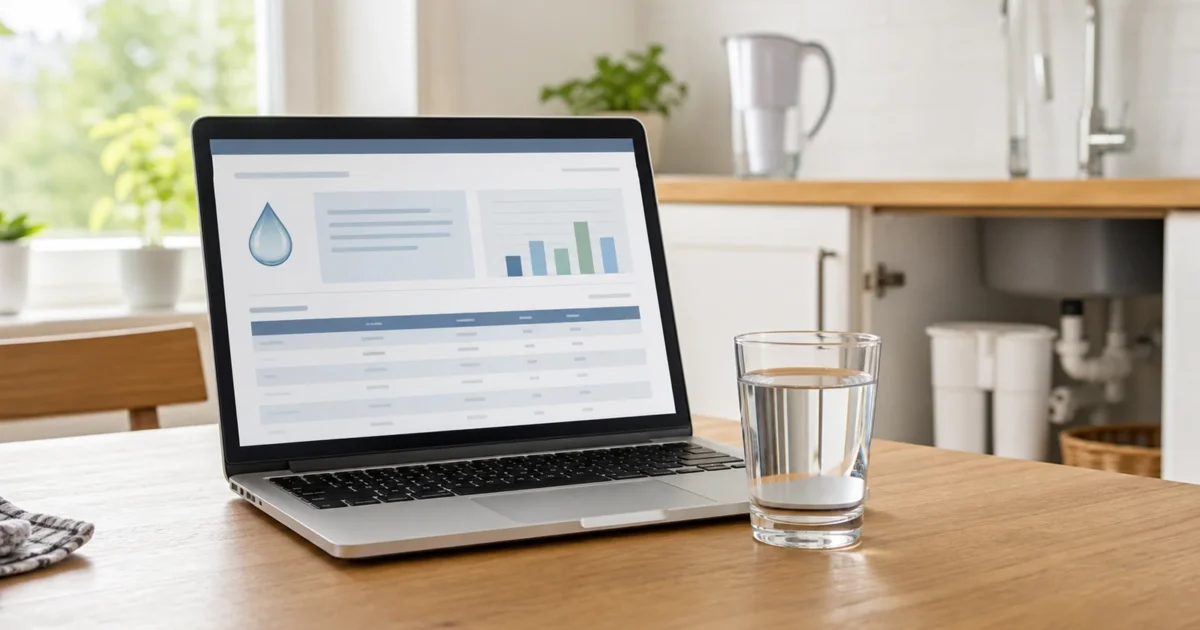
What’s in my tap water? is a question with a real, checkable answer for most U.S. households – you just have to know where to look, and in what order. The wrong way to answer it is to read a scary headline about PFAS or lead and buy the most expensive whole-house system on the shelf. The right way is to find the specific contaminants actually reported above a limit at your address, then buy the smallest certified filter tier that addresses those contaminants. Nothing more, nothing less.
This guide walks through the three places that answer “what’s in my tap water” for real – your utility’s Consumer Confidence Report, federal and state water-quality data, and our own Water Watchdog lookup – and then the decision table that turns whatever you find into an actual filter choice. It also covers the honest case where your data shows nothing above a limit, and the separate workflow private-well owners need.
What’s In My Tap Water? Start With Your Utility’s Consumer Confidence Report
If you’re on a public water system, your first stop is your utility’s Consumer Confidence Report (CCR) – the annual water-quality report the EPA requires every community water system to deliver to customers by July 1. It’s utility-specific, which is what makes it more useful than a national contaminant list: it tells you where your water comes from and what your own system detected.
Our full CCR walkthrough covers the report line by line, but for this workflow, pull four things from it: the detected-contaminant table (with the reported range and highest level detected), the MCL or action level each contaminant is measured against, the sampling year, and any public notices. If you can’t find your CCR through EPA’s finder, check your utility’s website, or call the utility named on your water bill directly – and if the report itself is confusing, the CDC’s guidance is to contact your utility, your local health department, or the EPA’s Drinking Water Hotline rather than guess.
One caution worth flagging up front: the CCR’s lead and copper row is a 90th-percentile statistic across sampled taps citywide, not a measurement of your kitchen faucet. A clean system-level number doesn’t rule out lead from your own service line or household plumbing – more on that below. And a coming change to know about: EPA’s 2024 CCR rule revisions will require systems serving more than 10,000 customers to deliver reports twice a year starting in 2027. For now, in 2026, the report is still annual.
Cross-Check EPA and State Water Data
A CCR is one utility’s self-report for one year. The next step is checking it against federal and state records, in a specific order: your CCR first, then your state’s primacy-agency drinking-water database if it’s available (EPA notes state data is often more current and more detailed than federal records), then EPA’s SDWIS/ECHO system for system-level compliance and enforcement history, then UCMR 5 for PFAS specifically.
SDWIS holds public water system information, reported compliance data, and enforcement history – search it by PWS ID if you have one from your bill or CCR, or by utility name, city, county, or state. UCMR 5 is separate and covers 29 PFAS compounds plus lithium, monitored between 2023 and 2025; as of the January 15, 2026 data release it represented roughly 95% of expected results, with the final release expected in fall 2026.
Three things matter when you read UCMR 5 results. First, they are reported in micrograms per liter – convert to parts per trillion by multiplying by 1,000 if you’re comparing against a ppt limit. Second, a result listed as “below MRL” is not the same as zero; the minimum reporting level reflects lab capability, not a health threshold. Third, and most important: EPA is explicit that UCMR 5 PFAS results do not indicate compliance or noncompliance with the PFAS MCLs. Say “reported above the PFOA comparison level,” never “in violation” – that phrasing is reserved for a formal compliance record from EPA or your state.
Not every system shows up in UCMR 5, either. It applies to systems serving 3,300 or more people plus a nationally representative sample of smaller ones – a missing result can mean your system wasn’t selected, hasn’t reported yet, or is a smaller system UCMR 5 doesn’t require to test.
Use Water Watchdog as the Shortcut Layer
Checking SDWIS, your state database, and UCMR 5 separately is the thorough path. Our free Water Watchdog ZIP-code lookup exists so you don’t have to run all three by hand – it surfaces what your system reported in the federal records in one place, and our national data studies on lead violations and PFAS occurrence show how your system compares nationally.
Treat that shortcut layer as an interface, not independent evidence – the regulatory dataset underneath it is still the source of truth, and the same integrity rule applies: if a tool shows nothing reported above a limit, the honest phrasing is “not reported above the selected limit in the available data,” not “your water is contaminant-free.” EPA’s own ECHO FAQ warns that no-violation lists can reflect underreporting, not a guarantee of absence.
Match What’s Actually in Your Water to a Certified Filter
Once you know which contaminant, if any, was reported above a limit, the decision rule is simple: pick the smallest certified filter tier that addresses that specific contaminant, verified against a real certification listing – not a brand promise or a “removes contaminants” label.
| Reported contaminant | EPA limit or comparison level | What to look for |
|---|---|---|
| PFOA / PFOS | 4.0 ppt MCL | NSF/ANSI 53 or 58 with a specific PFOA/PFOS reduction claim in the listing |
| PFHxS, PFNA, HFPO-DA (GenX) | 10 ppt under the 2024 rule; EPA proposed rescinding these components in 2026 | Same standards, but hedge – these thresholds are less settled than PFOA/PFOS |
| Lead | CCR action level (currently 15 ppb for most systems, transitioning to 10 ppb by November 2027) | NSF/ANSI 53 lead reduction to 5 ppb or less AND Class I particulate reduction (NSF/ANSI 42) – EPA’s consumer tool lists filters certified against both standards; a 42-only aesthetic claim is not a lead claim |
| Nitrate | 10 mg/L as nitrogen | NSF/ANSI 58 reverse osmosis with a nitrate/nitrite reduction claim |
| Arsenic | 0.010 mg/L | NSF-listed pentavalent arsenic reduction (RO or other listed category) – check speciation |
| Hardness | No EPA health-based MCL | NSF/ANSI 44 water softener |
A few things that decision table can’t tell you on its own. For PFAS, EPA has warned that current certification standards don’t yet prove a filter reduces PFAS all the way down to the new 4.0 ppt MCL – treat a PFAS-certified filter as certified for the listed reduction claim, not a guarantee of meeting the federal limit. For arsenic, NSF’s listings distinguish pentavalent arsenic at incoming concentrations of 50 ppb or less; if your water has arsenic III instead, you may need pretreatment before a standard-certified device performs as expected. And CDC is blunt that treatment types aren’t interchangeable – microfiltration can remove some parasites but not chemicals like lead or arsenic, and ultraviolet treatment doesn’t remove chemicals at all.
The standard number on the box is a starting point, not the answer. Verify the exact model and cartridge against which NSF standard actually removes what and our filter certification registry before buying – certification is SKU-specific, and NSF, WQA, and IAPMO R&T listings are the proof, not the packaging.
If Nothing Is Reported Above a Limit
Plenty of readers will run this whole workflow and find nothing reported above a relevant limit. EPA’s 2023 national compliance report found that 107,559 of 148,541 active public water systems had no reported drinking-water-standard issue that year – a dated snapshot, not a live 2026 count, but directionally useful: for a lot of households, an expensive whole-house treatment system is simply unnecessary.
If that’s your result, a taste-and-odor filter certified under NSF/ANSI 42 is a reasonable choice if chlorine taste, odor, or sediment bothers you – but it’s a preference purchase, not a health necessity, unless your own data shows otherwise. This is also where point-of-use versus point-of-entry matters: a certified filter at the kitchen sink is the smaller, more targeted tier for most drinking-water contaminants, while whole-house treatment makes more sense when the issue affects plumbing, appliances, or your entire water supply – hardness is the clearest legitimate case, since NSF/ANSI 44 softeners are built as point-of-entry systems for exactly that reason.
Whatever you buy, budget for maintenance separately from the purchase price. EPA is direct that PFAS filters work only if maintained on the manufacturer’s replacement schedule – so replacement cartridges are an ongoing cost, not a one-time purchase, and the cartridges are where the real spend lives over a system’s life. Retail pricing spans a wide range, from a few hundred dollars for a mainstream under-sink unit to well over a thousand for premium tankless or bundled systems before installation. Rather than trust a figure quoted in any guide, check the current listing for your exact model – our reverse osmosis cost breakdown walks through unit and annual filter costs with the arithmetic shown.
If You’re on a Private Well
None of the CCR, SDWIS, or UCMR 5 workflow above applies to private wells – around 15% of the U.S. population (over 43 million people) relies on one, and EPA is explicit that private wells aren’t regulated under the Safe Drinking Water Act. The owner is responsible for testing and treatment decisions, full stop.
CDC recommends testing a private well at least annually, through a state-certified laboratory, for total coliform bacteria, nitrates, total dissolved solids, and pH – and more often, or for additional contaminants like arsenic or radon, depending on local geology and any nearby land use changes. The professional sequence runs lab test first, then interpretation from your local health or environmental department, then contaminant-specific treatment selection, then maintenance verification – not a treatment system purchased before you know what’s actually in the water. Our guides on arsenic in well water and getting iron out of well water walk through two of the more common well-specific treatment decisions.
Even public-water customers have one well-adjacent edge case worth knowing: lead most often enters water after the meter, from a corroding lead service line or old household plumbing, not from the utility’s treatment plant. If your service-line material is unknown or your home has had recent plumbing work, checking your utility’s service-line inventory or testing your own tap is more reliable than trusting a systemwide CCR row alone. Professional opinions on the right treatment train can genuinely vary here – for wells, nitrate treatment, and arsenic speciation especially – because water chemistry and household plumbing change what actually works.
What to Do Next
The honest answer to “what’s in my tap water” is address-specific, so start with your CCR, run your ZIP code through Water Watchdog, and check our national PFAS and lead violations data studies for context on your system. Whatever contaminant turns up, match it to a certified filter tier using which NSF standard removes what and verify the exact model in our filter certification registry before you buy.
How do I find out what’s actually in my tap water?
Start with your utility’s Consumer Confidence Report, then cross-check it against EPA’s SDWIS and UCMR 5 data (or your state’s primacy-agency database if available). Our Water Watchdog tool pulls the federal records for your ZIP code in one lookup so you don’t have to search each database separately.
Does a clean water quality report mean my tap is lead-free?
Not necessarily. The CCR’s lead row is a 90th-percentile statistic across sampled taps citywide, not a measurement of your specific faucet. Lead most often enters water after the meter, from your own service line or household plumbing, so an unknown service-line material is worth checking separately.
Is a UCMR5 PFAS result the same as a violation?
No. EPA is explicit that UCMR 5 PFAS results do not indicate compliance or noncompliance with the PFAS MCLs – they’re monitoring data, not a formal compliance finding. The correct phrasing is “reported above the comparison level,” not “in violation.”
What if my report shows nothing above a limit – do I still need a filter?
Not necessarily. If nothing is reported above a relevant limit in your CCR or EPA/state data, an expensive whole-house system usually isn’t warranted. A taste-and-odor filter is still a reasonable preference purchase, but it’s not a health necessity without a specific local finding.
Do private well owners get a Consumer Confidence Report?
No. Private wells aren’t regulated under the Safe Drinking Water Act, and there’s no CCR for them. CDC recommends testing a private well at least annually through a state-certified lab for total coliform bacteria, nitrates, TDS, and pH.
How do I know which filter actually removes what’s in my water?
Match the specific contaminant reported above a limit to its NSF/ANSI standard – NSF/ANSI 53 or 58 with a named PFAS or lead claim, 58 for nitrate and arsenic, 44 for hardness – then verify the exact model and cartridge in a certification registry rather than trusting the standard number alone.
Sources
- EPA: Understanding Your Annual Water Quality Report (CCR)
- EPA: Consumer Confidence Report Rule Revisions
- EPA: I Am Looking at a Water Report for My Public Water System (Lead 90th Percentile FAQ)
- CDC: How to Read Your Drinking Water Quality Report
- EPA: Safe Drinking Water Information System (SDWIS)
- EPA: Primacy Agency Drinking Water Data
- EPA: Fifth Unregulated Contaminant Monitoring Rule (UCMR 5) Data Finder
- EPA: Occurrence Data for UCMR
- EPA: ECHO SDWA FAQ
- EPA: PFAS Drinking Water Rule
- EPA: Proposed PFAS Rescission Rule
- EPA: National Primary Drinking Water Regulations
- EPA: LCRI Questions and Answers
- EPA: Identifying Drinking Water Filters Certified to Reduce PFAS
- EPA: Consumer Tool for Point-of-Use and Pitcher Filters Certified to Reduce Lead
- EPA: 2023 National Public Water Systems Compliance Report
- EPA: Private Drinking Water Wells
- EPA: Protect Your Private Well
- CDC: Guidelines for Testing Well Water
- CDC: About Home Water Treatment Systems
- NSF: Standards for Water Treatment Systems
- NSF: Contaminant Reduction Claims Guide
Educational content only. Not a substitute for water testing or evaluation by a certified water-treatment professional or your local health department. Regulatory limits, EPA dataset releases, and product certifications can change – always verify current status with your utility, the EPA, your state health department, and the official NSF/WQA/IAPMO listing before making a decision. Use of any guidance from this guide is at your own risk.
As an affiliate, WaterByTheBook may earn from qualifying purchases – it costs you nothing and never changes which filter we say fits.
Related guides
Arsenic in Well Water: The EPA Limit, Health Risk, and Which Filters Actually Remove It
Arsenic in well water is dangerous precisely because nothing about your water will tell you it’s there. The…
Nitrate in Drinking Water: The Infant Risk, the EPA Limit, and What Actually Removes It
Nitrate in drinking water is one of the few contaminant stories with a genuine emergency dimension. For most…
Chloramine vs Chlorine: How to Tell What Your Utility Uses (and Why It Changes Your Filter)
Chloramine vs chlorine is not a question most homeowners think to ask – until a filter that used…