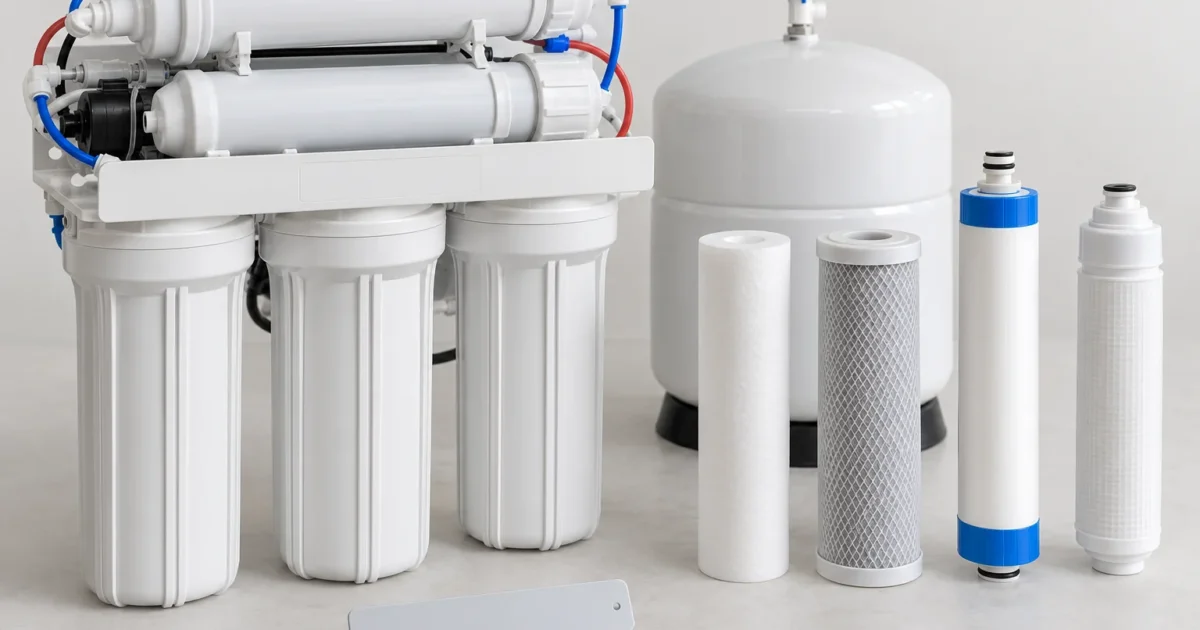
Are reverse osmosis filters universal? No. A replacement that looks right can still be the wrong stage, the wrong membrane size, or a cartridge that was never made for your system. The reliable route has three steps: find the model of the whole RO system, match each stage to the maker’s parts table, then confirm the part number on the cartridge you’re replacing. This guide walks through each step, shows what a fitting cartridge looks like by system type, and explains why “fits” and “certified” are two different claims.
Are Reverse Osmosis Filters Universal? The Short Answer
Reverse osmosis filters are not universally interchangeable. EPA describes a point-of-use RO system as a treatment system connected to a single fixture that uses pressure and a semipermeable membrane to separate treated water from reject water (EPA WaterSense: point-of-use RO systems). That membrane is one stage in a train of several, and each stage has its own replacement.
The controlling rule is: system model first, stage second, part number third. A cartridge that fits one stage is not a substitute for another, and a five-, six-, or seven-stage system can include sediment, carbon, membrane, post-carbon, remineralization, deionization (DI), or UV stages.
One scope note. If you landed here looking for a refrigerator filter, that is a different product. Our guide to whether water filters are interchangeable covers the fridge side. Here we stay under the sink.
Find Your System Model, Then Read Every Cartridge
Identify the system, not the cartridge
An under-sink RO system’s model number is usually tied to the system, manifold, head assembly, mounting bracket, front cover, tankless module, manual, registration material, or product page. It is not on a refrigerator-style serial plate. Check those places first. GE’s parts page for the GXRQ18NBN, for example, lists replacement filters by system model, and GE’s RO manual separates the pre- and post-cartridges, the membrane, and the remineralization or antimicrobial stage (GE GXRQ18NBN, GE RO owner’s manual).
Read the label on each cartridge
The current part number is normally printed on the cartridge label or molded wrapper. Read it for every stage, not just the one you think is due.
Note the housing type
Open sump systems and quick-change systems are identified differently. Traditional systems with vertical sump housings may use standard 10-inch or 20-inch cartridges. Proprietary twist-lock or push-lock systems use model-specific cartridges even when the cylinders look similar. Pentair documents its standard housings by length and diameter, while Waterdrop and Brondell each list a replacement cartridge against a named system (Pentair standard flat-cap housings, Waterdrop WD-G3-N2RO, Brondell RF-40).
The Fit Chart: What You See, What It Is, What Fits
Appearance sorts a system into a family. It never approves a cartridge on its own.
| What you see | What it is | What fits |
|---|---|---|
| Vertical sump housings that unscrew and take a drop-in cartridge | Open sump system | May accept standard 10-inch or 20-inch cartridges. Pentair documents defined diameter ranges, including common 2-1/2-inch to 2-7/8-inch formats. Match micron rating, media, flow rating and seals too. |
| Twist-lock, push-lock or enclosed cartridge bodies | Proprietary quick-change system | Only the cartridge the maker lists for your model, such as FQ18PN for the GE family below |
| A compact tankless module | Model-specific system | The exact model’s cartridges. Waterdrop lists WD-G3-N1CF as compatible with the G3 series and WD-G3-N2RO as compatible with the G3P400 (see Waterdrop below). |
| The membrane stage | RO membrane | Model, gallons-per-day (GPD) rating, flow restrictor pairing and manual all matter. Membranes can look alike. |
| Extra post-stages such as remineralization, DI or UV | Stages that exist only on some models | The stage-specific part the maker lists for your model. GE’s FQ18RT remineralization cartridge is one example (GE FQ18RT). |
| A carbon cartridge inside a refrigerator | An appliance water filter, not an RO membrane | The refrigerator’s own model lookup, not this chart |
A true RO system includes a membrane stage, not just sediment or carbon filtration. If yours has none, it is not what this article describes.
Identified your system type above? If it is a quick-change or model-specific system, order only the cartridge your model's manual lists — these are the examples named above, not universal parts. Check the seller: a listing that only says 'compatible' is not the genuine part and may not carry its NSF claims.
As an Amazon Associate, WaterByTheBook earns from qualifying purchases. Links below are affiliate links — they cost you nothing extra.
Same Brand, Different Cartridge: Real Examples
The maker’s own pages show how much the sets vary. Treat these as examples of the pattern, not a lookup table for your system.
GE. The PNRQ/PXRQ-style systems use FQROPF pre/post filters and FQROMF membrane filters. The GXRQ18NBN, GXRV40TBN and GNRQ18NBN systems use FQ18PN pre/post filters and FQ18MN membrane filters. FQ18RT is a separate remineralization/antimicrobial cartridge for the applicable newer family (GE FQROPF, GE FQROMF, GE FQ18PN, GE FQ18MN, GE FQ18RT).
APEC. Its ESSENCE parts include FILTER-SET-ES for stages 1-3, MEM-ES-50 or MEM-ES-75 for the membrane, and FI-ES-TCR-QC for stage 5. APEC’s replacement-filter page names its sets by system and stage, such as a complete filter set for the ESSENCE ROES-50 (stages 1-5) and a pre-filter set for all ESSENCE systems (stages 1-3) (APEC replacement filters).
iSpring. The same RCC family can share early-stage cartridges but diverge by alkaline, UV, DI, pump or membrane option. According to the manual, stages 6 and 7 exist only on certain models, and it tells owners to search their system’s model number when ordering replacements (iSpring RCC manual).
A. O. Smith. For the AO-US-RO-4000, AO-4000-CARBON includes the carbon/Claryum replacements and AO-RO-RM-R includes the RO membrane and remineralizer (A. O. Smith AO-4000-CARBON, A. O. Smith AO-RO-RM-R). According to A. O. Smith’s replacement catalog, other replacement paths exist, including AO-US-RO-MB-R and AO-US-RO-MEM. So do not assume every A. O. Smith RO owner needs those two kits; the exact system model still controls (A. O. Smith replacements).
Waterdrop. Tankless systems are model-specific, and looking alike within a series is not enough. G3-series CF and CB cartridges may be shared across some G3 variants, while the membrane can be specific to a flow rating. WD-G3-N2RO is identified as a 400 GPD membrane, and Lowe’s describes it as designed exclusively for the WD-G3-W 400 GPD system (Waterdrop G3-N1CF, Waterdrop WD-G3-N2RO, Lowe’s Waterdrop WD-G3-N2RO).
Brondell. For the Circle RC100, RF-40 is the RO membrane replacement and is not a complete annual kit. Brondell also shows RF-20 as the separate sediment/carbon pack (Brondell RF-40).
Culligan. The AC-30 family includes AC-30, AC-30M, AC-30L, AC-30 Plus, AC-30M Plus and AC-30L Plus. Owner-guide data lists separate elements, and membranes can vary by nitrate or non-nitrate version. Examples include particulate filter 00-4015-38, activated carbon element 01-0125-80, polishing filter 01-0042-91, and RO membrane 01-0074-02. That is a sample, not the whole parts list, so match your exact AC-30 variant to the owner-guide table (Culligan AC-30, Culligan AC-30 owner guide).
Aquasana. According to Aquasana’s owner-manual page and product page, the OptimH2O RO + Claryum system uses AQ-RO3-R for carbon/Claryum replacements, AQ-RO3-RO for the membrane, and AQ-RO3-RM for the remineralizer (Aquasana owner’s manuals, Aquasana AQ-RO3-R).
Aftermarket Packs and the “Fits Is Not Certified” Rule
Do not read “universal” as “always wrong.” Standard sump systems may accept correctly specified non-OEM cartridges. A cartridge that physically fits can still be wrong if its micron rating, media type, flow rating, seals, service life or certification does not match the system. The rule is: do not choose an aftermarket cartridge on fit alone. Proprietary quick-change systems and certified contaminant claims need the exact model or SKU verified.
Fit and certification are separate claims. A “compatible” cartridge can be installed in, or is marketed for, a system. Certification means a certification body lists a specific product, model, system or SKU for specific standards and reduction claims (NSF certified drinking water treatment units search).
Know the standards by name. NSF/ANSI 42 covers aesthetic effects such as chlorine taste and odor. NSF/ANSI 53 covers contaminants with health effects. NSF/ANSI 58 covers reverse-osmosis systems. NSF/ANSI 401 covers verified reduction of one or more emerging contaminants (NSF standards guide). NSF also says certification to one standard does not mean a product reduces all contaminants. For PFAS, EPA says to look for NSF/ANSI 53 or 58 certification and to check that it covers the specific PFAS or contaminant type you care about (EPA PFAS filter guide). More on the standards in our NSF certifications explainer.
To verify a specific SKU, search the databases directly: NSF’s drinking water treatment unit search (by manufacturer, brand or model, standard, product type or reduction claim), the WQA certified products listing, and the IAPMO Product Listing Directory. Our filter certification registry is a shortcut, but the listing is the proof.
Words like “tested to,” “meets,” “compatible with” and “replacement for” are not “certified.” Don’t treat them as if they were unless the exact SKU or system appears in a certification listing.
Which Lookup to Trust
Use this order when sources disagree: the label on the installed filter, then the manufacturer’s manual or parts page, then a certification database for performance claims, then a retailer listing for price and availability. Whirlpool’s help article takes a similar line for refrigerator filters, pointing to the owner’s manual, the number on the filter, or its finder (Whirlpool product help).
Manufacturer parts pages carry the fitment data. GE’s pages for FQ18PN, FQ18MN and FQ18RT each list the system models the cartridge fits (GE FQ18PN, GE FQ18MN, GE FQ18RT). Culligan’s product-manuals page lists owner’s guides by product, including the AC-30 Good Water Machine (Culligan manuals).
Retailer pages are fine for availability and price, and weak as fitment authorities. Home Depot’s and Lowe’s RO replacement categories put standard cartridges, proprietary cartridges, tankless-system filters and brand-specific filters on one shopping surface (Home Depot RO replacement filters, Lowe’s RO replacement filters). Use them once you know the OEM part number, not before.
Refrigerator lookups solve a different problem. Whirlpool points refrigerator owners to the EveryDrop filter finder (Whirlpool product help). Bosch has its own water-filter finder, which requires the full E-Nr including the slash and two digits (Bosch water-filter finder).
If an under-sink RO feeds your fridge dispenser or icemaker, the fridge’s internal cartridge may be bypassed, but the RO system still has its own filters and tank. According to Applied Membranes, connections to icemakers or other equipment should be turned off before maintenance (Applied Membranes RO manual).
If You Still Cannot Tell
When the brand and model are unreadable, document the whole system before you buy anything. Photograph the full under-sink layout, count the stages, photograph each cartridge label and the manifold or head, note tube sizes and colors, measure any drop-in cartridges, and note whether the membrane housing is separate from the prefilters.
Then contact the manufacturer, seller or local dealer with the model, the installed part numbers and the photos before you buy a “universal” pack. GE’s parts site, for example, searches by appliance model or part number (GE parts support). For a dealer-installed Culligan system, Culligan says its local water experts are the support and maintenance path for the AC-30 (Culligan AC-30).
A few cautions once you have the right part:
- Membrane direction. According to the APEC ROES manual, the double-ring end of the membrane goes into the housing first, and a membrane installed the wrong way cannot filter water.
- O-rings. APEC’s manual recommends replacing filter housing O-rings every year or when replacing the three prefilters. iSpring recommends replacing the membrane housing O-ring every three years.
- Shut off first. APEC and iSpring both instruct users to shut off feed water, close the tank valve or depressurize, and open the faucet before opening housings.
- Flushing and sanitizing vary. APEC says to refill the tank for 2-3 hours after installing a membrane and drain the first tank. Applied Membranes says to drain the first two tanks before drinking. GE adds a separate sanitization procedure. Follow the manual for your exact system; if you have none, know that manufacturers differ on these details.
- Performance check. According to GE’s RO manual, product water should be tested at least every six months, and the RO cartridge should be replaced along with the prefilter and postfilter when TDS reduction falls below 75%.
Finally, an honesty check. EPA says U.S. public water supplies are among the safest in the world, while noting that treatment may be useful for private wells or particular circumstances. If your water has nothing reported above a relevant limit, a premium RO system may be unnecessary. For PFAS concerns, EPA recommends contacting your state environmental agency, health department or water utility first, then checking certification information for the PFAS you care about.
What to Do Next
Find the model of your RO system, list the part number on every cartridge, and confirm each one on the manufacturer’s parts page before you order. Then check the exact SKU in the NSF, WQA or IAPMO listing if a contaminant claim matters to you. For replacement timing by stage, see how often to change reverse osmosis filters. And always confirm your model on the system and the current cartridges before buying.
Are reverse osmosis filters interchangeable between brands?
Not as a rule. Proprietary twist-lock and push-lock systems use cartridges made for specific models. Only standard open sump systems, with 10-inch or 20-inch housings, may accept correctly specified non-OEM cartridges.
Can I use a 10-inch generic cartridge in my RO system?
Only if your system uses a standard housing and the cartridge also matches the micron rating, media, flow rating and seals. Fit in the housing alone is not enough, and the system’s manual or parts page decides.
Is a compatible RO filter also NSF certified?
Not automatically. Certification is SKU-specific, system-specific and claim-specific. Look for the exact product in the NSF, WQA or IAPMO listing. WQA says only products that pass its testing requirements and facility audits appear in its listing. Our own rule: read “compatible with” or “replacement for” on a label as a fit claim until you find that listing.
Where do I find the part number if the cartridge label is worn?
Start with the system model and the manufacturer’s parts table or manual, then match each stage. If the model is also gone, photograph the whole system and call the manufacturer, seller or dealer.
Can I put a refrigerator filter in a reverse osmosis system?
No. An RO system takes the cartridges its maker lists for that model, so use the RO system’s own parts table. NSF/ANSI 58 is the standard that covers reverse-osmosis systems.
Sources
- EPA: WaterSense point-of-use reverse osmosis systems
- EPA: Identifying drinking water filters certified to reduce PFAS
- NSF: Standards for water treatment systems
- NSF: Certified drinking water treatment units search
- WQA: Certified products
- IAPMO: Product Listing Directory
- GE Appliance Parts: GXRQ18NBN
- GE Appliances: FQROPF
- GE Appliance Parts: FQROMF
- GE Appliance Parts: FQ18PN
- GE Appliance Parts: FQ18MN
- GE Appliance Parts: FQ18RT
- GE Appliance Parts: filter finder
- GE Appliance Parts: parts support
- GE: RO owner’s manual
- GE: RO manual (installation, sanitizing and testing)
- APEC: Replacement filters
- APEC: ROES manual
- iSpring: RCC manual
- A. O. Smith: AO-4000-CARBON
- A. O. Smith: AO-RO-RM-R
- A. O. Smith: Replacement filters
- Aquasana: Owner’s manuals
- Aquasana: AQ-RO3-R
- Waterdrop: RO replacement filters
- Waterdrop: WD-G3-N1CF
- Waterdrop: WD-G3-N2RO
- Lowe’s: Waterdrop WD-G3-N2RO
- Brondell: Circle RF-40 membrane
- Brondell: Circle RC100 user manual
- Culligan: AC-30 Good Water Machine
- Culligan: AC-30 owner guide
- Culligan: Product manuals
- Pentair: Standard flat-cap housings
- Applied Membranes: Home RO installation and operation manual
- Bosch: Water-filter finder
- Whirlpool: Purchasing replacement refrigerator water filters
- Home Depot: RO replacement filters
- Lowe’s: RO replacement filters
Educational content only. Not a substitute for water testing or evaluation by a certified water-treatment professional or your local health department. Product compatibility, certifications, and prices change – always verify the current status with your system manufacturer and the official NSF/WQA/IAPMO listing before you buy. Use of any guidance from this guide is at your own risk.
As an affiliate, WaterByTheBook may earn from qualifying purchases – it costs you nothing and never changes which filter we say fits.
Related guides
Radium and Uranium in Drinking Water: Gross Alpha, Limits and Filters
Radium and uranium in drinking water, along with gross alpha activity, are the naturally radioactive side of your…
Fluoride in Drinking Water: The Limits, the Benefit, and the Debate
Fluoride is the one contaminant on this site that is genuinely contested, so we are going to do…
Disinfection Byproducts in Drinking Water (TTHM & HAA5): The Limits and the Tradeoff
Disinfection byproducts in drinking water are the trade you make for safe water. Utilities add chlorine or chloramine…