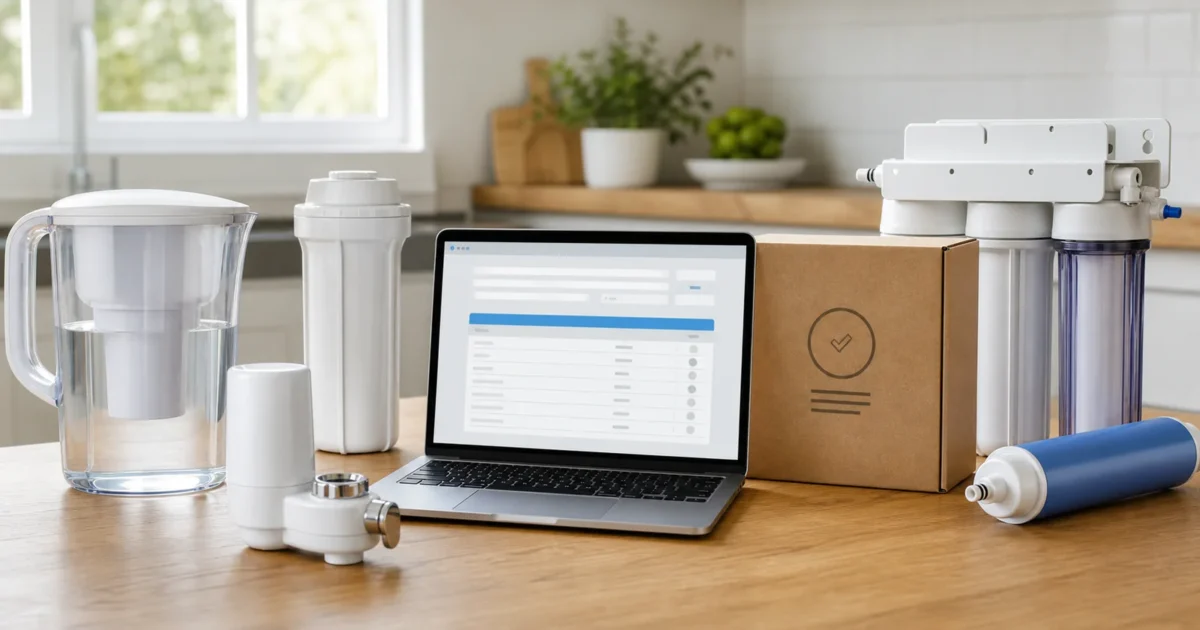
NSF filter certifications only mean something when two conditions are both true: the exact product is listed by an accredited certifier, and that listing names the specific standard and contaminant claim you actually care about. NSF says so itself – certification to one standard does not mean a filter reduces every possible contaminant, and a shopper has to check the standard and claim that matches their concern in the official listing, per NSF’s own standards overview.
Here is the short version. NSF/ANSI 42 covers aesthetic effects – chlorine taste and odor, nothing about health. NSF/ANSI 53 covers health-effect contaminants like lead, cysts, and (on some listings) PFAS. NSF/ANSI 58 covers reverse osmosis systems. NSF/ANSI 401 covers emerging, trace-level compounds like pharmaceuticals and pesticides. NSF P473 is a retired protocol whose PFOA/PFOS test now lives inside NSF/ANSI 53 and 58. None of those five names is a ranking, and none of them is interchangeable with any other. This guide walks through what each one certifies, what it does not, and the exact steps to verify a filter’s claim before you buy it.
NSF Filter Certifications Explained: The Standards at a Glance
A listed certification means the product appears in an official certifier database under a named standard, model, product type, and reduction claim. NSF states that its Product Listings show currently listed companies and products, and it maintains a Certification Records Department specifically for questions about whether a product is certified or registered, per NSF’s Certified Products and Systems page. WQA describes product certification the same way from its side: a third-party organization monitors manufacturing operations, tests products against a standard, and then requires annual inspections and retesting to keep the certification current, per WQA’s Product Certification page.
That distinction matters because a manufacturer phrase like “tested to NSF/ANSI 53” is not automatically a listed certification. It becomes one only when the exact model shows up in an official certifier database – because the public listing is the document that ties the claim to a specific product, standard, and contaminant, per NSF’s Certified Products and Systems page and WQA’s Find Certified Products search. “Tested to” is marketing copy until it is verified. “Listed” is a fact you can look up.
Five names come up constantly in filter marketing, and they are not five levels of the same thing – they are five different tests for five different jobs:
| Standard | Current revision | What it certifies | Concrete example claims | What it does NOT certify |
|---|---|---|---|---|
| NSF/ANSI 42 | 42-2025, revising 42-2023 | Aesthetic, non-health effects – chlorine taste/odor – in point-of-use and point-of-entry systems, per the NSF standards overview | Chlorine reduction, chloramine reduction, taste and odor reduction, nominal particulate reduction, bacteriostatic effects, per the NSF DWTU search | Any health-effect claim – NSF says a certified system does not automatically reduce every possible contaminant |
| NSF/ANSI 53 | 53-2025, revising 53-2024 | Health-related contaminants in POU/POE systems, regulated by EPA and Health Canada limits, per the ANSI Webstore entry for 53-2025 | Lead, cyst, mercury, asbestos, VOC, chromium, microcystin, PFOA, PFOS, and Total PFAS reduction, per the NSF DWTU search | Any contaminant not specifically named in that product’s own listing |
| NSF/ANSI 58 | 58-2025, revising 58-2024 | Materials, construction, and performance of reverse osmosis drinking-water treatment systems, per the NSF/ANSI 58 knowledge-library page | Mandatory TDS reduction, plus optional claims such as cyst, arsenic, nitrate/nitrite, lead, barium, fluoride, and PFAS reduction, per the same NSF/ANSI 58 page | Any carbon-only filter’s performance – a non-RO cartridge should be checked against the standard that matches its own technology |
| NSF/ANSI 401 | 401-2023, revising 401-2022 | Reduction of up to 15 emerging or incidental compounds found at trace levels, per NSF’s emerging contaminants page | Prescription and OTC drugs, herbicides, pesticides, flame retardants, and detergents such as meprobamate, carbamazepine, DEET, and bisphenol A, per the same NSF emerging contaminants page | A medical or broad health-protection claim – NSF says evidence of health effects at these trace levels has not yet been established |
| NSF P473 | Retired protocol, folded into 53/58 | The legacy PFOA/PFOS reduction test, now replaced by PFAS-specific claims inside NSF/ANSI 53 or 58 | A product once marked “P473” should now show a PFOA Reduction, PFOS Reduction, or Total PFAS Reduction claim under 53 or 58, per NSF’s PFAS standards history | Any current claim under its own name – NSF says products and references to P473 have been removed and replaced |
NSF/ANSI 42 – Aesthetic Effects
NSF/ANSI 42 is the taste-and-odor standard. It covers point-of-use and point-of-entry systems – under-sink units, pitchers, whole-house systems – for non-health-related, aesthetic effects, chiefly chlorine taste and odor, per the NSF standards overview. NSF’s own technical page on the 42/53/401 family notes that 42 also verifies material safety and structural integrity, on top of whichever specific aesthetic reduction claims a given product carries, per NSF’s 42/53/401 page.
The claim list under 42 is narrow by design: chlorine reduction, chloramine reduction, taste and odor reduction, nominal particulate reduction, zinc reduction, and bacteriostatic effects, per the NSF DWTU search. A filter certified only to NSF/ANSI 42 makes water taste and smell better. It makes zero health claim, and NSF is explicit that certification to a standard or protocol does not mean the system reduces all possible contaminants, per the NSF standards overview. If your concern is lead, cysts, or PFAS, a 42-only listing does not answer it – that is NSF/ANSI 53 or 58 territory.
NSF/ANSI 53 – Health Effects
NSF/ANSI 53 is the workhorse health standard, and it is the one most homeowners actually need to check. It certifies POU and POE systems for the reduction of specific health-related contaminants in public or private supplies, with the health-effect thresholds set to track EPA and Health Canada regulatory limits, per the ANSI Webstore entry for 53-2025. NSF’s technical page describes more than 50 separate contaminant-reduction claims available under this one standard, each verified independently, per NSF’s 42/53/401 page.
That breadth is exactly why “NSF/ANSI 53 certified” is not, by itself, a useful sentence. The current claim list spans lead, cyst, mercury, asbestos, VOCs, chromium, microcystin, and – since the P473 protocol’s test method was incorporated – PFOA, PFOS, and Total PFAS reduction, per the NSF DWTU search. A filter can be certified to 53 for lead and carry no PFAS claim at all, or vice versa. NSF’s standards overview is direct about this: the shopper has to verify that the specific product is certified to the standard for the specific contaminant of concern, not just the standard number on the box, per the NSF standards overview. Read the listing’s claim line, not the certification badge.
NSF/ANSI 58 – Reverse Osmosis Systems
NSF/ANSI 58 is a system-level standard built specifically for reverse osmosis. It sets minimum requirements for materials, design, construction, and performance – and NSF’s knowledge-library page on the standard says that includes material safety, structural integrity, TDS reduction, efficiency rating, recovery rating, contaminant-reduction performance, and end-user information, per the ANSI Webstore entry for 58-2025 and NSF’s 58 page.
TDS reduction is the one mandatory claim under 58. Everything past that is optional and product-specific: cyst, chromium, arsenic, nitrate/nitrite, cadmium, lead, barium, turbidity, fluoride, copper, VOC, asbestos, perchlorate, radium 226/228, selenium, and pentavalent arsenic reduction all appear as separate claims a given RO system may or may not carry, per NSF’s 58 page. NSF also notes most RO systems bundle one or more carbon filters around the membrane – so a full RO system’s real-world performance is a combination of the 58-certified membrane stage and whatever the pre- or post-filters are separately certified for, per the NSF standards overview. If you’re weighing whether an RO system is the right format at all, our reverse osmosis guide walks through the trade-offs.
NSF/ANSI 401 – Emerging and Incidental Contaminants
NSF/ANSI 401 is the newest of the mainstream standards and covers a different category entirely: compounds that show up at trace, incidental levels rather than as regulated health contaminants. NSF says the standard verifies a device’s ability to reduce up to 15 such compounds, including prescription and over-the-counter drugs, herbicides, pesticides, flame retardants, and detergents, per NSF’s emerging contaminants page. Named substances on that list include meprobamate, phenytoin, atenolol, carbamazepine, TCEP, TCPP, DEET, metolachlor, trimethoprim, ibuprofen, naproxen, estrone, bisphenol A, linuron, and nonyl phenol, per the same NSF page. NSF’s certified-product search also now exposes a separate microplastics-reduction claim inside the 401 search section, per the NSF DWTU search.
The important caveat, stated by NSF itself: evidence of health effects has not yet been established for these compounds at the trace levels currently detected in drinking water, so a 401 claim should not be read as a medical or broad health-protection statement, per NSF’s emerging contaminants page. It is a real, verified reduction claim for a real, named list of compounds – just not a safety verdict.
NSF P473 and the PFOA/PFOS Story
NSF P473 is the standard people still search for even though it no longer exists as an active certification path, and it is worth understanding why. NSF developed Protocol P473 after the EPA set a 2016 health advisory of 70 parts per trillion for combined PFOA and PFOS, and work that began in 2017 eventually folded the P473 test method into the permanent standards – NSF/ANSI 53 and NSF/ANSI 58 – rather than keeping it as a standalone protocol, per NSF’s PFAS standards history. NSF is explicit that this resulted in products and references to P473 being removed and replaced by NSF/ANSI 53 or 58 listings, per the same page. If a product’s marketing still leans on the name “P473,” treat it as a legacy term pointing at an older claim, not a currently active certification.
The standards kept evolving past that first migration. NSF’s own history notes that 2022 updates added PFHpA, PFHxS, PFNA, and PFBS to create a broader “Total PFAS” reduction claim, and lowered the combined PFAS pass level from 70 parts per trillion to 20 parts per trillion within the NSF/ANSI 53 and 58 claim work, per NSF’s PFAS standards history. Then the regulatory ground shifted again – twice. EPA’s first legally enforceable national PFAS drinking-water rule, finalized in April 2024, set maximum contaminant levels of 4.0 ppt each for PFOA and PFOS, 10 ppt each for PFHxS, PFNA, and HFPO-DA/GenX chemicals, plus a Hazard Index of 1 for mixtures containing two or more of PFHxS, PFNA, HFPO-DA, and PFBS, per EPA’s PFAS rule analysis. Then on 2026-05-18 EPA proposed to change it. EPA announced it will keep the enforceable 4.0 ppt limits for PFOA and PFOS while offering systems the option to request two additional years – to 2031 – to comply, and it proposed to rescind the drinking-water regulations for PFHxS, PFNA, HFPO-DA (GenX) and the Hazard Index mixture, per EPA’s PFAS rule page. That is a proposal, not a final rule, so the 2024 limits are what stand today – but if you are shopping against a specific PFAS compound other than PFOA or PFOS, check the current federal status before treating a number as settled law.
That leaves a real gap between the certification world and the new regulatory numbers. NSF’s standards workspace shows task groups were working to propose NSF/ANSI 53 and 58 updates aligned with EPA’s 2024 rule, and EPA itself cautioned that, as of April 2024, existing filter certifications did not yet indicate a filter would reduce PFAS down to the new regulatory levels, per EPA’s own PFAS filter guidance. EPA’s practical advice to consumers is to look for NSF/ANSI 53 or 58 certification and confirm the listing names the specific PFAS type you’re trying to remove – the same “check the exact claim” rule that applies everywhere else in this article, per the same EPA guidance. For a deeper look at which filter formats actually carry a verified PFAS claim today, see how to remove PFAS from water and our refrigerator-filter PFAS check.
The Label Traps: What a Standard Number Does Not Tell You
Three misreadings account for most bad filter purchases, and all three come from treating a standard number as a guarantee.
A standard number is not a contaminant list. A filter certified to NSF/ANSI 53 is not automatically a lead filter, a PFAS filter, or a chromium filter. It is certified only for the specific claims named in its own listing, per NSF’s standards overview. NSF/ANSI 53 covers more than 50 separate contaminant claims; a product can hold one of them and none of the rest.
NSF/ANSI 42 gets misread in the other direction. Because it is the most common certification on inexpensive filters, people assume it must cover something beyond taste. It does not. NSF/ANSI 42 is aesthetic effects only – chlorine taste and odor, chloramine, particulate, iron, manganese, zinc – and it should never be read as lead, PFAS, arsenic, or general safety protection.
NSF/ANSI/CAN 372 is about the filter, not your water. This is the confusion that costs people the most, because the standard sounds like a lead claim and is not one. NSF/ANSI/CAN 372 addresses lead content in the materials a plumbing product is made from – it certifies the device as lead-free, not the water leaving it. Lead reduction from drinking water is verified separately under NSF/ANSI 53 or 58, and only when “Lead Reduction” appears as a named claim on that model’s listing, per NSF’s lead content database and NSF’s lead reduction listings.
How to Verify an NSF Filter Certification in 5 Steps
Three organizations maintain public, searchable listings of certified products, and checking one of them takes about two minutes:
| Certifier | Where to search | What to confirm |
|---|---|---|
| NSF | The NSF DWTU database, searchable by manufacturer, brand/model, standard, or reduction claim | The exact model, standard number, product type, certified claims, and capacity/flow rate where shown |
| IAPMO R&T | The IAPMO R&T Product Listing Directory, searchable by file number, listee, product description, or standard | That the listing names your product and the relevant standard – IAPMO covers NSF/ANSI 42, 53, 58, 401, and P473-lineage claims, per IAPMO’s water systems certification page |
| WQA | WQA’s Find Certified Products search, searchable by manufacturer/brand/model, category, or contaminant | That the exact product appears – WQA says only products passing its testing requirements and annual manufacturing audits are listed, per WQA’s Find Certified Products page |
Put those tools to use in order:
- Start with the contaminant, not the logo. NSF is explicit that a certified filter does not reduce all possible contaminants – decide what you actually want reduced before you look anything up, per the NSF standards overview.
- Match the concern to a standard. Taste and odor point to 42; lead, cysts, and most health contaminants point to 53; RO systems point to 58; trace pharmaceuticals and pesticides point to 401; PFAS points to a 53 or 58 listing that specifically names PFOA, PFOS, or Total PFAS.
- Search by the exact manufacturer, brand, and model in the NSF, WQA, or IAPMO tools above – all three maintain public listing search for this purpose.
- Read the claim line, not just the standard number. A listing can show a system model, replacement element, capacity, and flow rate tied to one specific claim rather than a whole brand family.
- For PFAS specifically, check the exact claim label. NSF’s database separates PFOA Reduction, PFOS Reduction, and Total PFAS Reduction as distinct lines under health-effect claims – confirm the one that matches the PFAS type you’re trying to remove, per the NSF DWTU search and EPA’s PFAS filter guidance.
We do this exact lookup, brand by brand and SKU by SKU, in our filter certification registry – and our filter finder ties a fridge or fixture model to the filters that fit it, with each one’s certification status stated plainly rather than assumed from the brand name.
Quick Decision Table: Which NSF Standard Matches Your Concern
| Your concern | Standard to look for | What the listing must name |
|---|---|---|
| Chlorine taste or odor | NSF/ANSI 42 | Chlorine or taste-and-odor reduction |
| Lead, cysts, chromium, mercury | NSF/ANSI 53 | The specific contaminant, by name |
| A reverse osmosis system | NSF/ANSI 58 | TDS reduction (mandatory) plus any optional claim you need |
| Trace pharmaceuticals, pesticides, flame retardants | NSF/ANSI 401 | The specific compound or class |
| PFOA, PFOS, or “forever chemicals” | NSF/ANSI 53 or 58 | PFOA Reduction, PFOS Reduction, or Total PFAS Reduction – not the retired “P473” name alone |
Common Mistakes That Cost You
Treating a TDS meter as a lead or PFAS test. A total-dissolved-solids meter measures minerals in solution. It does not tell you whether lead is present, and it does not tell you whether a lead-reduction filter is still working – only qualified laboratory testing does that, per NSF’s lead reduction listings.
Buying a counterfeit cartridge that fits but does not perform. A cartridge can snap physically into place and carry none of the certified claims the original part does. NSF warns that counterfeit purifiers and replacement cartridges may fail to reduce contaminants and may even contaminate the water passing through them. Whirlpool names the practical tells – suspicious packaging, malformed model numbers, unauthorized sellers – and GE publishes its own counterfeit warning separately.
Letting the replacement schedule slide. This is not only a cost issue. A filter must be replaced at the manufacturer’s rated capacity to keep reducing lead and other certified contaminants, and CDC warns that germs can grow inside a filter that is overdue. An expired certified filter is functionally an uncertified one.
Assuming every refrigerator or pitcher filter is the same. Many are primarily taste-and-odor products, and the format itself implies nothing about lead or PFAS protection. The reverse assumption is equally wrong – some refrigerator and pitcher models genuinely are certified for lead or PFAS, but only as specific listed products with specific listed claims. Check the exact model every time rather than trusting the category.
Edge Cases Worth Knowing Before You Buy
Arsenic claims need a valency check. NSF lists arsenic claims as “Arsenic (Pentavalent) Reduction” with incoming-level qualifiers, and EPA’s arsenic treatment material explains that arsenite – As(III) – is removed less efficiently than arsenate, As(V), so oxidation may be required first where arsenite predominates. A private-well owner with an arsenic concern needs testing and speciation, not a filter with “arsenic” printed somewhere on the box.
A PFAS certification is not proof of compliance with a federal limit. NSF/ANSI 53 or 58 PFAS certification remains the right shopping criterion, but EPA has cautioned that existing certifications did not demonstrate reduction down to the newer regulatory levels, per EPA’s PFAS filter guidance – and the federal numbers themselves are in flux, as the P473 section above sets out. If your water is near or above an enforceable PFAS limit, confirm with current testing and product documentation rather than a certification badge.
None of these standards is microbial protection. The certification framework for 42, 53, 58 and 401 is separate from the microbiological purifier protocols. A pitcher or refrigerator filter certified for taste, or even for lead, is not a substitute for boiling during a health advisory – see our boil-water advisory checklist for what actually applies then.
Certification is voluntary, and the rules vary by place. There is no federal requirement that a residential filter be certified at all. Some states, cities and retailers require it independently, so do not assume one uniform national rule applies wherever you shop.
Is “tested to NSF standards” the same as an NSF filter certification?
No. A listed certification means the exact product appears in an official certifier’s database under a named standard, model, and claim. “Tested to NSF/ANSI 53” on a package is a manufacturer statement – it only becomes a certification once you find that specific model in the NSF, WQA, or IAPMO listings.
Does NSF/ANSI 53 certification mean my filter removes PFAS?
Not automatically. NSF/ANSI 53 covers more than 50 separate contaminant claims, and PFOA/PFOS/Total PFAS is just one of them. A filter can be 53-certified for lead and carry no PFAS claim at all. Check the listing’s claim line, not the standard number alone.
What happened to NSF P473?
NSF retired it as a standalone protocol after folding its PFOA/PFOS test method into NSF/ANSI 53 and 58. Products and references to P473 have been removed and replaced by 53 or 58 listings that name PFOA Reduction, PFOS Reduction, or Total PFAS Reduction specifically.
How do I check if my exact filter model is certified?
Search the model number in the NSF DWTU database, the WQA Find Certified Products tool, or the IAPMO R&T listings. All three are free, public, and searchable by manufacturer, brand, and model.
Is an IAPMO or WQA certification as trustworthy as an NSF one?
Yes, for the standard it covers. IAPMO R&T and WQA are accredited certifiers that test products against the same NSF/ANSI standards NSF itself uses. The distinction that matters is whether the exact SKU is listed with any accredited certifier – not which certifier’s name is on the badge.
Does an NSF/ANSI 401 claim mean the compounds it covers are dangerous?
No. NSF states that evidence of health effects has not yet been established for the emerging contaminants covered under 401 at the trace levels currently detected in drinking water. A 401 claim is a verified reduction of a named compound list – not a health warning.
Related guides
Boil-Water Advisory Checklist: What to Do During and After [2026]
A boil-water advisory checklist only works if you follow it in the right order, and the order is…
Boil-Water Advisory: What Your Filter Can and Cannot Do
Your phone buzzes with a boil-water advisory, and your first instinct is to check the pitcher filter on…

How to Read Your Water Quality Report (CCR): A Plain-English Guide
If an annual water quality report showed up in your mail or inbox recently, that is your CCR…