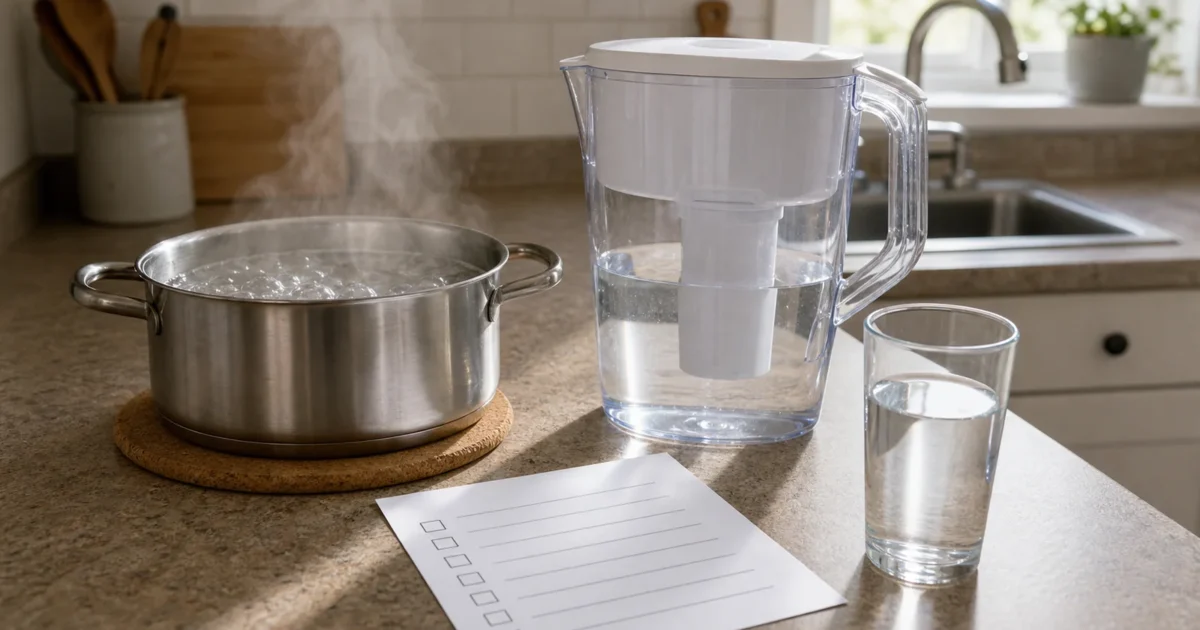
A boil-water advisory checklist only works if you follow it in the right order, and the order is where most homeowners go wrong. CDC’s rule is blunt: boil your tap water, or use bottled water, for drinking, cooking, and brushing teeth during the advisory – and do not use ice from a refrigerator or freezer dispenser, which CDC rules out under every advisory type, even if that water already passed through a pitcher, refrigerator, or faucet filter. Our companion guide on what a boil-water advisory filter can and cannot do covers the certification side of that rule in depth – NSF/ANSI 42, 53, 58, and P231, and what each one actually proves. This guide is the other half: the step-by-step checklist for what to do, in what order, while the advisory is active and after it lifts, plus the households – private wells, immunocompromised family members – who need to read the fine print more carefully than the flyer on your door explains.
Boil-Water Advisory Checklist: The Quick Answer
Here’s the boil-water advisory checklist in its shortest form, before the details below fill in the parts a one-page flyer usually skips:
- Boil clear water for 1 minute (3 minutes above 6,500 feet), or use bottled water, for drinking, cooking, food prep, and brushing teeth, per CDC.
- Skip the fridge and freezer dispenser entirely – they’re appliances connected to the water line, and CDC’s advisory covers them too.
- Don’t assume your filter or RO system fixes this. Most household filters aren’t built to remove germs, and CDC says to boil filtered water anyway.
- Confirm which kind of advisory you actually got. A boil-water advisory is about germs (boil it). A do-not-drink or do-not-use advisory is usually about chemicals or broader contamination (boiling won’t help there – use bottled water and follow local instructions).
- After the advisory lifts, follow your utility’s specific instructions before assuming things are back to normal. Flushing and filter-replacement steps genuinely vary by city and by situation.
The rest of this guide walks through each of those points, plus the households that need extra care.
Not All Advisories Are the Same
A boil-water advisory means officials have found, or suspect, germs in the water supply, and boiling is the fix: officials are telling residents to boil tap water before use because germs in it could make people sick, per CDC. That’s the advisory this checklist is built around.
A do-not-drink advisory is a different animal. CDC uses it when chemicals or toxins, not germs, are the concern – and boiling a chemically contaminated water supply will not make it safe. EPA agrees: boiling and disinfection kill most disease-causing microorganisms but do not destroy heavy metals, salts, and most other chemicals. For at least one specific chemical, EPA is more pointed still – for PFOA-contaminated water, boiling can actually concentrate the chemical as water evaporates, and EPA says boiling should not be treated as an emergency response for that kind of contamination. A do-not-use advisory is stricter yet: CDC says it means using bottled water for everything, because even touching or otherwise contacting the water could be unsafe.
If the notice you got is labeled “precautionary” – issued after a water-main break, a pressure loss, a turbidity reading, or a treatment interruption rather than a confirmed positive test – treat it as a real boil-water advisory until officials say otherwise. Both EPA and CDC frame these events the same way: follow the water system’s specific directions, because advisory recommendations depend on exactly what triggered them.
How to Boil Water Correctly (and the Step Most Checklists Skip)
For clear water, CDC’s instruction is a full rolling boil for 1 minute, then let it cool before use – 3 minutes if you’re above 6,500 feet in elevation. Sources vary slightly on the exact elevation cutoff and duration: EPA’s own emergency guidance uses 3 minutes above 5,000 feet, and some state notices (Texas’s TCEQ, for example) instruct a 2-minute boil under a boil-water notice generally. When your local advisory states a specific time, follow that instruction over any of these; when it doesn’t, CDC’s rule is the safest national default, and boiling longer is never the wrong call.
If the water looks cloudy, don’t skip straight to the pot. EPA says to let cloudy water settle, then filter it through a clean cloth, paper towel, or coffee filter, before boiling or disinfecting it – sediment can physically shield some organisms from the heat. That filtering step is a sediment pre-treatment only. It is not a substitute for the boil that comes after it.
The During-Advisory Rules That Trip People Up
Boiling drinking water is the headline rule, but a handful of everyday habits during an advisory cause more confusion than the boiling itself.
Dishwashers are genuinely disputed across agencies. CDC and Texas’s TCEQ both say a dishwasher is fine if it has a sanitizing cycle or reaches a final-rinse temperature of at least 150°F (66°C). Philadelphia’s water department, on the other hand, tells customers not to run the dishwasher at all during a boil-water advisory, since the water inside doesn’t reach a true boil. The safest approach: use your dishwasher only if your local advisory allows it and your unit meets that sanitizing-cycle or 150°F threshold; otherwise, hand-wash with boiled or bottled water, or use disposable dishes until the advisory lifts.
Handwashing with tap water and soap is acceptable in many cases if local officials allow it, per CDC. But don’t reach for hand sanitizer as a substitute if Cryptosporidium is the specific concern behind your advisory – CDC’s guidance on preventing cryptosporidiosis is explicit that alcohol-based sanitizers do not kill Cryptosporidium, and soap plus properly disinfected water is the actual prevention step.
Showering and bathing are generally fine, with one caution: be careful not to swallow water, and CDC recommends extra care with babies and young children in the tub or shower. Separately, don’t use tap water for sinus rinsing or nasal irrigation during an advisory – CDC notes that contaminated water can cause illness if it goes up the nose, via organisms like Naegleria fowleri, so that’s one household habit worth pausing entirely until the advisory lifts.
What About My Filter or RO System?
The short version, stated without hedging: your everyday pitcher, refrigerator, or faucet filter is not a substitute for boiling during the advisory. CDC’s own instruction is to boil tap water even if it has already passed through a home filter, and manufacturers say the same thing about their own products – Brita states that only potable drinking water should be filtered through its filters, and PUR says its faucet filters do not filter microbes.
Reverse osmosis deserves a more careful answer than a flat yes or no. CDC does list reverse osmosis among the technologies that can remove parasites, bacteria, and viruses – but CDC’s advisory guidance separately instructs consumers to boil tap water during a boil-water advisory even when it has already passed through a household filter, and NSF’s standards each cover a defined set of contaminant-reduction claims, so certification to one standard does not mean a system reduces every possible contaminant. The honest rule: a household RO unit only counts as advisory-relevant protection if your exact installed system carries a verified microbiological reduction claim, is maintained within its rated specifications, and your local advisory itself says filtered water is acceptable. Absent all three, boil the water regardless of what’s under your sink. For the full breakdown of which certifications (NSF/ANSI 53 cyst claims, P231, NSF/ANSI 55 Class A UV) actually clear that bar, see our filter-certification deep dive and NSF filter certifications explained.
After the Advisory Lifts: Why “Back to Normal” Isn’t the Same Everywhere
Waiting for the official lift notice is step one – don’t resume normal water use based on a guess that things have improved. From there, instructions genuinely differ by utility, and this checklist won’t pretend otherwise.
Some utilities ask for real, specific action. When American Water lifted a 2026 advisory for Camden customers, it instructed residents to run cold-water faucets for 3-5 minutes, empty and clean automatic ice makers and water chillers, drain and refill hot water heaters set below 113°F, and run water softeners or cartridge filters through their manufacturer-recommended procedures. Austin Water’s post-advisory guidance is shorter: flush cold-water faucets for about 1 minute and discard the first three batches of ice from an automatic icemaker. Philadelphia’s utility takes a different position entirely – it tells customers that most boil-water advisories do not require flushing household pipes at all, and that normal water use can resume immediately once the advisory is lifted, unless the department specifically says otherwise.
This is the part of the boil-water advisory checklist that a generic flyer can’t cover, because it genuinely varies by utility – don’t treat any single instruction above as a universal rule. Follow your utility’s exact post-lift notice first. If officials or your appliance manufacturer tell you to flush lines or replace cartridges, do it before using that water or filter again. If no specific instruction is given but a filter cartridge was in active use during the advisory – especially one labeled against use with microbiologically unsafe water – replacing it is the conservative, reasonable choice rather than a strict requirement. Once you know which cartridge you need, our filter finder matches your exact fridge or fixture model to a certified replacement so the swap is a confirmed match, not a guess.
Who Needs Extra Caution
Private well owners aren’t automatically covered by a municipal boil-water advisory in the first place – EPA regulates public water systems, not private domestic wells, so a municipal notice does not reach well owners (EPA). Well owners should contact their local or state health department directly about flooding, contamination, or wellhead damage. Separately of any advisory, CDC recommends testing private well water at least annually, and again any time taste, color, or smell changes, per CDC’s well-testing guidance.
Immunocompromised household members face a higher risk from waterborne germs generally, and especially from Cryptosporidium, per CDC – anyone in that situation should talk to a healthcare provider and a water-treatment specialist about additional precautions. CDC also makes a specific, easy-to-miss point: people with weakened immune systems should avoid changing water filters themselves, since a used cartridge can expose the person handling it to whatever germs or chemicals it captured. Have someone else in the household do that swap.
Restaurants, daycares, and food-service operations are held to a stricter standard than the household checklist above. FDA guidance tells food manufacturers to stop using water subject to a boil-water advisory until it again meets drinking-water standards, unless it’s been adequately treated for the specific organisms of concern – regulated and commercial settings should coordinate with local health authorities rather than follow a homeowner’s checklist.
Quick Reference: Your Boil-Water Advisory Checklist at a Glance
| When | What to Do |
|---|---|
| Advisory just issued | Confirm the type (boil-water vs. do-not-drink/use) and read the specific local instructions – don’t assume from the headline alone |
| Drinking, cooking, brushing teeth | Boil 1 minute (3 min above 6,500 ft) or use bottled water – filtered water still needs boiling |
| Dishwasher | Only if your notice allows it and the unit sanitizes or hits a 150°F final rinse; otherwise hand-wash with boiled/bottled water |
| Handwashing | Soap and tap water is usually fine if officials allow it; skip sanitizer alone if Cryptosporidium is the concern |
| Showering, sinus rinsing | Showering is fine with care not to swallow water; skip nasal rinsing/sinus irrigation with tap water entirely |
| Fridge/freezer dispenser | Don’t use – it’s a water-line-connected appliance covered by the advisory |
| Advisory lifted | Wait for the official notice, then follow your utility’s specific flushing instructions – they vary by city |
| Filters and cartridges | Replace if instructed, or if the cartridge was in use during the advisory and its label warns against unsafe water |
What to Do Next
That covers the full boil-water advisory checklist end to end. If you haven’t already, read what a boil-water advisory filter can and cannot do for the certification-by-certification breakdown of NSF/ANSI 42, 53, 58, and P231 referenced above. When it’s time to replace a cartridge after the advisory lifts, our filter finder matches your fridge or fixture model to the correct certified replacement, and our filter-certification registry lets you verify any specific product’s actual listed claims before you buy.
Can I run my dishwasher during a boil-water advisory?
It depends on your local notice and your dishwasher. CDC and TCEQ say a dishwasher is fine if it has a sanitizing cycle or reaches a 150°F (66°C) final rinse. Philadelphia’s water department advises against dishwasher use during an advisory entirely, since dishwasher water doesn’t reach a true boil. Check your specific notice, and hand-wash with boiled or bottled water if it doesn’t address dishwashers directly.
Is hand sanitizer enough during a boil-water advisory?
Not always. CDC says tap water and soap are generally fine for handwashing if local officials allow it, but alcohol-based hand sanitizer does not kill Cryptosporidium. If your advisory is tied to a Cryptosporidium concern, soap and properly disinfected water is the recommended step, not sanitizer alone.
Do I need to replace my water filter after a boil-water advisory lifts?
Sometimes, but it’s not a universal rule. Follow your utility’s specific post-lift instructions first. If a cartridge was in active use during the advisory and its label warns against microbiologically unsafe water, replacing it is the conservative choice. Some utilities, like Philadelphia’s, say most advisories don’t require it unless specifically instructed.
Does a boil-water advisory apply if I have a private well?
Not directly – municipal boil-water advisories are issued for regulated public water systems, and private wells fall outside that framework. Well owners should contact their local or state health department about specific contamination concerns, and CDC recommends testing well water at least annually regardless.
Is a “precautionary” boil-water notice something I can ignore?
No. A precautionary notice, issued after events like a water-main break or a pressure loss, should be treated as a full boil-water advisory until officials lift or revise it. The trigger being precautionary doesn’t change the boiling instruction.
Is it safe to shower during a boil-water advisory?
Generally yes, with care not to swallow the water, and CDC recommends extra caution with babies and young children while bathing. Separately, avoid using tap water for sinus rinsing or nasal irrigation during the advisory, since contaminated water entering the nose carries its own specific risk.
Sources
- CDC: Drinking water advisories, an overview
- EPA: Emergency disinfection of drinking water
- EPA: Water decontamination FAQs for customers
- EPA: INTERIM Drinking Water Health Advisory – Perfluorooctanoic Acid (PFOA) CASRN 335-67-1 (2022)
- CDC: Choosing a home water filter
- NSF: Standards overview for water treatment systems
- TCEQ: Understanding boil water notices
- Philadelphia Water Department: Boil water advisory FAQ
- CDC: Cryptosporidium prevention in commercial settings
- Austin Water: Boil water notice FAQ
- American Water: Boil-water advisory lifted for Camden customers
- CDC: Guidelines for treating well water
- CDC: Guidelines for testing well water
- EPA: Private drinking water wells
- Brita: Replacement filter FAQ
- PUR: Faucet filter product page
- FDA: Water use guidance for food manufacturers under a boil-water advisory
Educational content only. Not a substitute for your local water utility’s or health department’s official advisory instructions, or for evaluation by a licensed water-treatment or public-health professional. Advisory instructions, boiling times, and post-advisory procedures vary by location and can change – always follow your local notice first. Use of any guidance from this guide is at your own risk.
As an affiliate, WaterByTheBook may earn from qualifying purchases – it costs you nothing and never changes which filter we say fits.
Related guides
Boil-Water Advisory: What Your Filter Can and Cannot Do
Your phone buzzes with a boil-water advisory, and your first instinct is to check the pitcher filter on…
NSF Filter Certifications Explained: 42 vs 53 vs 58 vs 401 vs P473
NSF filter certifications only mean something when two conditions are both true: the exact product is listed by…
How to Read Your Water Quality Report (CCR): A Plain-English Guide
If an annual water quality report showed up in your mail or inbox recently, that is your CCR…