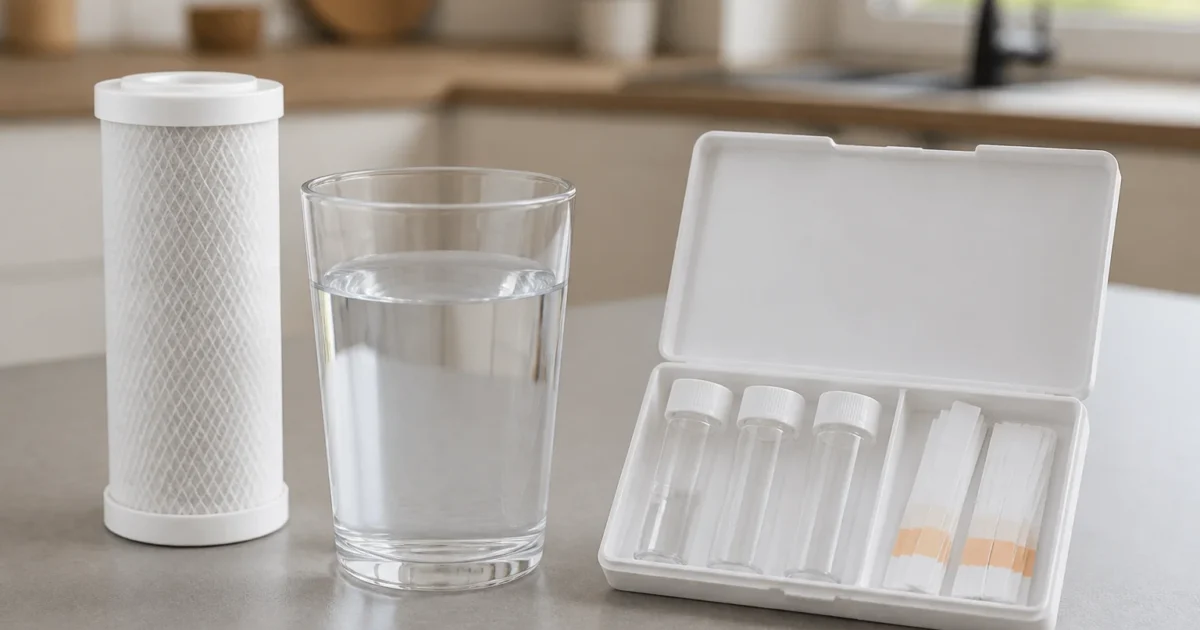
Chromium-6 in drinking water – the contaminant the Erin Brockovich case made famous – has no separate federal limit today. The EPA regulates total chromium at 0.1 mg/L (100 ppb), a standard that legally covers chromium-6 and chromium-3 combined, but there is no chromium-6-specific federal MCL. California is the exception: it set its own enforceable chromium-6 limit of 10 ppb, effective October 1, 2024, after a decade of litigation and rulemaking. Both numbers sit far above the 0.02 ppb health goal California’s own scientists calculated – and that gap, not a scandal, is the thing worth understanding.
This guide covers where the regulatory record actually stands, why the health-goal-to-legal-limit gap exists, where chromium-6 comes from, how to find out what’s in your own water, and which treatments are actually certified to remove it – as opposed to the ones marketing copy implies do.
Chromium-6 in Drinking Water: Is There a Federal Limit?
Not a separate one. The EPA’s enforceable federal standard covers total chromium, set at an MCL and MCLG of 0.1 mg/L (100 ppb), and EPA states plainly that this standard is meant to cover chromium-3 and chromium-6 together – for risk-assessment purposes, EPA treats a total-chromium result as though it were 100% chromium-6. There is no additional, chromium-6-only federal drinking-water limit.
That status is not frozen, though the timeline is easy to get wrong. EPA finalized its IRIS Toxicological Review of Hexavalent Chromium in August 2024 (report EPA/635/R-24/164Fa), and EPA’s own “regulations under development or review” page currently lists chromium (total/hexavalent) as under review. EPA’s general chromium drinking-water page still reads as if the health assessment is pending – it appears to lag the 2024 IRIS finalization – so treat that page as reliable for the current federal MCL, not as the most current word on assessment status. The honest summary: there’s no separate federal chromium-6 MCL today, and chromium remains under regulatory review with a finalized 2024 health assessment behind it.
California’s Chromium-6 Rule – and Why It Took a Decade
California is the one state with its own enforceable chromium-6 standard: 0.010 mg/L (10 µg/L, or 10 ppb), effective October 1, 2024, with a chromium-6 reporting detection limit of 0.1 µg/L. According to the State Water Board, California also maintains a separate enforceable total-chromium limit of 50 µg/L, distinct from the new chromium-6 number.
Compliance isn’t immediate for every system. California staggered the compliance dates by system size: systems serving 10,000 or more connections must comply by October 1, 2026; systems serving 1,000-9,999 connections by October 1, 2027; and systems serving fewer than 1,000 connections by October 1, 2028. Community and nontransient noncommunity systems had to complete initial chromium-6 sampling by April 1, 2025.
This isn’t California’s first attempt. The state adopted a chromium-6 MCL in 2014, but a Sacramento County Superior Court invalidated it in 2017 (California Manufacturers and Technology Association v. California Department of Public Health). The court didn’t rule the limit too strict or too lenient on health grounds – the State Water Board says the court found California hadn’t adequately documented that compliance was economically feasible. California restarted the process and adopted the current 10 ppb MCL in 2024.
One more nuance worth knowing before you read any occurrence data: under California Health and Safety Code § 116341, effective January 1, 2026, a public water system implementing a State Water Board-approved compliance plan isn’t deemed in violation of the chromium-6 standard, as long as it still meets the total-chromium MCL. Separately, the State Water Board’s rulemaking page states that compliance plans are required within 90 days for sources exceeding the chromium-6 MCL before their applicable date in Table 64432-B.
That’s why a number reported above 10 ppb should be described as “reported above California’s chromium-6 MCL” – not as a “violation” – unless the compliance date, compliance calculation, and compliance-plan status have all been verified.
The Health Goal vs. the Legal Limit: Why There’s Such a Big Gap
California’s 2011 Public Health Goal (PHG) for chromium-6 is 0.00002 mg/L – 0.02 µg/L, or 0.02 ppb. That’s 500 times lower than the state’s own 10 ppb enforceable MCL. The gap looks alarming until you understand what each number means: a PHG is a health-based target, not an enforceable limit, and California law requires MCLs to be set as close to the PHG as is technologically and economically feasible – not at the PHG itself.
Neither extreme reading is correct: being above the PHG doesn’t mean the water is automatically unsafe, and being under the enforceable MCL doesn’t mean the exposure risk is zero. It means the MCL is a regulatory compromise between the health goal and what treatment technology and cost can currently deliver at scale.
OEHHA sharpened this picture on February 9, 2026, finalizing a 5 ppb noncancer health-protective concentration for chromium-6 in drinking water, with a separate cancer-effects document to follow as part of the ongoing PHG update.
On the toxicology side, NIEHS lists hexavalent chromium compounds as known human carcinogens, based mostly on occupational inhalation studies showing elevated lung cancer in exposed workers; for oral/drinking-water exposure specifically, NIEHS points to National Toxicology Program animal studies that found cancer following ingestion of sodium dichromate dihydrate, a chromium-6 compound. None of that translates into a verdict about any individual’s tap water – it’s the reasoning behind why regulators keep revisiting this number, not a reason to panic over a single test result.
Where Chromium-6 Comes From
Chromium shows up in water from two directions, and both are common. EPA says chromium occurs naturally in rock, soil, plants, volcanic dust, and animals, and that chromium-6 specifically can form through natural erosion of chromium deposits. It’s also an industrial byproduct – NIEHS ties chromium compounds to electroplating, stainless steel production, leather tanning, textile manufacturing, and wood preservation, and EPA notes that chromium-6 can enter water through leakage, poor storage, or inadequate industrial waste disposal.
A detection in your area doesn’t automatically point to a nearby polluter – natural geology explains a lot of chromium-6 occurrence, especially in groundwater. It’s also chemically active once it’s in the system: EPA and Health Canada both note that chromium-3 and chromium-6 can convert back and forth in water, and oxidants or disinfectants used in treatment can push chromium-3 toward chromium-6. That’s one reason utilities that monitor chromium-6 closely sample more than just the source water – they check representative points across the distribution system, including locations with the longest residence time.
How to Find Your Chromium-6 Level
Start with what your utility already reports. If you’re on a public water system, your annual Consumer Confidence Report (CCR) is the first stop – our guide to reading a CCR walks through what the report does and doesn’t tell you. You can also look up your own system’s reported federal results with our free Water Watchdog ZIP lookup, or search California’s Drinking Water Watch database directly if you’re a California customer.
The main national dataset is EPA’s third Unregulated Contaminant Monitoring Rule (UCMR 3), which required chromium-6 monitoring from 2013 to 2015 using EPA Method 218.7, with a minimum reporting level (MRL) of 0.03 µg/L. EPA’s UCMR summary shows 47,503 chromium-6 results at or above that MRL out of 62,837 total results reported, across 4,401 of the 4,919 public water systems that reported chromium-6 data – but that figure needs two caveats before you read anything into it for your own tap.
First, UCMR 3 wasn’t universal: it covered every system serving more than 10,000 people plus a representative sample of only 800 smaller systems, so a system with no UCMR 3 record may simply never have been required to test, not have zero chromium-6. Second, a UCMR result should be described as “detected at or above the minimum reporting level” – not as exceeding a health threshold. EPA is explicit that MRLs reflect laboratory detection capability, not a safety line, and that 2013-2015 data may no longer reflect current water if a system has since blended sources, closed a well, or added treatment.
Chromium-6 isn’t on a standard home water test, and it’s easy to assume a generic “metals” test kit covers it – it usually doesn’t. A credible result requires a test that specifically measures hexavalent chromium with correct sample preservation, ideally EPA Method 218.7 (a low-level ion-chromatography method with a 14-day holding time) run by a certified laboratory. This matters even more if you’re on a private well: EPA and the CDC both note that private wells are not covered by the Safe Drinking Water Act, and testing is entirely the owner’s responsibility – a state-certified lab is the right route, not a mail-in kit that doesn’t name chromium-6 specifically.
What Actually Removes Chromium-6
Reverse osmosis is the strongest consumer option – but only when the specific product carries the right certification. NSF/ANSI 58 covers point-of-use reverse osmosis systems, and TDS reduction is a mandatory claim under that standard – but a chromium-6 claim is optional, not automatic. “NSF/ANSI 58 certified” by itself tells you the unit reduces total dissolved solids. It does not tell you it’s certified for chromium-6. Look for the exact phrase “Chromium (Hexavalent) Reduction” on the certifier’s listing for your specific model and finish variant, per our full breakdown of NSF filter certifications.
Strong-base anion-exchange resin is also a legitimate chromium-6 treatment category – EPA lists anion exchange as effective for negatively charged contaminants (EPA). But it’s more technical than a cartridge swap: Health Canada recommends running water through granular activated carbon before the resin (to protect it from chlorine or chloramine) and monitoring treated water routinely, because “chromatographic peaking” can push previously captured competing anions such as nitrate and sulfate back into the treated water as chromate displaces them on the resin, if the resin is not managed and replaced correctly.
Standard carbon is not the answer here. NSF/ANSI 42 – the certification on most basic pitcher and faucet filters – covers aesthetic effects like chlorine taste and odor, not chromium-6. That doesn’t mean no carbon-based system can ever carry a chromium-6 claim; some certified systems use carbon as part of a larger design. It means a generic taste-and-odor filter does little for chromium-6 on its own, and the certification – not the presence of carbon – is what tells you whether a specific product actually works.
Certified product claims are also easy to overstate in retail listings, so verify the exact model before buying. A few real examples show why:
| Product | What the retailer says | What the certifier listing actually shows |
|---|---|---|
iSpring RCC7AK |
Home Depot’s listing says the system is NSF 58 certified and highlights “chromium” reduction | NSF’s own listing for the base RCC7AK trade name shows a TDS Reduction claim; related finish variants list trivalent chromium reduction, not a hexavalent chromium claim – confirm the exact SKU before assuming coverage |
APEC ROES-50 |
Lowe’s describes it as WQA Gold Seal certified and says it removes chromium | VENDOR CLAIM, not a certifier record: APEC’s own FAQ advertises WQA-certified reduction of Chromium (Hexavalent) at 98.3% and Chromium (Trivalent) at 99.0%, and names no model. Verify the actual WQA listing for your exact model before purchase |
Aquasana AQ-SFRO2 SmartFlow RO |
Aquasana lists WQA testing and certification to NSF/ANSI 42, 53, 58, 401, and CSA B483.1, with chromium (hexavalent and trivalent) named in its contaminant list | Confirm the current certifier record for your exact model and finish before buying |
Our filter certification registry is built for exactly this check – confirm the specific model’s claim before you buy rather than trusting a category or a retailer’s paraphrase.
A few installation notes matter too. Residential RO and distillation systems are generally installed at the point of use rather than whole-house, partly because treated water can be more corrosive to plumbing components and pretreatment may be needed to protect the membrane. As a dated spot check, DIY point-of-use RO units with plausible chromium relevance run roughly $230-$480 for the unit before installation, while professional and commercial-style RO systems cost substantially more before installation and maintenance – confirm current pricing before budgeting. For more on how RO systems work and their tradeoffs, see our reverse osmosis guide.
One last distinction worth naming: household guidance – check your CCR and UCMR data, test with a certified lab, buy a certified point-of-use system – is not the same as how a utility manages chromium-6. Utilities work with source-water sampling, distribution-system monitoring, anion exchange or reduction/coagulation/filtration at scale, pH control, and ongoing breakthrough monitoring. Professional practice and homeowner practice solve the same problem at very different scales, and that’s expected, not a sign either side is doing it wrong.
Is there a federal limit for chromium-6 in drinking water?
Not a separate one. The EPA’s enforceable federal MCL of 0.1 mg/L (100 ppb) covers total chromium, which legally includes chromium-6, but there is no chromium-6-specific federal standard. EPA finalized its chromium-6 health assessment (IRIS) in August 2024, and chromium remains listed as under regulatory review.
What is California’s chromium-6 limit, and does it apply to my water?
California’s chromium-6 MCL is 10 ppb (0.010 mg/L), effective October 1, 2024, but compliance dates are staggered by system size through 2028. It only applies to California public water systems – check your system’s size and compliance date, and remember a system implementing an approved compliance plan isn’t automatically “in violation” even if it reports above 10 ppb.
Does a standard water filter pitcher remove chromium-6?
Generally no. Most pitcher and faucet filters are certified under NSF/ANSI 42 for chlorine taste and odor, which says nothing about chromium-6. A pitcher or under-sink system only removes chromium-6 if its specific model carries a “Chromium (Hexavalent) Reduction” claim on the certifier’s listing – check before you buy, don’t assume from the format.
How do I find out if my water has chromium-6 in it?
Start with your utility’s Consumer Confidence Report or our Water Watchdog ZIP lookup for reported federal data. For a current, tap-specific answer – especially on a private well – get a certified lab test using EPA Method 218.7, since chromium-6 isn’t included in standard home water tests.
Is an NSF/ANSI 58-certified RO system automatically certified for chromium-6?
No. NSF/ANSI 58 requires a TDS reduction claim, but a chromium-6 claim is optional and must be listed separately on the certifier’s record for that exact model. Confirm the specific “Chromium (Hexavalent) Reduction” claim before assuming an RO system handles it.
Where does chromium-6 in drinking water come from?
Both natural and industrial sources. It can form naturally through erosion of chromium-bearing rock and soil, and it’s also linked to industrial processes like electroplating, stainless steel production, and leather tanning. A detection doesn’t automatically point to a nearby polluter – natural geology is a common source, especially in groundwater.
Sources
- EPA: Chromium in drinking water
- EPA: National Primary Drinking Water Regulations
- NCBI Bookshelf: EPA IRIS Toxicological Review of Hexavalent Chromium
- EPA: Drinking water regulations under development or review
- California State Water Board: Chromium-6 rulemaking
- California State Water Board: Chromium-6 drinking water page
- California Health and Safety Code § 116341
- OEHHA: Chromium-6 chemical page
- OEHHA: Noncancer health-protective concentration for hexavalent chromium
- NIEHS: Hexavalent chromium
- EPA: UCMR Archival Data Finder
- EPA: UCMR 3 data summary
- EPA: Private wells
- CDC: Private well testing guidance
- Health Canada: Chromium technical document
- NSF: NSF/ANSI 58 reverse osmosis standard
- NSF: Contaminant reduction claims guide
- WQA: Certified products search
- EPA: Overview of drinking water treatment technologies
- APEC: ROES-50 product page
- APEC: FAQ
- NSF: iSpring RCC7AK listing
- Aquasana: SmartFlow RO product page
Educational content only. Not a substitute for water testing or evaluation by a certified water-treatment professional or your local health department. Regulatory limits, compliance dates, and product certifications can change – always verify current status with the EPA, your state water board, and the official NSF/WQA listing before making a decision. Use of any guidance from this guide is at your own risk.
As an affiliate, WaterByTheBook may earn from qualifying purchases – it costs you nothing and never changes which filter we say fits.
Related guides
What’s In My Tap Water? How to Check Your EPA Data and Pick a Filter
What’s in my tap water? is a question with a real, checkable answer for most U.S. households –…
Arsenic in Well Water: The EPA Limit, Health Risk, and Which Filters Actually Remove It
Arsenic in well water is dangerous precisely because nothing about your water will tell you it’s there. The…
Nitrate in Drinking Water: The Infant Risk, the EPA Limit, and What Actually Removes It
Nitrate in drinking water is one of the few contaminant stories with a genuine emergency dimension. For most…